Welcome to the final lesson of our foundational module. In the last session, we identified the essential characteristics of a successful community: a shared purpose, an intentional culture, and meaningful engagement. We focused on the internal "what" that makes a community thrive. Now, we'll shift our perspective outward to explore the "how" of growth, contrasting the modern, relationship-focused approach with traditional methods.
Today's lesson addresses a critical concept that underpins much of modern community strategy: Community-Led Growth (CLG). We will describe how CLG fundamentally differs from traditional marketing. This distinction is not just academic; it represents a philosophical shift in how organizations build relationships and create value. For you, with your background in Web3, this concept will likely feel both familiar and powerful, as CLG is the native growth language of decentralized ecosystems. By the end of this lesson, you will be able to articulate the core differences in strategy, tactics, and goals between these two models.
1. A Tale of Two Models: Push vs. Pull
At its heart, the difference between traditional marketing and community-led growth is the difference between a monologue and a dialogue. Traditional marketing operates on a "push" basis, broadcasting a message from the company to a wide audience. Community-led growth is a "pull" strategy, creating a valuable space that attracts people and fosters connections among them.
Let's start with a high-level comparison. The image below contrasts the typical strategies of Web2 marketing (which is largely traditional) with Web3 marketing (which is inherently community-led).

Notice the key dichotomies:
- Top-down vs. Community-driven: Decisions and messaging originate from the company vs. emerging from the community itself.
- One-way communication vs. Two-way engagement: The company talks at the customer vs. talking with members.
- Funnels vs. Networks: A linear path to purchase vs. a web of interconnected relationships.
This isn't just a change in marketing tactics; it reflects a deeper shift in the underlying business philosophy.
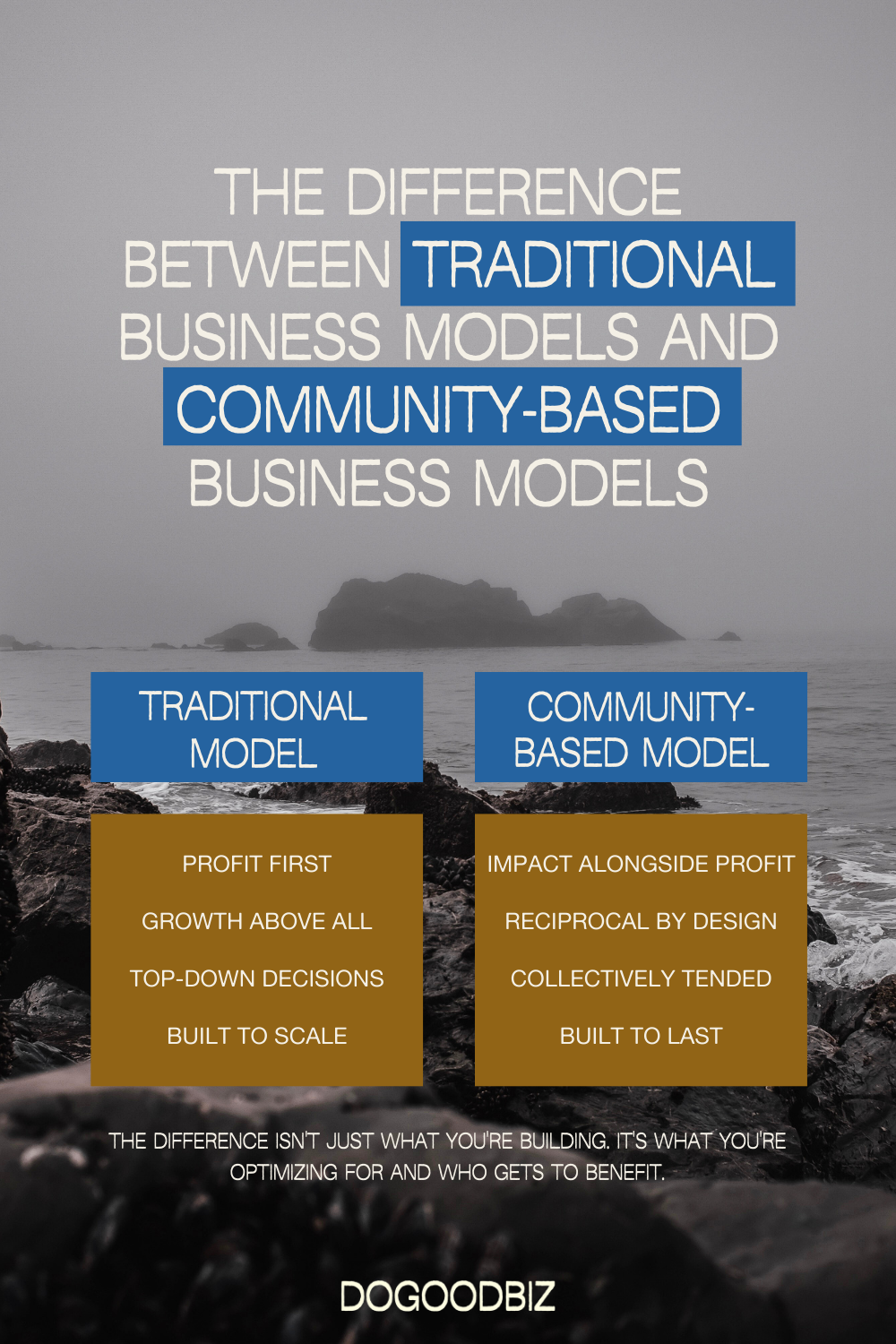
As you can see, the community-based model optimizes for entirely different outcomes: impact, reciprocity, and longevity. The marketing approach is a natural extension of this core philosophy.
2. Beyond the Funnel: The Hourglass Model
The most common metaphor for traditional marketing is the funnel. You may have heard of the "AARRR" framework (Acquisition, Activation, Retention, Referral, Revenue). In this model, the goal is to pour as many people as possible into the top and convert a percentage of them at the bottom. It's a linear, transactional process where the customer is a relatively passive participant.
However, this model fails to capture the magic of community. In a community-led approach, the journey doesn't end at "Revenue" or "Referral." The most engaged and loyal members become active drivers of growth themselves. This is better visualized with an Hourglass Model.
The following article from Nate's Noggin provides an excellent critique of traditional growth models and introduces this powerful new mental model.
Community-Led Growth in Web3(&2) - Nate's Noggin
This article explains why old models like the marketing funnel are insufficient for understanding community-led growth and proposes a new framework.
First, read the section critiquing traditional funnels. Then, focus on the subsequent section that introduces the Hourglass Model. Pay close attention to how it reframes the most loyal members not as the end of the funnel, but as the beginning of a new, outward-spreading growth engine.
The key insight of the hourglass model is that your most passionate members—your "community owners/drivers"—are not just customers; they are co-creators and evangelists. Your role as a community manager is to create the infrastructure that empowers them to "fan out the funnel on the other side," actively growing and enriching the community through their own volition.
3. Conversation over Broadcast
This shift from a funnel to an hourglass requires a different way of communicating. Traditional marketing relies on scalable, one-way broadcasts like paid ads and mass emails. It analyzes success through quantitative data like click-through rates and conversion percentages.
Community-led growth, on the other hand, thrives on conversation and qualitative understanding. It's less about what the analytics dashboard says and more about what members are saying to each other in Discord, on Telegram, or during a live event.
In this clip, community expert Callum McDonnell discusses why simply looking at metrics is not enough.
How To Build Community For Your Brand In 2025 | Live Masterclass
This segment from a live masterclass highlights the importance of direct human interaction over a pure reliance on data.
Watch the section from the beginning, where the speaker explains why you must "talk to people" and not just rely on social listening metrics to truly understand your community's sentiment and needs.
This is something you are already doing in your WhatsApp group. Every time you ask a question, facilitate a discussion, or respond to a member's query, you are practicing a core tenet of CLG: fostering two-way engagement.
4. The Web3 Imperative: Community as the Moat
In your work as a Web3 KOL and ambassador, you've witnessed firsthand that community isn't just a "nice-to-have"; it's the central pillar of any successful project. In the traditional Web2 world, companies like Google and Meta built defensive "moats" around their business using proprietary user data. In the open-source, permissionless world of Web3, this is not possible.
As the "Nate's Noggin" article you read earlier stated, "In Web3 — community is THE moat." A strong, engaged, and values-aligned community creates a powerful form of "stickiness" that can't be replicated, even when the underlying code is open for anyone to fork.
This article from Quecko is written specifically about CLG in a Web3 context and perfectly summarizes why this approach is so critical in the space you operate in.
Community-Led Growth in Web3 - Quecko
This article directly connects the principles of CLG to the foundational values of Web3, explaining why they are a natural fit.
Please read two key parts of this article. First, review the brief section titled How CLG Differs. Then, read the more detailed section Why Community is Central to Web3. As you read, notice how principles like decentralized governance and shared ownership make a community-led approach not just a strategy, but a necessity.
The core takeaway is that community-led growth is the operational expression of Web3's core values. It aligns incentives, builds trust, and fosters the collaborative innovation needed for a decentralized project to thrive.
Finally, CLG is also a more sustainable and cost-effective approach. In an era of "trust recession," where people are increasingly skeptical of glossy ads, a recommendation from a trusted peer is far more powerful.
How To Build Community For Your Brand In 2025 | Live Masterclass
This final clip makes the business case for investing in community over traditional advertising.
Watch this segment starting at the cost-effective argument. The speaker explains why retaining a loyal advocate is more valuable than acquiring a new customer and introduces the concept of co-creation as a powerful engagement tool.
Conclusion
In this lesson, we have drawn a clear line between the broadcast-oriented world of traditional marketing and the relationship-centric universe of community-led growth. This is the final piece of our foundational module, providing the strategic "why" behind the community-building work we will explore in the rest of the course.
Here are the key takeaways:
- Traditional Marketing is a Push Model: It uses a top-down, one-way approach focused on acquiring customers through a transactional funnel.
- Community-Led Growth is a Pull Model: It uses a bottom-up, two-way approach focused on building relationships and empowering members through a relational hourglass model.
- The Goal Shifts: The focus moves from acquiring passive customers to empowering active advocates who become a sustainable engine for growth, engagement, and innovation.
- CLG is Native to Web3: The principles of decentralization, shared ownership, and transparency make community the essential "moat" for any Web3 project.
We have now established what a community is, what makes it successful, and how it grows. With this foundation in place, we are ready to turn our attention to the heart of any community: its members. In our next lesson, we will begin Module 2 by exploring the core human motivations for why people join, stay, and participate in communities. Understanding this psychology is the key to building a space that people truly value.