Hello! Welcome to the next lesson in our journey through developmental editing.
In our last session, we focused on the logical architecture of nonfiction, learning how to evaluate the coherence and flow of a book-length argument. We're now shifting our focus back to the world of fiction. Just as a strong argument is the backbone of great nonfiction, compelling characters are the heart of most novels.
Today's lesson directly addresses the learning outcome: Assess character development, motivation, and consistency in a fiction manuscript. As a developmental editor, your ability to diagnose issues within a character's journey is one of your most critical skills. A character who feels flat, acts illogically, or changes without reason can cause a reader to lose faith in the entire story. We'll build on our previous discussion of underdeveloped characters by giving you a robust set of tools to analyze why a character isn't working and what might be missing.
Part 1: The Engine of Character — Goals and Motivation
Every action a character takes should be driven by something. As an editor, your first step is to distinguish between the what and the why. A character's goal is the tangible outcome they are trying to achieve. Their motivation is the deeper, emotional reason they are pursuing that goal. A weak motivation, even for a clear goal, makes for a shallow character.
To explore this distinction, let's start with a video that breaks down these core concepts.
Character Goals and Motivations (Writing Advice)
This video, 'Character Goals and Motivations' from the Writer Brandon McNulty channel, offers a clear definition of goals versus motivations and provides a powerful framework for analyzing their depth.
Please watch the following two sections: Defining Goals and Motivations (00:34 - 02:47): Pay close attention to the distinction between a tangible goal (e.g., write a novel) and the emotional motivation (e.g., to prove someone wrong). This is the foundation of character analysis. The Four Stages of Motivation (04:39 - 07:38): This is a crucial framework for you as an editor. It provides a method to dig deeper into a character's psyche, moving from the surface-level goal to the foundational backstory event that shapes their entire worldview.
The video introduces a key analytical model for an editor:
- Goal (The What)
- Motivation (The Why)
- Deep Dark Belief (The internal worldview driving the motivation)
- Origin of the Deep Dark Belief (The backstory event that created the belief)
When a character's actions feel inconsistent or unbelievable, it's often because one of these layers is missing or poorly defined in the manuscript. As an editor, you can use this hierarchy to pinpoint the weakness. Does the character have a goal and motivation, but we never sense the deeper belief that makes them so driven? Or is the belief present, but we have no hint of its origin, making it feel unearned?
This framework is also part of a classic concept in fiction writing known as Goal, Motivation, and Conflict (GMC). Let's look at a brief article that defines this triad.
Goal, Motivation, Conflict: The Key to Character Development
The article 'Goal, Motivation, Conflict: The Key to Character Development' provides a concise summary of this essential framework. It will reinforce the concepts from the video and introduce the element of conflict.
Please read the sections titled 'Goal,' 'Motivation,' and 'Conflict.' Notice how 'Conflict' is defined as the 'Why not?'—the internal and external barriers that stand in the character's way.
The motivations that drive characters can be complex and multi-layered. They can stem from basic needs, past trauma, or high-level aspirations.

Part 2: The Journey of Change — Character Arcs
With a solid understanding of what drives a character, we can now turn to how they change over the course of the story. This journey is their character arc. Assessing this arc is central to evaluating character development.
The most powerful tool for analyzing an arc is understanding the Lie the Character Believes. Most transformative character arcs begin with a character who holds a fundamental misconception about themselves or the world. The story's events force them to confront this lie.
Character Arcs, Flaws, & Lies Don't Need to Be Confusing (Writing Advice)
Let's return to Brandon McNulty's channel. This video, 'Character Arcs, Flaws, & Lies Don't Need to Be Confusing,' explains the mechanics of character change and provides clear categories for different types of arcs.
Please watch the following sections: Definitions (00:41 - 04:02): Focus on the definitions of Character Arc, Character Flaw, and the Character Lie. Understand that the Flaw is the negative behavior, and the Lie is the misguided belief that often causes it. The Three Types of Arcs (04:02 - 06:33): This explains the core types of character journeys: the Positive Change Arc, the Flat Arc, and the Negative Change Arc. These are your primary categories for assessing character development.
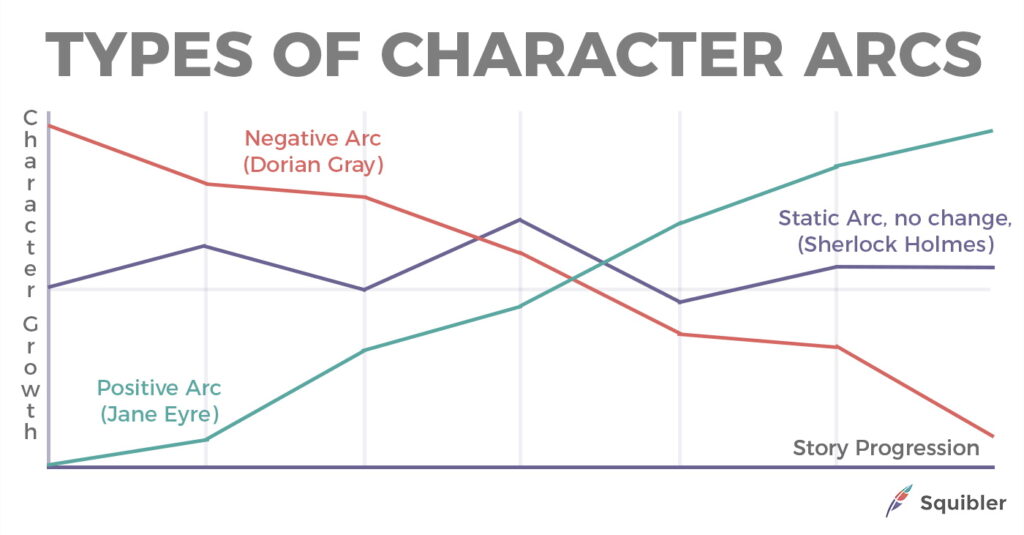
To summarize the three main character arcs:
- Positive Arc: The character starts by believing a Lie, and through the story's events, overcomes it to learn a Truth. This leads to positive personal growth. (e.g., Phil Connors in Groundhog Day).
- Negative Arc: The character either starts with a Truth and succumbs to a Lie, or descends deeper into a destructive Lie. This is an arc of disillusionment or corruption. (e.g., Michael Corleone in The Godfather).
- Flat Arc: The character already knows the Truth and does not fundamentally change. Instead, they are tested and must hold onto their belief, often changing the world around them in the process. (e.g., Captain America, Sherlock Holmes).
This visual provides a simple way to conceptualize these journeys:
Part 3: The Editor's Assessment — Consistency and Analysis
Now, let's bring these concepts together to form an analytical process. When you read a manuscript and a character feels "off," how do you diagnose the problem? You can use the frameworks we've discussed to ask a series of targeted questions.
Your Character Assessment Checklist:
-
Motivation:
- What is the character's external Goal? Is it clear and specific?
- What is their internal Motivation? Is the emotional "why" compelling?
- What is the Deep Dark Belief (or the Lie) that drives their motivation? Is it evident in their thoughts and actions?
- Are there hints of the Origin of this belief? Does their backstory feel connected to their present behavior?
-
Development (Arc):
- Which of the three arcs (Positive, Negative, Flat) is the character intended to have?
- What is the Lie they believe at the start? What is the Truth they need to learn (or that they already possess)?
- Does the central plot conflict force the character to confront their Lie and Flaw?
- Is the character's transformation (or lack thereof) earned and believable by the end of the story?
-
Consistency:
- Do the character's actions and decisions align with their established motivations and beliefs?
- When they act "out of character," does it serve as a meaningful turning point in their arc, rather than a random, unexplainable action?
- If a character's core Flaw persists (as it often does, even in positive arcs), does it feel like a realistic human weakness rather than an authorial inconsistency?
The final part of the video you just watched deals with common points of confusion. These are invaluable for an editor, as they represent the tricky, nuanced areas where a character's portrayal can fall apart.
Character Arcs, Flaws, & Lies Don't Need to Be Confusing (Writing Advice)
Let's watch one more clip from 'Character Arcs, Flaws, & Lies...' This section addresses the complexities that arise when putting these elements together.
Please watch the section on 'Why character arcs, flaws, and lies are so confusing' (06:33 - 10:48). This directly addresses common editorial problems, such as flaws and lies overlapping, lies being conquered while flaws persist, and the difficulty in identifying arc types. These are the exact kinds of issues you'll be diagnosing in manuscripts.
Recognizing these patterns helps you move from a vague feeling that "something is wrong with this character" to a precise diagnosis like, "The protagonist's main Lie about their self-worth is resolved by the midpoint, but their flaw of recklessness continues to drive the plot, which is why the second half feels repetitive. We need to introduce a new internal challenge for them to face."
Conclusion
In this lesson, we deconstructed the core components of a fictional character to build an analytical toolkit for developmental editing. You learned to look beyond the surface of a character's actions to uncover the deep-seated motivations and beliefs that drive them.
Key Takeaways:
- Goal, Motivation, Conflict (GMC) is a foundational framework. The Goal is the what, the Motivation is the why, and Conflict is the why not.
- Effective character motivation is layered, often stemming from a "Deep Dark Belief" formed by a past event.
- Character development is defined by the character arc, which is typically a journey from a Lie to a Truth (Positive Arc), a descent into a Lie (Negative Arc), or a struggle to uphold a Truth (Flat Arc).
- Assessing consistency involves checking if a character's actions align with their established motivations and their position along their arc.
Next Up:
This lesson concludes our module on the principles of developmental editing. You now possess frameworks for analyzing the macro-level structure of both nonfiction arguments and fictional character journeys. In our next lesson, we will put this knowledge into practice. We'll begin Module 4, "Developmental Editing: Practical Application," where you will learn how to write a comprehensive developmental edit letter that clearly and constructively communicates your analysis of these major structural issues to an author.