Hello! Let's dive into our next lesson on developmental editing.
In our last session, we ventured into the world of fiction, learning to spot structural flaws like pacing issues, underdeveloped characters, and plot holes. We focused on how the architecture of a story creates an emotional journey for the reader.
Today, we return to the realm of nonfiction, building on what we learned about weak theses and chapter organization. Our goal is to refine that skill by learning to evaluate the coherence and logical flow of an argument in a nonfiction manuscript. Your background in journalism has given you extensive practice in constructing and analyzing arguments in articles. This lesson will expand that skill set to the unique challenges and scale of a book-length project. A developmental editor's core responsibility in nonfiction is to ensure the central argument is not just present, but powerful, persuasive, and seamlessly woven through the entire text.
The First Pass: Initial Checks for a Sound Argument
When an editor first approaches a nonfiction manuscript, they aren't looking for grammatical errors; they're stress-testing the foundation of the entire project. Is the core idea clear? Is it well-supported? Does it progress logically?
Let's watch a video where a professional editor breaks down her initial evaluation process. This will give us a high-level checklist for assessing an argument's viability.
Non-Fiction Book Content Editing Breakdown
In this clip from 'Non-Fiction Book Content Editing Breakdown,' editor Kelly Ragan of Book Launchers explains the first things she looks for in a manuscript. Her approach provides an excellent framework for our topic.
Please watch the following segments: First Impressions (00:49 - 02:02): Notice the three key questions Kelly asks immediately: What is the book about? Who is it for? Why is the author the expert? The Foundation (02:20 - 03:07): Pay attention to the house foundation analogy and her role as a 'shark' looking for weak points in the evidence. The Central Question (05:46 - 06:25): This part reinforces the importance of a single, unifying thesis that every chapter must support. These clips highlight the initial, crucial steps in evaluating the overall coherence of a manuscript's argument.
Kelly's approach highlights three pillars of a coherent argument:
- A Clear Claim: Can the core argument be stated in a sentence or two?
- A Solid Foundation: Is the claim supported by credible evidence, research, or experience?
- A Unified Structure: Does every chapter clearly serve and build upon that central claim?
A weakness in any of these areas signals a significant structural problem.
The Anatomy of an Argument
To evaluate the flow of an argument, it helps to break it down into its essential components. At both the chapter level and the level of the book as a whole, a strong argument contains these interconnected parts.
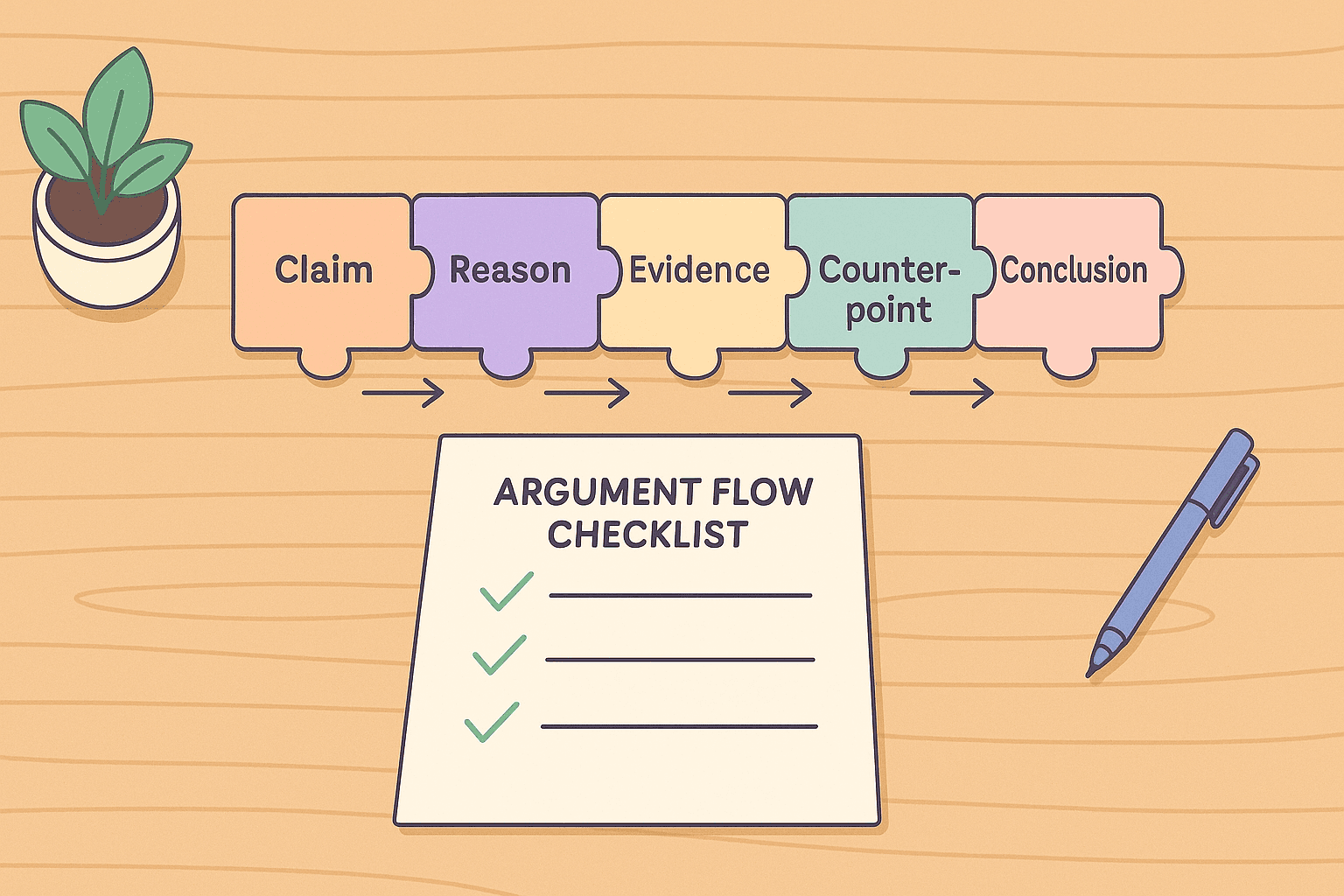
As an editor, you will be tracing this chain of logic through the manuscript. When the flow breaks down, it is usually because one of these links is weak or missing.
- Is a reason offered without any supporting evidence?
- Does the conclusion introduce a new idea not previously discussed?
- Does a chapter wander off on a tangent, failing to connect back to the main claim?
These are the kinds of breaks in logical flow that you will learn to identify.
Finding the "Big Idea": A Systematic Approach
Many nonfiction books, particularly in the trade market, are "Big Idea" books. They are built around a single, compelling, and often counter-intuitive argument. A primary task for the editor is to help the author clarify this big idea and then ensure the entire manuscript is architected to deliver it effectively.
The following resource is a transcript of a conversation between two seasoned editors, Shawn Coyne and Tim Grahl, as they diagnose a nonfiction manuscript. It provides a masterclass in how an editor guides a writer to identify and structure their core argument.
Editing Non-Fiction - Story Grid
This discussion, from an episode of the Story Grid podcast titled 'Editing Non-Fiction,' demonstrates the Socratic method an editor uses to help an author unearth the true argument of their book. It's a fantastic look at the theory behind analyzing nonfiction structure.
Please read the selected excerpts from this conversation. It's a bit longer, but it's a rich, practical look at the theory. Start by reading the section that begins with Shawn Coyne saying, 'In the book the Story Grid, I lay out... an Editor’s Six Core Questions...' and ends with '...you can actually write one?'. This covers the first question (Genre, especially 'Big Idea'), the second (Conventions), and delves deeply into identifying the core argument by figuring out what conventional belief the book is arguing against. Focus on how Coyne pushes Grahl to move from a narrow 'how-to' concept to a much larger 'big idea' framework. This is a key developmental editing move. Finally, read the part discussing the fifth question, 'what is the controlling idea theme'. This shows how to distill the entire book's argument into a single, powerful sentence.
As you saw, a huge part of evaluating coherence is first establishing what the central argument is. The "Six Core Questions" provide a powerful framework for this, forcing clarity on genre, conventions, and the controlling idea.
This leads to a crucial principle: every element in the book—every chapter, story, and data point—must serve what author Ben Rawlence calls the "governing logic" of the argument. In narrative nonfiction, this logic is the story; in argument-driven nonfiction, it is the thesis. As the editor, you are the guardian of this logic.
A Practical Tool for Analysis: The Rhetorical Précis
Once you have a grasp of the argument, you need a way to articulate your analysis clearly. A rhetorical précis is a highly structured, four-sentence summary that forces you to identify the essential components of an argument. It's an excellent tool for an editor to crystallize their understanding of a manuscript's argument and its potential weaknesses.
Writing a Summary or Rhetorical Précis to Analyze Nonfiction ...
This guide from the University of Wisconsin-Madison's Writing Center, 'Writing a Summary or Rhetorical Précis to Analyze Nonfiction,' explains a powerful method for deconstructing an argument.
Please read the following sections: 'Parts of a Rhetorical Précis': Focus on the specific function of each of the four sentences. Understand how they break down an argument into its 'What,' 'How,' 'Why,' and 'For Whom.' 'Evaluation and Critique': This short section is key. It shows how, once you've written a précis, you can use it to ask critical questions about the argument's effectiveness, coherence, and support.
Imagine reading a 300-page manuscript and then attempting to write a précis for it.
- If you struggle with the first sentence (the what), the author's central claim is likely weak or buried.
- If you struggle with the second sentence (the how), the book's structure is probably disorganized or illogical.
- If you struggle with the third sentence (the why), the book may lack a clear purpose or call to action.
The précis is not just a summary; it's a diagnostic tool.
Conclusion
Today, we've focused on one of the most intellectually demanding aspects of developmental editing: assessing the coherence of a book-length argument. We've moved from high-level initial checks to a deep, systematic framework for analysis, and finally to a practical tool for articulating that analysis.
Key Takeaways:
- A coherent nonfiction argument has a clear central claim (the "big idea"), a logical structure that builds the argument chapter by chapter, and a foundation of credible evidence.
- The genre of the book (e.g., "Big Idea," academic, how-to) dictates the conventions and expectations for how the argument should be presented.
- Every part of the manuscript must serve the "governing logic" of the central argument.
- A rhetorical précis is a powerful diagnostic tool for an editor to test the clarity, structure, and purpose of a manuscript's argument.
Next Up:
This lesson concludes our module on the principles of developmental editing. You now have frameworks for identifying major structural issues in both fiction and nonfiction. In our next lesson, we will begin Module 4, "Developmental Editing: Practical Application." You'll learn how to take the analysis we've practiced and write a comprehensive developmental edit letter that identifies major structural issues in a professional, constructive, and actionable way for an author.