Hello! Welcome to the third lesson in our module on the UK's energy regulatory framework.
In the last lesson, we explored the RIIO price control framework, which is how Ofgem, the regulator, determines the total revenue network companies can earn. RIIO sets the high-level financial 'envelope' and performance targets. Now, we're going to zoom in on the detailed rules that govern the day-to-day use of the high-voltage transmission grid.
This lesson's learning outcome is to explain the purpose and scope of the Connection and Use of System Code (CUSC), governing connection, charging, and balancing. Think of the CUSC as the detailed terms and conditions for anyone wanting to connect to or use Britain's electricity motorway.
1. What is the CUSC and Why Do We Need It?
The high-voltage transmission system is the backbone of the national electricity grid. It's a single, shared infrastructure used by many different parties:
- Large power stations (gas, nuclear, wind farms) connect to it to export power.
- Electricity suppliers use it to transport wholesale energy across the country.
- Distribution Network Operators (DNOs) connect to it to draw power for their local networks.
- Large industrial sites might connect directly to it.
With so many users, it's essential to have a single, transparent, and fair set of rules. Without a common framework, connection agreements would be chaotic, and there would be no consistent way to charge for using the system. The CUSC provides this framework.
Let's start by reading a summary from National Grid, the Electricity System Operator (ESO), who administers the code.
Connection and Use of System Code Summary Document
This summary document from National Grid ESO provides an excellent overview of what the CUSC is and what it does. It establishes the CUSC as the core contractual framework for using the transmission system.
Please read the 'Foreword' on page 3 and section 2.2 'What does the CUSC do?' on page 8. Focus on understanding the CUSC's fundamental role as a contractual framework.
As the document states, the CUSC is the "contractual framework for connection to, and use of, Great Britain’s (GB) high voltage transmission system." In essence, any party that holds an electricity generation, distribution, or supply licence must sign up to the CUSC. This legally binds them to its rules, ensuring everyone operates on a level playing field.
2. The Scope of the CUSC: Connection, Charging, and Balancing
The CUSC is a complex document, but its contents can be grouped into three main functions that directly align with our learning outcome. These functions are primarily covered in specific sections of the code.
Connection and Use of System Code Summary Document
To understand the scope of the CUSC, it's helpful to see how it's structured. This document provides a high-level tour of the CUSC's main sections.
Please skim through Section 3.1.1 'The CUSC' on pages 11-13. You don't need to memorize every detail. Instead, pay attention to the titles of the following key sections, as they define the CUSC's core scope: Section 2 - Connection Section 3 - Use of System Section 4 - Balancing Services Section 14 - Charging Methodologies
From this overview, we can see the CUSC is structured to manage the entire lifecycle of a user's interaction with the transmission grid. Let's explore these three key governance areas in more detail.
3. Governing Area 1: Connection
Before anyone can use the transmission system, they need a physical connection. The CUSC sets out the formal process for this. It defines the technical standards, commercial terms, and step-by-step procedures for getting connected.
The image below illustrates the typical high-level process for a new connection.
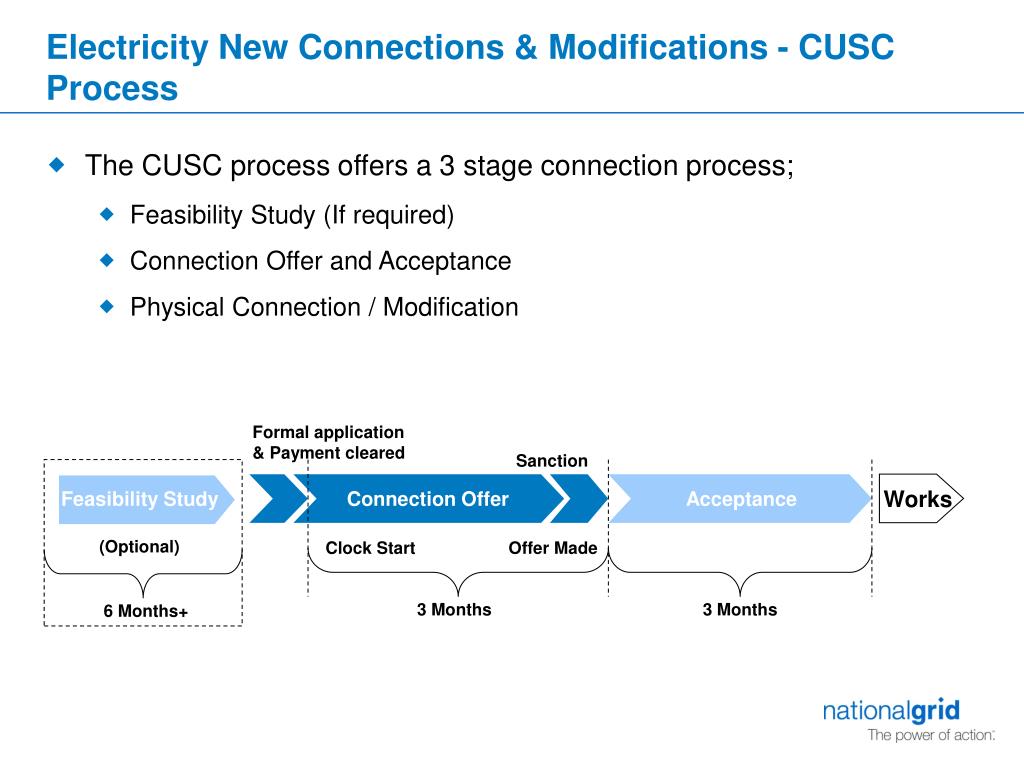
As the diagram shows, the process involves:
- Application & Feasibility: A developer applies to National Grid ESO for a connection. This can involve initial feasibility studies to see what is possible.
- Offer & Agreement: The ESO makes a formal connection offer, detailing the technical design, costs, and timeline. If the developer accepts, they sign a Bilateral Connection Agreement (BCA), which is one of the key contracts that sits under the CUSC framework.
- Construction: The necessary grid infrastructure (e.g., substations, power lines) is built, and the user is physically connected.
Section 2 of the CUSC governs this entire process, ensuring it's handled consistently for all applicants.
4. Governing Area 2: Charging
Connecting to and using the grid comes at a cost. The revenue that network companies can collect is set by Ofgem's RIIO framework, but the CUSC specifies how this revenue is recovered from individual users. Section 14 of the CUSC contains the detailed Charging Methodologies.
The following introductory guide provides a clear and simple breakdown of the main transmission charges.
Electricity Transmission network charging
This guide simplifies the complex topic of transmission network charging. It explains the three main charges and clarifies who pays for what, linking each charge back to the CUSC.
Please read this short guide in its entirety (pages 1-5). Focus on understanding the purpose of the three main charges: Connection Charges, BSUoS, and TNUoS.
As the guide explains, the CUSC methodologies are used to calculate three distinct charges:
- Connection Charges: This covers the cost of assets used only by one user. For example, the specific substation bay and short power line connecting a single wind farm to the main grid. It's a charge for your private driveway.
- Transmission Network Use of System (TNUoS) Charges: This recovers the cost of building, operating, and maintaining the shared transmission system (the "motorway"). These charges are locational – a generator in a remote part of Scotland (far from demand) will pay more than one next to London, signalling where it's most efficient to build new power plants.
- Balancing Services Use of System (BSUoS) Charges: This recovers the cost of the ESO's real-time actions to balance supply and demand and keep the grid stable at 50Hz. This includes paying generators to turn on or off at short notice.
The CUSC ensures these charges are calculated in a transparent and non-discriminatory way for all users.
Test your understanding!
A company is building a new large-scale solar farm in Cornwall. For each of the costs below, identify which charge type it corresponds to (Connection, TNUoS, or BSUoS).
- A monthly bill to cover the cost of the dedicated transformer and switchgear installed just for the solar farm's connection point.
- A charge that varies every half-hour, reflecting the cost of the ESO paying a gas power station in the Midlands to increase its output when national demand suddenly spiked.
- An annual charge based on the solar farm's capacity and its location in the South West of England, contributing to the upkeep of the entire national grid infrastructure.
Show answer
- Connection Charge: This is for "sole use" assets dedicated to that specific solar farm.
- BSUoS Charge: This charge socialises the real-time balancing costs incurred by the System Operator across all users.
- TNUoS Charge: This is the charge for using the shared "motorway," and it includes a locational signal.
5. Governing Area 3: Balancing
The third key function of the CUSC is to provide the commercial framework for Balancing Services. As we learned, keeping the grid frequency stable at 50Hz requires the ESO to constantly manage the balance between generation and demand.
Section 4 of the CUSC, "Balancing Services," defines the different services the ESO can buy from market participants (like generators or large consumers) to help them do this. It sets out the rules for:
- How parties can offer these services to the ESO.
- The conditions under which the ESO can use them.
- The payment mechanisms for these services.
While the BSUoS charge is about recovering the cost of balancing, Section 4 of the CUSC is about the rules of engagement for providing the balancing services themselves.
Conclusion
In this lesson, we've demystified the Connection and Use of System Code. We've seen that it's not just a dense legal document, but a vital piece of the regulatory puzzle that translates high-level policy into practical, everyday rules for the electricity transmission system.
Key Takeaways:
- The CUSC is the binding contractual rulebook for connecting to and using the GB high-voltage transmission system.
- Its purpose is to provide a fair, transparent, and non-discriminatory framework for all users, such as generators, suppliers, and distributors.
- The CUSC's scope is centred on three core governance areas:
- Connection: The formal process for getting physically connected to the grid.
- Charging: The methodologies for calculating the main transmission charges (Connection, TNUoS, and BSUoS).
- Balancing: The commercial framework for the services used by the ESO to keep the system stable in real-time.
- The CUSC is a "living document," constantly being updated by industry participants to adapt to the evolving energy landscape.
Preview of the next lesson:
The CUSC governs the transmission "motorway." But what about the local "A and B roads" that deliver power to our homes and businesses? These are the distribution networks. In the next lesson, we will examine the Distribution Connection and Use of System Agreement (DCUSA), which is the equivalent code for the regional distribution systems.