Hello! Welcome to the fourth lesson in our module on the UK's energy regulatory framework.
In our last lesson, we looked at the Connection and Use of System Code (CUSC), which we described as the rulebook for the high-voltage transmission "motorway". Now, we'll turn our attention to the local "A and B roads" that deliver electricity to homes and businesses.
This lesson's learning outcome is to describe the Distribution Connection and Use of System Agreement (DCUSA). Just as the CUSC governs the national transmission grid, the DCUSA provides the essential commercial and technical rules for the regional distribution networks.
1. What is the DCUSA?
Before 2006, the rules for connecting to and using the various regional distribution networks were managed through many separate, two-party (bilateral) contracts. This was inefficient and inconsistent. The DCUSA was created to solve this problem.
Let's begin by reading a brief introduction from the official DCUSA website.
This webpage provides a concise history and purpose of the DCUSA. It explains its role as a standardized multi-party contract.
Please read the section 'Our history'. Focus on what the DCUSA is, when it was established, and what it replaced.
As the text explains, the DCUSA is a multi-party contract that standardises the relationship between all the companies that use Great Britain's electricity distribution systems. It creates a single, common set of terms and conditions that everyone must abide by.
2. Who are the Parties to the DCUSA?
The DCUSA is a contract between the owners of the distribution networks and the users of those networks. To understand what this means in practice, it's helpful to know who these organisations are.
The Frequently Asked Questions (FAQs) page on the DCUSA site gives a clear and simple answer to who the main parties are.
Read the answer to the question 'Who are the parties to the DCUSA?'. This will give you the main categories of participants.
The key parties, as mentioned in the reading, are:
- Electricity Distributors: These are the companies that own and operate the regional electricity networks. They are responsible for the power lines, cables, and substations that take electricity from the national transmission grid and deliver it to local areas. There are two types:
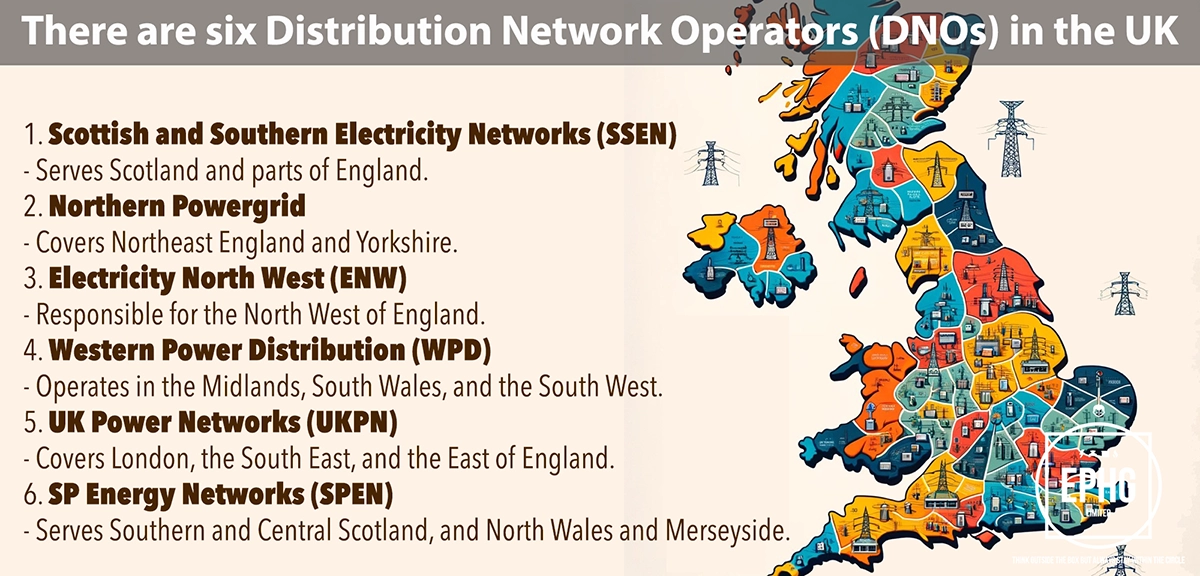
- Distribution Network Operators (DNOs): The 14 large, regional monopoly companies.
- Independent Distribution Network Operators (IDNOs): Smaller network owners, often operating within new housing or commercial developments.
- Electricity Suppliers: These are the retail companies (like British Gas, E.ON, Octopus Energy) that customers buy their electricity from. They use the distribution networks to deliver the energy they've purchased on the wholesale market to their customers' homes and businesses.
- Generators/CVA Registrants: This includes generators connected directly to the distribution network (e.g., solar farms, small wind farms). "CVA Registrants" is a technical term for parties registered in the Central Volume Allocation market, which often includes these distributed generators.
The map below shows the main Distribution Network Operators (DNOs) and the regions they serve.
3. The Scope of the DCUSA
So, what exactly does this agreement cover? The name itself—Distribution Connection and Use of System Agreement—tells us a lot. Its scope is similar to the CUSC's but applied at the distribution level.
This FAQ provides a succinct summary of what the DCUSA governs.
Please read the answer to the question 'What is DCUSA and what does it do?'.
The DCUSA's scope covers three main areas:
- Connection: It defines the standard terms and processes for getting a new connection to the distribution network. This applies to everything from a single new house to a commercial-scale solar farm. It ensures the process is fair and consistent regardless of which DNO region you are in.
- Use of System (Charging): This is a critical part of the DCUSA. It sets out the methodology for calculating Distribution Use of System (DUoS) charges. DUoS charges are what suppliers and some generators pay to the DNOs for using the local network. This money covers the cost of operating, maintaining, and investing in the distribution grid. It is the distribution-level equivalent of the TNUoS charges we saw in the CUSC.
- Governance: The energy system is constantly changing, so the rules need to adapt. The DCUSA has a formal Change Process that allows parties to propose, develop, and vote on modifications to the agreement. This process is overseen by the DCUSA Panel, which is made up of elected representatives from the member parties. This ensures the code remains relevant and fit for purpose.
Test your understanding!
For each of the following scenarios, decide whether the rules would primarily be found in the CUSC or the DCUSA.
- A new, large offshore wind farm needs to connect to the 400kV national grid.
- An electricity supplier needs to calculate the network costs for delivering power to its customers in the Midlands.
- A developer is building a new housing estate and needs to connect 50 homes to the local 11kV network.
- The System Operator needs to buy services to manage a national frequency drop.
Show answer
- CUSC: Connections to the high-voltage (400kV) transmission system are governed by the CUSC.
- DCUSA: Charges for using the local distribution network to deliver power to end customers are the DUoS charges, which are defined in the DCUSA.
- DCUSA: Connections to the low-voltage local distribution network are governed by the DCUSA.
- CUSC: The rules for the national Balancing Services used by the ESO are defined in Section 4 of the CUSC.
4. DCUSA in the Wider Regulatory Context
The UK electricity market has several of these complex rulebooks, known as "industry codes." It's important to understand how they fit together.
This final reading from the FAQ page helps place the DCUSA in context by comparing it to other key industry codes.
Please read the answers to the questions 'What is the difference between DCUSA and other industry codes?' and 'How does DCUSA fit into the wider energy market?'.
As the text highlights:
- CUSC vs. DCUSA: CUSC is for the transmission "motorway"; DCUSA is for the distribution "local roads".
- DCUSA vs. BSC: The Balancing and Settlement Code (BSC) deals with the financial settlement of electricity trades—figuring out who owes what money for the energy used. DCUSA deals with the physical use of the distribution network.
- DCUSA vs. SEC: The Smart Energy Code (SEC) governs the rules for the national smart metering infrastructure.
While DCUSA is an industry agreement, it is not independent of the regulator. Ofgem oversees all industry codes and has the final authority to approve or reject any significant changes, ensuring that the rules continue to protect the interests of consumers.
Conclusion
In this lesson, we have unpacked the Distribution Connection and Use of System Agreement. We've seen that, like the CUSC, it is a foundational document that replaces chaos with consistency, providing a single, shared rulebook for a vital piece of national infrastructure.
Key Takeaways:
- The DCUSA is the multi-party agreement that governs the commercial and technical rules for using Great Britain's regional electricity distribution networks.
- It provides a standardised framework, replacing the need for thousands of separate bilateral contracts.
- The main parties are Distributors (DNOs/IDNOs), Suppliers, and distributed Generators.
- Its scope covers the rules for connection, the methodology for DUoS charges, and a governance process for keeping the code up-to-date.
- DCUSA is the distribution-level counterpart to the CUSC, which governs the transmission system.
Preview of the next lesson:
So far, we have covered the key regulatory agreements for the physical networks (CUSC and DCUSA). But what about the companies that interact directly with customers? In our next lesson, we will examine supplier license obligations and the retail market regulatory framework, exploring the rules that govern the companies that send you your electricity bill.