Hello! Welcome to the next lesson in our module on the UK's regulatory framework.
In our last lesson, we learned that Ofgem, as the energy regulator, plays two different roles. For competitive parts of the market like retail, it acts as a referee. But for natural monopolies like the electricity networks, it acts as a substitute for competition. We briefly mentioned that it does this using a framework called RIIO.
This lesson will dive deep into that framework. Our learning outcome is to explain the RIIO price control framework for regulating network companies. We'll unpack what the acronym stands for, how the framework operates in practice, and why it's such a fundamental part of ensuring the grid is run efficiently and in the public interest.
1. Why Do Network Companies Need a Price Control?
Before we get into the details of RIIO, it's crucial to understand why such a complex framework is needed in the first place. As we've learned in previous modules, the companies that own and operate the transmission and distribution networks (the wires, pylons, and substations) are natural monopolies. It wouldn't make sense to have multiple competing sets of power lines running to your home.
However, a monopoly without oversight could charge excessive prices and have little reason to provide good service. This is where Ofgem's price controls come in. They are designed to protect consumers by mimicking the pressures of a competitive market.
To start, let's explore this concept further.
What is the RIIO-ED2 price control and why are the draft business plans important?
This article from the Energy Networks Association clearly explains why price controls are necessary for regulated monopolies like the electricity distribution network operators.
Please read the section titled 'What are price controls and why do we need them?'. Focus on understanding why electricity networks are considered 'regulated monopolies' and how price controls act as a contract between the company and the regulator.
As the article explains, price controls set the rules of the game. They define what network companies must deliver and, crucially, how much revenue they are allowed to earn from customers to do it. The current framework for doing this is called RIIO.
2. The RIIO Framework: Revenue, Incentives, Innovation, and Outputs
RIIO is a performance-based model. The name itself is an acronym that neatly summarizes its core components. Ofgem's official website provides a concise definition.
Let's turn to the regulator's own website for a definition of the RIIO framework and its components.
Please read the section 'The RIIO framework' to see how Ofgem defines the four key elements.
Now, let's break down each of those components in more detail.
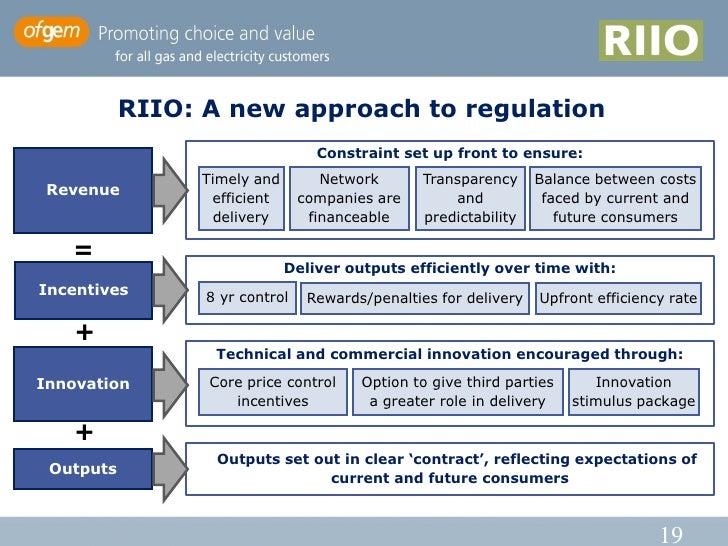
-
R is for Revenue: This is the total amount of money the network company is allowed to collect from consumers over a set period (typically 5-8 years). This revenue is determined by Ofgem before the period starts, based on the company's business plan and Ofgem's assessment of what efficient costs should be. This provides cost certainty for consumers and a clear budget for the company.
-
I is for Incentives: The RIIO model isn't just about capping revenue. It uses financial rewards (bonuses) and penalties to push companies to deliver better service. For example, a company might earn a bonus for reducing the number and duration of power cuts below a certain target, or face a penalty if customer satisfaction scores are too low. This creates a direct financial motivation to serve customers well.
-
I is for Innovation: The framework actively encourages companies to find smarter, more efficient ways of managing the grid. This is especially important as the UK moves towards Net Zero, requiring new solutions for connecting renewables and managing electric vehicle charging. RIIO includes specific funding mechanisms to support innovation projects. The reading from Ofgem's website mentions these:
- Network Innovation Allowance (NIA): A set amount of money each network company receives to fund smaller innovation projects.
- Strategic Innovation Fund (SIF): A larger fund that companies can compete for to finance ambitious, large-scale projects aligned with the UK's strategic energy goals.
-
O is for Outputs: This is what the network company promises to deliver in return for its revenue. Outputs are the specific, measurable targets that form the 'contract' with Ofgem and consumers. They cover a wide range of areas, including:
- Safety: Ensuring the network is safe for the public and for workers.
- Reliability: Minimising power cuts and network faults.
- Environmental Impact: Reducing the company's carbon footprint and connecting low-carbon technologies.
- Customer Satisfaction: Providing a high level of service to all customers, including those in vulnerable situations.
Test your understanding!
Imagine a distribution network company (DNO) operating under the RIIO framework. For each of the following actions, identify which RIIO component (Revenue, Incentives, Innovation, or Outputs) is most directly at play.
- The DNO launches a trial using artificial intelligence to predict and prevent faults on its network before they cause power cuts.
- The DNO's performance report shows it successfully kept the average duration of power cuts per customer 10% below the target set by Ofgem, earning it a £2 million bonus.
- Ofgem determines that the DNO will be allowed to collect £5 billion from its customers over the next five years to cover its costs.
- The DNO publishes its annual report, showing it met its target to connect 50,000 new electric vehicle chargers to its network.
Show answer
- Innovation: This is a classic example of using new technology to improve network management, likely funded through the NIA or SIF.
- Incentives: The company outperformed a specific target and received a direct financial reward.
- Revenue: This is the pre-determined total revenue allowance for the price control period.
- Outputs: This is the company delivering on a specific, pre-agreed performance target.
3. The RIIO Process and Timeline
The RIIO framework is not a one-time event; it's a continuous cycle that repeats over multi-year periods.
-
Business Plan Submission: Well before a price control period begins, each network company must develop and submit a detailed business plan to Ofgem. This plan outlines everything it intends to do over the next period and how much it will cost. Crucially, these plans are co-created with extensive input from customers and other stakeholders.
-
Ofgem's Determination: Ofgem scrutinises these plans, challenging the proposed costs and performance targets to ensure they represent good value for money. After a period of review and consultation, Ofgem issues its final decision, or 'determination', which sets the final package of Revenues, Incentives, and Outputs for that company.
-
The Price Control Period: The company then operates for the duration of the price control period (e.g., five years), working to deliver its outputs while managing its costs. Its performance is continuously monitored.
The framework has evolved through different generations:
- RIIO-1: The first price control period, which started in 2013 and ended for electricity distribution in 2023.
- RIIO-2: The current price control period. The timings vary for different parts of the network:
- RIIO-T2 (for Transmission networks) runs from 2021 to 2026.
- RIIO-ED2 (for Electricity Distribution networks) runs from 2023 to 2028.
- RIIO-3: Preparations are already underway for the next set of price controls that will follow RIIO-2.
This long-term, cyclical approach provides stability for investment while allowing the framework to adapt to changing priorities, such as the transition to Net Zero.
Conclusion
In this lesson, we've unpacked the RIIO framework, Ofgem's primary tool for regulating the UK's monopoly energy networks. It is far more sophisticated than a simple price cap, creating a detailed contract that balances consumer costs with the need for a safe, reliable, and innovative grid.
Key Takeaways:
- Price controls are necessary because network companies are natural monopolies.
- The RIIO framework stands for Revenue = Incentives + Innovation + Outputs.
- Revenue is set in advance for a multi-year period, providing cost certainty.
- Outputs are the specific, measurable performance targets companies must deliver.
- Incentives are financial rewards and penalties that encourage companies to outperform their targets and operate efficiently.
- Innovation is actively encouraged through dedicated funding mechanisms like the NIA and SIF.
- The framework operates in multi-year cycles (RIIO-1, RIIO-2, etc.), beginning with companies submitting detailed business plans for Ofgem's approval.
Preview of the next lesson:
Now that we understand how Ofgem regulates the network companies themselves, we will move on to the rules that govern how others can use the network. In the next lesson, we will explore the Connection and Use of System Code (CUSC), the key legal document that defines the relationship between generators, large consumers, and the high-voltage transmission system.