Hello! Welcome to your second lesson on the fundamentals of grid operation.
In our last session, we established why maintaining a stable 50 Hz frequency is absolutely critical for the health of the UK's power grid. We learned that frequency is physically linked to the spinning speed of generators and that any deviation from 50 Hz risks equipment damage and blackouts.
Today, we will build directly on that knowledge to explore the core principle behind frequency changes. By the end of this lesson, you will be able to describe the precise relationship between the balance of electricity generation and demand, and how this balance dictates the grid's frequency.
We will cover:
- The real-time nature of the power grid.
- How an imbalance between supply and demand causes frequency to rise or fall.
- The role of the grid operator in managing this constant balancing act.
The Great Balancing Act: Generation Must Equal Demand
Unlike water, which can be stored in a reservoir, or gas, which can be stored in a tank, electricity on a grid-scale cannot be easily stored. It is generated, transmitted, and used in the same instant. This means that for the grid to remain stable, the amount of power being produced by generators (supply) must exactly match the amount of power being used by consumers (demand) at every single moment.
This short video clip from the Practical Engineering channel explains this fundamental concept.
This clip from the video 'How Does the Power Grid Work?' explains the real-time nature of electricity supply and the challenge of 'load following'—matching generation to unpredictable demand.
Please watch from the beginning (00:21 to 00:45) and then the section from 06:08 to 07:48. Focus on the idea that electricity is used the instant it's produced and that the grid operator's job is to balance this in real time.
As the video highlights, this is a fantastically complex job. Every time you turn on a light, the grid operator has to ensure a generator somewhere produces a little more power to meet that new demand, instantly.
Frequency: The Grid's Speedometer
So, how does the grid operator know if supply and demand are balanced? They watch the frequency. In the previous lesson, we touched on the idea that frequency is the indicator of this balance. Now, let's make that relationship explicit.
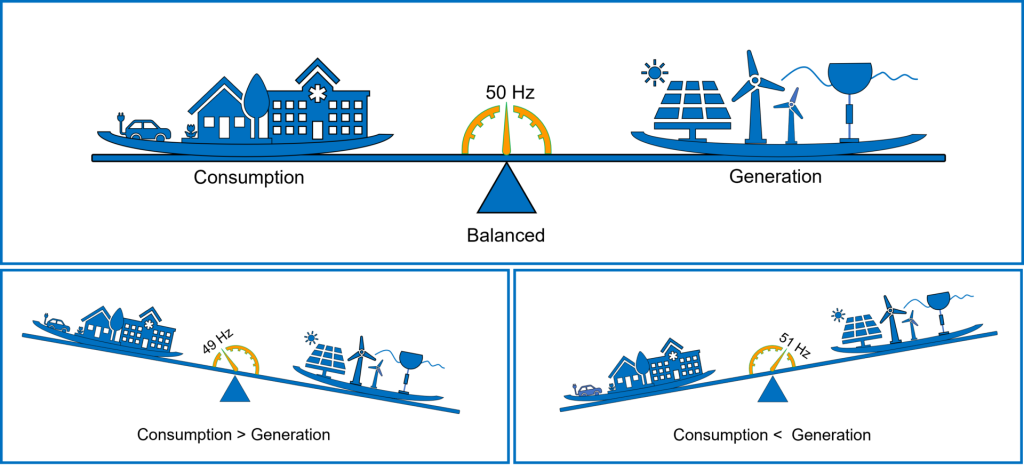
- When generation and demand are perfectly balanced, the generators spin at their target speed, and the frequency is stable at 50 Hz.
- When demand is greater than generation, the load on the system is too high. This acts like a brake on the generators, causing them to slow down, and the frequency falls.
- When generation is greater than demand, there is excess energy in the system. This causes the generators to speed up, and the frequency rises.
This relationship is the cornerstone of grid control.
The National Grid Electricity System Operator (NESO), who is responsible for balancing the GB grid, provides a clear explanation of this.
This article from NESO, titled 'What is frequency?', directly explains how frequency changes in response to an imbalance between electricity supply and demand.
Please read the section that begins with 'As supply and demand change...' and ends with '...Our control room uses tools like the balancing mechanism to do this.' Focus on the simple rules: more demand than supply means frequency falls, and more supply than demand means frequency rises.
This simple but powerful relationship can be visualized using a seesaw analogy.
What Happens During a Sudden Imbalance?
This relationship isn't just a slow drift; it's an immediate, physical reaction. Let's consider a common scenario: a large power station suddenly trips and goes offline due to a fault.
- At that instant, a large source of generation is lost from the grid.
- Demand, however, remains the same. The power being consumed by homes and businesses is now greater than the power being produced.
- This imbalance immediately puts a strain on all the remaining online generators, causing them to slow down.
- As a result, the frequency of the entire grid starts to drop.
This next clip describes this exact situation.
Connecting Solar to the Grid is Harder Than You Think
This video, 'Connecting Solar to the Grid is Harder Than You Think', uses a real-world example to illustrate exactly what happens to frequency when a generator is suddenly lost.
Please watch from 09:50 to 11:09. The video first explains the general principle and then uses the specific example of a generator tripping offline to show how frequency immediately begins to fall.
As the video explains, if nothing is done to inject more power into the system, the frequency will continue to fall, leading to the dangerous situations we discussed in the last lesson.
Test your understanding!
Imagine it's a sunny and very windy Sunday afternoon. Demand for electricity is relatively low because many businesses are closed. However, the UK's solar farms and wind turbines are all generating a large amount of power.
If the grid operator does not intervene, what will happen to the grid frequency? Why?
Show answer
The grid frequency will rise. In this scenario, the electricity supply (generation) from the renewables is greater than the electricity demand. This excess energy in the system will cause the synchronised generators to speed up, increasing the overall grid frequency above 50 Hz.
Restoring the Balance
As you've now learned from the NESO and Practical Engineering resources, it is the job of the System Operator to constantly take action to keep the seesaw level.
In their control room, engineers monitor the grid frequency in real time.
- If they see the frequency dropping, they know that demand is outstripping supply. They will instruct other power stations to increase their generation to bring the balance back.
- If they see the frequency rising, they know supply is greater than demand. They will instruct generators to reduce their output.
This article from Drax, a major UK power generator, describes this process from the generator's perspective.
what it takes to keep the power grid stable
This article, 'What it takes to keep the power grid stable', explains how the system operator works with generators to provide 'ancillary services' like frequency response.
Read the first few introductory paragraphs and the section titled 'Frequency response'. This reinforces the concept of balancing and shows how National Grid instructs generators to change their output to correct frequency deviations.
Conclusion: Key Takeaways
In this lesson, we have focused on the direct, cause-and-effect relationship between the power balance and grid frequency.
- The grid operates as a real-time system where electricity supply must instantaneously match demand.
- Grid frequency is the primary, system-wide indicator of this balance.
- If demand exceeds generation, the system is overloaded, and frequency falls.
- If generation exceeds demand, there is excess energy, and frequency rises.
- The National Grid Electricity System Operator (NESO) is responsible for monitoring frequency and instructing generators to adjust their output to maintain the balance and keep the frequency at 50 Hz.
You now have a solid understanding of why frequency changes. However, when a sudden imbalance occurs, the system doesn't just collapse instantly. There's a built-in buffer that resists these changes, giving the grid operator precious seconds to react. This buffer is called inertia.
In our next lesson, we will explore the concept of rotational inertia, explaining how the physical mass of large, spinning generators provides a crucial, passive defence against frequency fluctuations.