Hello! Welcome to your first lesson in our course on the UK electrical grid.
Given that we're starting from scratch, we're going to dive into one of the most fundamental principles of operating a power grid: maintaining a stable frequency. By the end of this lesson, you will be able to explain why keeping the grid's frequency locked at 50 Hertz is so critical for its safe and reliable operation.
We'll cover:
- What electrical frequency is and how it's created.
- The crucial link between frequency and the balance of electricity supply and demand.
- The serious consequences of letting the frequency stray from its target.
Let's begin by understanding what "frequency" means in the context of electricity.
What is Electrical Frequency?
Most of the world's electricity grids, including the one in the UK, use Alternating Current (AC). As the name suggests, the current rapidly alternates its direction, flowing back and forth in the circuit. This is different from Direct Current (DC), like that from a battery, where the current flows in only one direction.
This oscillation of AC electricity follows a smooth, repetitive wave pattern. Frequency is the measure of how many complete cycles of this wave occur every second. The unit for frequency is Hertz (Hz).
In Great Britain, and across Europe, the grid is designed to operate at a standard frequency of precisely 50 Hz.
To get a clear definition of this, please read the first few paragraphs of the following article from the National Grid Electricity System Operator (ESO).
This resource from National Grid ESO provides a clear, non-technical definition of electrical frequency and why all our appliances are designed to use it.
Please read the text from the beginning down to the sentence: 'It’s therefore important to constantly monitor frequency right across GB’s electricity network to make sure it stays close to 50hz every second.'
As the article mentions, every appliance and piece of electrical equipment in the country, from your phone charger to a massive industrial motor, is built to work at 50 Hz. But where does this frequency come from?
The Source of the Grid's Heartbeat
The 50 Hz frequency isn't an abstract number; it's a direct result of a physical process. The electricity on our grid is generated in power stations by enormous, spinning machines called synchronous generators.
Think of a bicycle dynamo lighting a lamp. As you pedal, you spin a wheel, which spins the dynamo, generating electricity. A power station generator works on the same principle, but on a massive scale. A source of energy (like steam from burning gas, or the force of wind or water) turns a giant turbine, and this turbine spins the generator.
The speed of this rotation directly sets the frequency of the electricity produced. To get a 50 Hz output, these massive generators must spin at a constant, specific speed—typically 3,000 revolutions per minute (rpm).
Crucially, the entire national grid is a single, interconnected system. This means that every single large generator connected to it, from a nuclear plant in Somerset to a wind farm in Scotland, must spin in perfect lockstep. They are synchronised, all rotating together to create one unified, stable 50 Hz frequency across the country.
This next article explains this connection between generator speed and frequency, and the importance of synchronisation.
Why we need the whole country on the same frequency
This article from Drax, a major UK power generator, clearly explains the link between spinning generators and grid frequency.
Please read the sections 'What is electrical frequency?' and 'Why is this important?'. Focus on how the generator's rotation creates the AC frequency and the concept of all generators being 'locked together – synchronised'.
Frequency: The Ultimate Balancing Act
You now know that frequency is set by the speed of generators. This physical link is what makes frequency the single most important indicator of the grid's health.
The grid is in a constant, delicate balancing act between the amount of electricity being produced (supply) and the amount being consumed (demand). Frequency is the immediate, real-time measure of this balance.
- If demand is higher than supply: There isn't enough power to meet everyone's needs. The extra load acts like a brake on the generators, causing them to slow down. The frequency falls.
- If supply is higher than demand: More power is being generated than used. This excess energy causes the generators to speed up. The frequency rises.
The job of the National Grid ESO is to ensure that generation precisely matches demand, second by second, to keep the generators' speed—and therefore the grid's frequency—stable at 50 Hz.
This image perfectly illustrates the concept.

This relationship is not just a theoretical concept; it's the fundamental principle of operating the grid.
Test your understanding!
Imagine it's half-time during a major televised football final. Millions of people across the country get up and switch on their electric kettles to make a cup of tea. What will be the immediate effect on the grid frequency if the system operator doesn't do anything? Why?
Show answer
The grid frequency will immediately start to fall. The simultaneous switching on of millions of kettles creates a huge, sudden increase in electricity demand. If generation (supply) does not increase to match this new demand, the load will overwhelm the generators, causing them to slow down and thus lowering the frequency of the entire grid.
Why Stability is Non-Negotiable
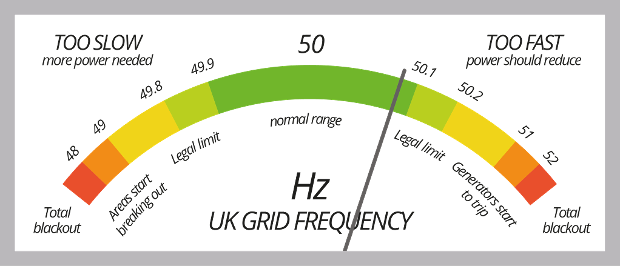
The grid operator, National Grid ESO, is legally required to keep the frequency within 1% of 50 Hz (between 49.5 Hz and 50.5 Hz). In practice, they operate within even tighter limits. Why such a strict rule?
Deviating from 50 Hz has two major, potentially catastrophic, consequences:
1. Equipment Damage and Malfunction:
As we learned earlier, electrical equipment is designed for 50 Hz.
- Motors running at the wrong frequency can overheat and become damaged.
- Sensitive electronics can malfunction.
- Some older electric clocks even used the 50 Hz frequency to keep time, so an unstable frequency would make them run fast or slow.
2. Grid Instability and Blackouts:
This is the most critical danger. If the frequency deviates too far, it threatens the stability of the entire system.
- Low Frequency (Under-frequency): If demand continues to exceed supply and the frequency drops too low, automatic safety systems will start disconnecting entire areas from the grid (so-called "load shedding" or rolling blackouts) to reduce demand and prevent a total collapse. If this doesn't work, the generators themselves can be damaged, leading to a nationwide blackout.
- High Frequency (Over-frequency): If supply exceeds demand and the frequency rises too high, generators' own protection systems will automatically disconnect them from the grid to avoid being damaged by spinning too fast. This sudden loss of a generator causes a drop in supply, which can then cause the frequency to crash, potentially triggering a cascading failure and, again, a blackout.
This short video clip summarises the importance of maintaining the 50 Hz target and the services used to achieve it.
Ancillary services for electricity (The Energy Academy - S3 E10)
This video from Modo Energy quickly recaps why frequency is so important and what happens if it deviates from the target of 50 Hz.
Watch the section from 01:09 to 01:38. Notice the tight frequency band (49.5 Hz to 50.5 Hz) and the stated risk of blackouts if it is breached.
The following image provides a stark visual of these operational limits and the severe consequences of breaching them.
Summary and What's Next
In this lesson, you've learned the fundamental importance of grid frequency. Let's recap the key takeaways:
- Frequency is the rate at which Alternating Current (AC) changes direction, set at 50 cycles per second (50 Hz) in the UK.
- It is physically determined by the rotational speed of large, synchronised generators across the country.
- Frequency serves as the grid's real-time "heartbeat," indicating the crucial balance between electricity supply (generation) and demand (consumption).
- Maintaining a stable 50 Hz frequency is critical to prevent damage to electrical equipment and, most importantly, to avoid cascading failures that can lead to blackouts.
You now understand why frequency is so vital and its relationship to the supply-demand balance. In our next lesson, we will delve into the grid's first line of defence against frequency changes: rotational inertia. We'll explore how the sheer physical mass of spinning generators provides a natural, instantaneous buffer that helps keep the frequency stable during sudden events.