Hello! Welcome to your next lesson on grid operation.
In our last session, we established the fundamental rule of grid balancing: electricity generation must match demand in real-time. We learned that the grid's frequency is the live indicator of this balance, falling when demand exceeds generation and rising when generation exceeds demand.
Today, we will explore the grid's first line of defence against sudden changes in frequency. This isn't a computer or a control system, but a fundamental property of physics. By the end of this lesson, you will be able to explain the concept of rotational inertia in synchronous generators and how it provides a passive, instantaneous response to resist changes in grid frequency.
We will cover:
- What inertia is in a physical sense.
- How traditional power stations provide inertia to the grid.
- The step-by-step process of how inertia acts like a "shock absorber" during a power imbalance.
- Why this instantaneous response is critical for preventing blackouts.
What is Rotational Inertia?
Before we talk about the grid, let's start with a simple concept from physics. Inertia is the resistance of any physical object to a change in its state of motion. For spinning objects, we call this rotational inertia.
Think about a heavy spinning top versus a light one. The heavy top is much harder to get spinning, but once it's going, it's also much harder to stop. It has more rotational inertia. This tendency to keep spinning is because it has more stored energy in its motion, known as kinetic energy.
The National Grid ESO, the operator of the GB grid, uses a great analogy to describe this.
Energy Explained: How inertia keeps the lights on
This article from the National Grid ESO, 'Energy Explained: How inertia keeps the lights on', introduces inertia as a 'natural shock absorber' and compares its effect to a heavy truck handling a bump in the road better than a light car.
Please read the entire article. It's short and provides an excellent high-level overview of why inertia is essential for resisting frequency changes and keeping the grid secure.
Where Does Grid Inertia Come From?
So where are these "heavy spinning tops" in the electricity grid? They are the massive, rotating components inside traditional synchronous generators. These are the types of generators used in thermal power stations (like coal, gas, and nuclear) and hydropower plants.
A generator works by spinning a huge, heavy electromagnet (the rotor) inside a coil of wires (the stator). The combined weight of the turbine and the rotor, spinning at high speed, stores a tremendous amount of kinetic energy.
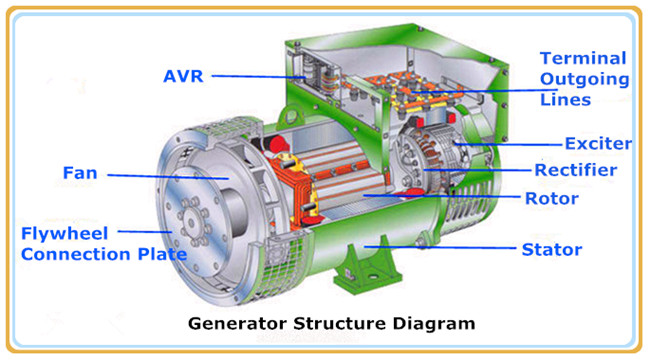
All the synchronous generators connected to the grid spin together, perfectly in sync, creating the 50 Hz frequency. Together, their combined rotational inertia acts like one enormous, continent-sized flywheel.
This short video explains which types of power plants provide this inertia and why newer renewable sources like solar and wind do not.
Why Is Grid Stability Getting Harder? The Hidden Challenge of Renewable Integration
This clip from the video 'Why Is Grid Stability Getting Harder?' introduces the types of power stations that provide inertia and other essential services.
Watch the section from 08:49 to 09:41. Pay close attention to the distinction made between 'synchronous machines' (coal, gas, nuclear) and other sources like wind and solar.
How Inertia Responds to a Grid Disturbance
Now, let's connect all these ideas. Imagine a large power station suddenly trips offline—the same scenario we discussed in the last lesson.
- Instant Imbalance: At that moment, a large amount of generation disappears. Demand is now greater than supply.
- Physics Takes Over: The millions of homes and businesses on the grid are still trying to draw that missing power. The only place they can get it from, in the first fraction of a second, is the kinetic energy stored in all the other spinning generators across the country.
- Energy is Released: The grid automatically and instantaneously "borrows" energy from the inertia of the remaining generators. This is not a decision made by an operator; it's a consequence of the laws of physics.
- Generators Slow Down: As these generators give up some of their kinetic energy to fill the power gap, they begin to slow down.
- Frequency Falls: Because the speed of the generators is physically tied to the grid's frequency, the frequency of the entire grid starts to fall.
This entire sequence is known as the inertial response. It is a passive and instantaneous reaction that begins the very moment an imbalance occurs.
This next video provides an excellent, detailed explanation of this exact process.
Why Is Grid Stability Getting Harder? The Hidden Challenge of Renewable Integration
This clip, again from 'Why Is Grid Stability Getting Harder?', walks through the inertial response following a generator trip.
Watch carefully from 09:41 to 11:52. The speaker clearly explains how the stored kinetic energy fills the gap and, crucially, how this affects the rate at which the frequency falls.
The Critical Role of "Buying Time"
As the video explained, the most important function of inertia is to slow down the rate of change of frequency (RoCoF).
- In a high-inertia grid (with many synchronous generators running), there is a vast reservoir of stored kinetic energy. A fault will cause the frequency to decline slowly and gracefully.
- In a low-inertia grid (with fewer synchronous generators, and more solar/wind), there is much less stored energy. The same fault will cause the frequency to drop much faster and more steeply.
This difference is critical. The slow decline in a high-inertia system gives the grid operator's slower, active control systems (which we will discuss in the next lesson) precious seconds to detect the problem, react, and instruct other power plants to ramp up their output.
Without enough inertia, the frequency could fall so quickly that it hits the dangerously low levels we discussed in Lesson 1, forcing automatic safety systems to disconnect parts of the grid before any active control could even begin to work. Inertia, therefore, "buys time" and is the grid's first and most important shock absorber.
This concept is so fundamental that it's worth seeing another explanation.
Operating low-inertia grids: challenges and solutions
This video, 'Operating low-inertia grids', explains the same process from a more academic perspective and uses a helpful diagram.
Please watch from 01:58 to 05:41. Focus on how the rotating masses 'spontaneously release' kinetic energy and how the graph at 03:40 illustrates the difference in frequency drop between a high-inertia and a low-inertia system.
Test your understanding!
Imagine two different days on the GB grid.
- Day A: A cold, dark, and still winter evening. Demand is very high, and most power is coming from large gas-fired power stations.
- Day B: A sunny, windy Sunday afternoon. Demand is low, and most power is coming from solar farms and wind turbines, with only a few gas plants running.
On both days, a large interconnector linking GB with France trips, causing an identical loss of 1,000 MW of imported power.
On which day will the grid frequency fall faster? Why?
Show answer
The frequency will fall much faster on Day B.
Here's why:
- On Day A, many large, synchronous gas generators are running. This means the system has high inertia. There is a large amount of stored kinetic energy to cushion the blow from the loss of the interconnector.
- On Day B, most of the power is coming from solar and wind, which are connected via power electronics and do not provide natural inertia. With only a few synchronous gas plants online, the system has low inertia. There is far less stored kinetic energy available to fill the 1,000 MW gap, so the remaining generators slow down much more rapidly.
Monitoring Inertia in Real Time
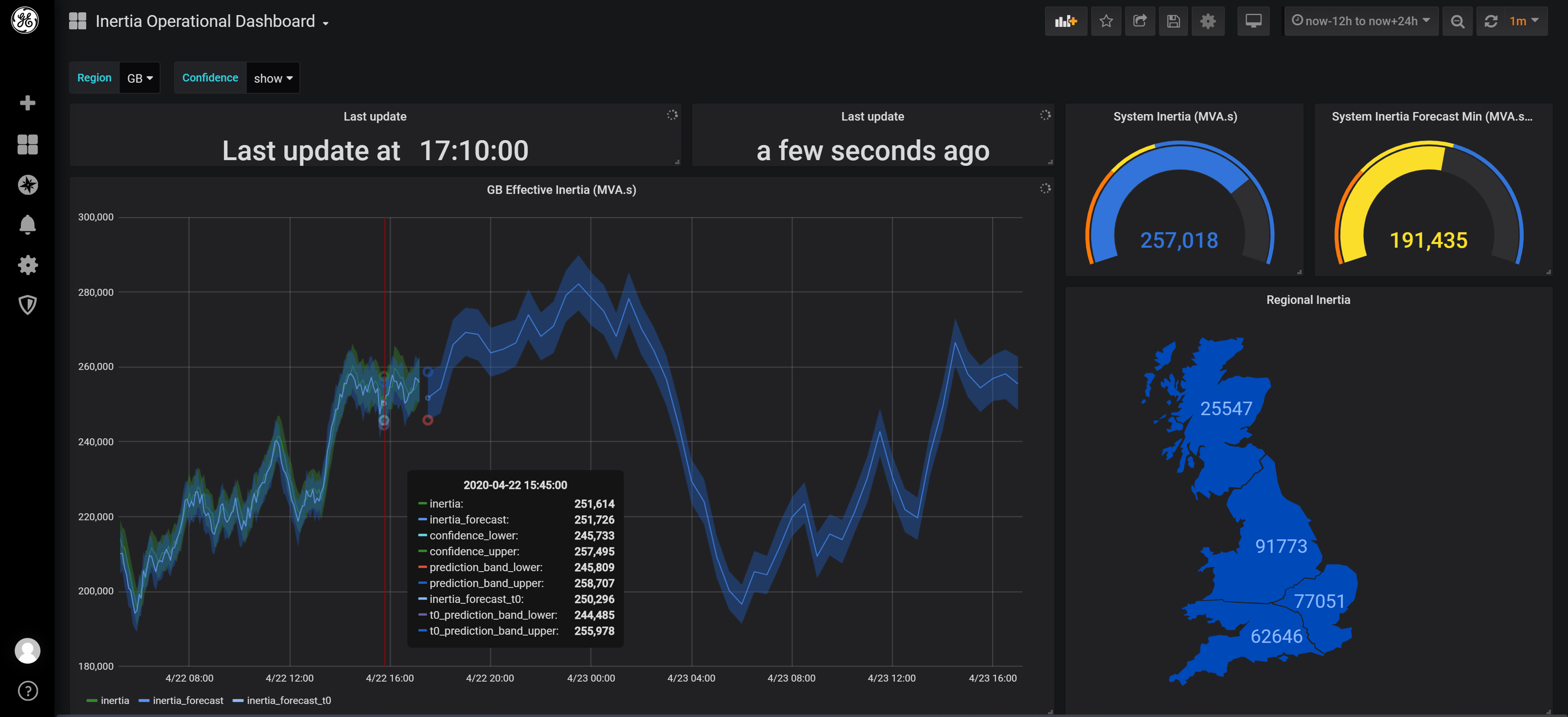
Because inertia is so critical for security, it is something the National Grid ESO monitors and forecasts constantly. It isn't a fixed value; it changes throughout the day depending on which power stations are running.
The unit for inertia is typically Gigawatt-seconds (GW·s). This represents energy (Power × Time). For example, a system with 100 GW·s of inertia could theoretically supply 100 GW for 1 second, or 1 GW for 100 seconds, using only its stored kinetic energy.
The image below shows a real operational dashboard used by engineers to track system inertia in Great Britain.
Conclusion: Key Takeaways
In this lesson, we've explored the grid's invisible but vital defence mechanism.
- Rotational inertia is the stored kinetic energy in the massive spinning turbines and rotors of synchronous generators (e.g., in gas, coal, nuclear, and hydro plants).
- It provides a passive and instantaneous response to a power imbalance. When generation is lost, energy is automatically drawn from this spinning mass.
- This response acts like a shock absorber, slowing down the rate at which the frequency changes.
- This "buys time" for slower, active control systems to react and restore balance, thereby preventing widespread blackouts.
- As the UK uses more renewable energy sources like wind and solar that don't provide natural inertia, managing low system inertia is becoming one of the biggest challenges for the grid operator.
Now you understand the grid's passive, physical defence. But what happens in the seconds after inertia has done its initial job? In the next lesson, we will look at the first stage of active frequency control: the governor systems on generators that automatically detect the frequency drop and start increasing their power output.