Hello! Welcome to the third lesson in our module on modern grid stability challenges.
In our last lesson, we discovered how the shift to converter-connected generation reduces the grid's physical inertia, which makes the system's frequency less stable and more vulnerable to disturbances. We learned that less inertia means a higher Rate of Change of Frequency (RoCoF), giving grid operators less time to react.
Today, we'll investigate another critical side-effect of this transition. This lesson addresses the learning outcome: Describe the impact of converter-connected generation on system strength (short-circuit level) and the associated challenges for voltage stability and protection system performance.
We will explore what "system strength" means, see why converter-based resources reduce it, and unpack the serious consequences this has for keeping our grid voltage stable and ensuring safety systems work as designed.
1. What is System Strength?
Imagine the electrical grid as a river. A very large, deep, and powerful river has a lot of force. If you create a small disturbance, like dropping a stone in, the overall flow is barely affected. This is a strong river. Now, imagine a small, shallow stream. The same stone could cause large ripples and significantly disrupt the flow. This is a weak stream.
"System strength" is a similar concept for the power grid. A strong grid can maintain a stable voltage level even when large loads switch on or off, or when faults occur. A weak grid is much more fragile, and its voltage can fluctuate wildly in response to the same events.
The most common way to measure system strength at a particular point is the Short-Circuit Level (SCL). This is the maximum amount of electrical current that would flow if a "short circuit"—an accidental, low-resistance connection—were to occur at that point.
- A high Short-Circuit Level means lots of current would flow, indicating a strong system. The voltage is "stiff" and resilient.
- A low Short-Circuit Level means less current would flow, indicating a weak system. The voltage is "soft" and easily disturbed.
2. Why Converters Weaken the Grid
So, what determines the Short-Circuit Level? It's primarily the type of generation connected to the grid. Here, traditional synchronous generators and modern converter-based resources behave in starkly different ways during a fault.
- Synchronous Generators (e.g., in gas or nuclear plants): These are huge, spinning machines directly synchronized with the grid. During a short circuit, their massive rotational energy allows them to temporarily unleash a huge surge of current—often 5 to 7 times their normal operating current. This large "fault current" is an inherent physical property.
- Converter-Based Resources (IBRs like solar, wind, batteries): These are connected to the grid via power electronic inverters. Inverters are built from sensitive semiconductor switches. To prevent these components from destroying themselves during a fault, their control systems are designed to strictly limit the output current, typically to just a little above their normal rating (e.g., 1.1 or 1.2 times).
As we decommission large synchronous power stations and replace them with wind and solar farms, we are swapping out machines that provide high fault currents for ones that don't. The result is a system-wide reduction in the available fault current, which means the grid's Short-Circuit Level drops, and the system becomes "weaker."
The following reading explains this fundamental change.
Changing energy mix and its impact on grid stability
This report from Swiss Re, 'Changing energy mix and its impact on grid stability', clearly explains why the protective current-limiting feature of inverters leads to reduced system strength.
Please read the short section titled 'What is the impact of inverters on overall system strengths?'. Focus on the first sentence, which gets to the heart of the issue, and then note the list of challenges that result from a weak network.
Now that we understand why system strength is decreasing, let's look at the three major challenges this creates.
3. Challenge 1: Voltage Instability
The most immediate consequence of a weak grid is poor voltage stability. As we just read, a weak system is "more susceptible to voltage instability."
During a fault, the voltage on the grid near the fault location will dip significantly. In a strong system, once the fault is cleared (by a circuit breaker opening), the high SCL helps the voltage to recover quickly and cleanly.
In a weak system, the story is very different. The initial voltage dip can be deeper and spread over a wider area. More importantly, after the fault is cleared, the system may struggle to restore the voltage to its normal level. The recovery can be slow and oscillatory, or in the worst case, it can fail completely, leading to a progressive, unstoppable drop in voltage known as voltage collapse.
The image below perfectly illustrates this difference.
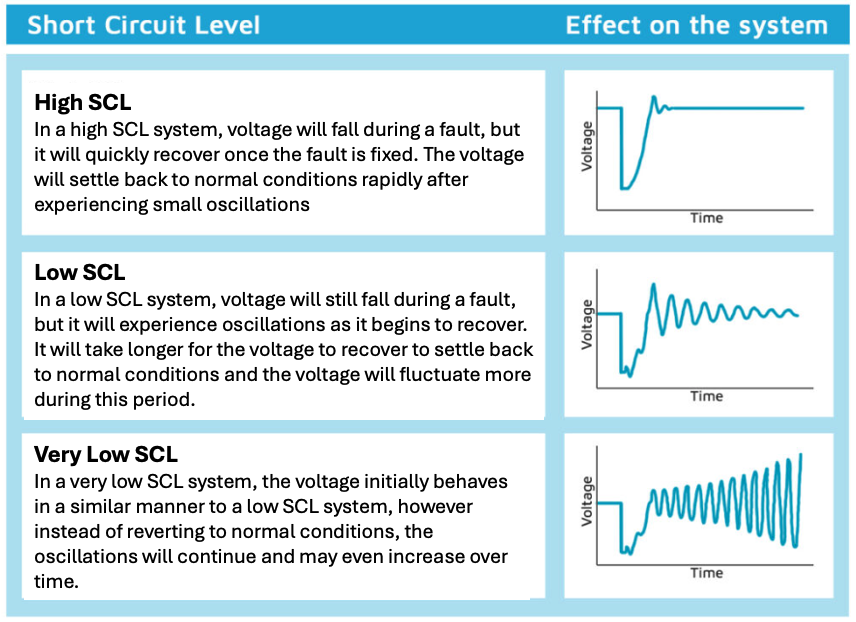
This increased risk of voltage collapse is a major concern for grid operators in areas with high penetrations of IBRs.
Test your understanding!
A fault occurs on a transmission line in a rural area with many new wind farms, far from any large conventional power plants. Another identical fault occurs on a line in an industrial area right next to a large gas-fired power station.
In which location is the grid more likely to struggle with voltage recovery after the fault is cleared, and why?
Show answer
The rural area with many wind farms is more likely to struggle with voltage recovery.
The area is dominated by converter-connected wind farms, which provide very little fault current. This means the system strength (SCL) in that area is low. The nearby gas-fired power station, with its synchronous generators, provides a high fault current, making the system in the industrial area much stronger. As we've seen, weak systems have more difficulty recovering their voltage after a fault and are more prone to instability.
4. Challenge 2: Protection System Malfunctions
Grid protection systems are the silent guardians of the network. They are sets of relays and circuit breakers designed to detect faults (like short circuits) and rapidly disconnect the faulty section to prevent damage and widespread blackouts.
Traditionally, the primary method for detecting a fault is simple: look for a massive, sudden spike in current. A protection relay is programmed to trip a circuit breaker if the current it measures exceeds a certain threshold for a certain amount of time.
Herein lies the problem. In a weak grid dominated by IBRs, the fault current is no longer a massive spike. It's much smaller, sometimes not much larger than a normal heavy load. This can cause two dangerous issues for protection systems:
- Failure to Operate: The fault current may be too low to ever cross the relay's trip threshold. The protection system fails to see the fault, leaving it connected to the grid, which can lead to equipment damage and cascading failures.
- Slow Operation: The relay may eventually detect the fault, but it takes much longer to make a decision because the signal is less clear. This delay means the fault stays on the system for longer, increasing the stress on other components and the risk of the instability spreading.
The report you read earlier, from resource LINK, explicitly notes that "low levels of system strength may also introduce risks to protection systems ... and increase relays’ trip time."
5. Challenge 3: Inverter Control Instability
The final challenge is more subtle and relates to the control systems inside the inverters themselves. Most inverters are "grid-following," meaning they use a control system called a Phase-Locked Loop (PLL) to listen to the grid's voltage waveform and synchronize their own output with it.
In a strong grid, the voltage waveform is a clean, stable, and reliable signal for the PLL to follow. In a weak grid, however, the voltage waveform is "noisier" and can become heavily distorted during a fault.
This can cause the PLL to become confused and "lose synchronism" with the grid. If this happens, the inverter might start injecting current at the wrong time (i.e., with the wrong phase angle) relative to the grid voltage. Instead of helping to support the grid, this incorrect response can make the voltage problem even worse, potentially pushing the system further towards instability.
The following reading describes this phenomenon.
Stability With 100% Inverter- Based Resources (IBR)
These presentation slides from the Global Power System Transformation Consortium (G-PST) provide a concise summary of stability issues. We will focus on the problem of PLL instability.
First, quickly read the slide 'Voltage Stability (4)' to reinforce what we've learned about weak grids and voltage recovery. Then, read the slide 'PLL Loss of Synchronism (1)'. Focus on the core idea: in weak networks, the PLL can struggle to track the voltage during a fault, causing the inverter to inject current incorrectly and worsen the instability.
This interaction between the inverter's own controls and a weak grid is a complex and active area of research, representing one of the key technical hurdles to operating a 100% renewable-based power system.
Conclusion
The replacement of synchronous generators with converter-based resources is a necessary step in decarbonisation, but it fundamentally alters the physics of the grid. It not only reduces the inertia needed for frequency stability but also diminishes the system strength required for voltage stability.
Key Takeaways:
- System strength describes the grid's ability to maintain a stable voltage and is measured by the Short-Circuit Level (SCL).
- Converter-based resources (IBRs) are current-limited to protect their electronics, unlike synchronous generators which provide a large fault current. This replacement of generation types reduces the overall SCL, creating a "weaker" grid.
- A weak grid faces three major challenges:
- Poor Voltage Stability: Voltage is more volatile and struggles to recover after faults, increasing the risk of voltage collapse.
- Protection System Issues: Low fault currents can cause protection relays to operate too slowly or fail to detect faults entirely.
- IBR Control Instability: The inverter's own control systems (like the PLL) can become unstable in weak grids, worsening grid disturbances.
In this lesson and the last, we've seen how the very nature of converters creates new challenges for frequency and voltage stability. In our next lesson, we'll look at another side-effect: the impact of converters on power quality, specifically the issue of harmonic distortion.