Hello! Welcome to the second lesson in Module 9 of our course on UK electrical grids.
In our last lesson, we explored the rare but critical scenario of a "black start." We saw that one of the emerging challenges for this procedure is the retirement of large, conventional power stations. We briefly mentioned that this reduces the grid's physical inertia, making the system harder to control during restoration.
Today, we will dive deep into that exact topic. This lesson is dedicated to helping you explain how converter-connected generation reduces system inertia and the resulting impact on frequency stability. We'll demystify what inertia is, see why it's a natural property of old power plants but not new ones, and understand why its decline poses one of the fundamental challenges for the future of the grid.
1. The Grid's Shock Absorber: What is System Inertia?
In our very first module, we learned that the grid must constantly balance electricity generation and demand to maintain a stable frequency of 50 Hz. But what happens when there's a sudden, unexpected imbalance, like a large power station tripping offline?
This is where inertia comes in. In a power system, inertia refers to the kinetic energy stored in the huge, heavy, spinning metal turbines and generators of traditional power plants (like coal, gas, and nuclear). These massive components rotate in perfect synchrony with the grid's 50 Hz frequency.
Think of system inertia as the grid's shock absorber.
To get a formal definition from the UK's Electricity System Operator (ESO), please read this short explainer.
This article from National Grid ESO, titled 'What is inertia?', provides a concise and authoritative definition of system inertia and uses the excellent analogy of a car's shock absorbers.
Please read the text down to the end of the section with the car analogy. Focus on how the 'stored' kinetic energy in spinning parts helps to slow down changes in frequency.
As the article explains, when a large generator suddenly disconnects from the grid, demand momentarily exceeds supply, and the grid frequency begins to fall. However, all the other synchronized spinning generators on the system won't slow down instantly. Their stored kinetic energy is automatically released back into the grid, counteracting the frequency drop. This provides a crucial, instantaneous, physics-based buffer that slows down the rate of change, giving the grid's control systems precious seconds to react and deploy backup power.
2. The Rise of Converter-Connected Generation
The challenge we face today is that the traditional sources of inertia are being replaced. The UK grid is rapidly decarbonising, moving away from large synchronous power stations towards renewable sources like wind and solar. These resources, along with battery storage and interconnectors, are fundamentally different. They are converter-connected, also known as Inverter-Based Resources (IBRs).
Instead of being physically synchronized with the grid's frequency, they generate or store direct current (DC) electricity, which is then converted to alternating current (AC) using a power electronics device called an inverter.
This inverter acts as an interface between the energy source and the grid. To understand the basic principle, let's watch a clip from Practical Engineering.
Connecting Solar to the Grid is Harder Than You Think
This video, 'Connecting Solar to the Grid is Harder Than You Think', explains the role of inverters. Pay close attention to the concept of a 'grid-following' inverter.
Watch from 06:26 to 07:46. The key takeaway is that most inverters are 'grid-following' – they listen to the grid's frequency and try to match it, rather than creating it or physically contributing to it.
This "grid-following" nature is the crux of the issue. A grid-following inverter is like a musician playing along to a backing track; it follows the rhythm but doesn't have the physical weight to keep the rhythm steady if the backing track suddenly falters. Similarly, these inverters are electronically programmed to match the grid's frequency, but they do not have the large, physically spinning mass that provides the "shock absorber" effect of inertia.

3. Why Don't Wind Turbines Provide Inertia?
A common point of confusion is wind turbines. After all, they have massive spinning blades. Why don't they provide inertia?
The reason goes back to the power converter. Modern wind turbines are designed to spin at whatever speed is most efficient for the current wind speed, not at a speed locked to the grid's 50 Hz frequency. The inverter then converts the variable-frequency AC power from the turbine's generator into the fixed 50 Hz AC power required by the grid. Because the spinning blades are electronically decoupled from the grid, their kinetic energy is not inherently available to support the system during a disturbance.
Let's hear this explained in an interview with an expert in grid integration.
Why Is Grid Stability Getting Harder? The Hidden Challenge of Renewable Integration
This clip from Modo Energy's podcast, 'Why Is Grid Stability Getting Harder?', directly addresses why the spinning mass of wind turbines doesn't provide the same kind of inertia as traditional power plants.
First, watch from 08:19 to 09:41 to understand the overall shift away from synchronous machines. Then, watch from 13:57 to 15:35, where the host asks the specific question about why spinning wind turbines don't help.
As the expert explains, while it's technically possible to create a "synthetic inertia" response from a wind turbine by rapidly slowing its blades, this can be counterproductive, creating an even bigger power deficit moments later. The key point is that the automatic, physics-based inertial response is lost.
4. The Impact: A Faster, Steeper Frequency Drop
So, what is the consequence of a grid with less inertia?
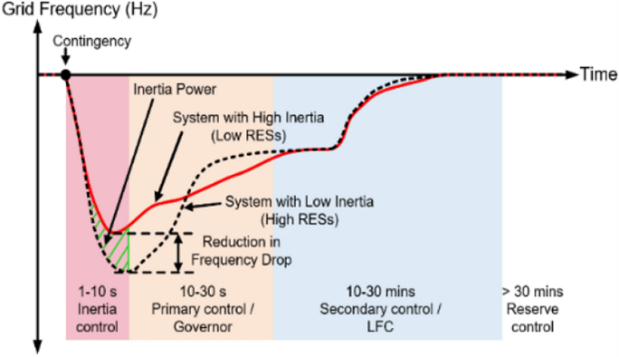
With less stored kinetic energy to act as a buffer, any imbalance between generation and demand will cause the grid's frequency to change much more quickly. This is measured as the Rate of Change of Frequency (RoCoF), often pronounced "rock-off".
- High-Inertia Grid: A large generator trips. The immense kinetic energy from other synchronous machines is released, slowing the frequency drop. The RoCoF is low. Grid operators have more time (many seconds) to activate backup power.
- Low-Inertia Grid: A large generator trips. There is very little stored kinetic energy to cushion the blow. The frequency plummets immediately. The RoCoF is high. Grid operators have much less time (perhaps only a second or two) to react before the frequency hits critical safety thresholds.
If the frequency falls too low, too fast, automatic protection systems will start disconnecting customers (load shedding) to prevent a total grid collapse. The 2019 UK power cut was a real-world example where a rapid frequency drop led to significant disruption.
This next clip provides an excellent explanation of this effect.
Why Is Grid Stability Getting Harder? The Hidden Challenge of Renewable Integration
Returning to the Modo Energy podcast, this section explains precisely why low inertia is dangerous, linking it directly to the Rate of Change of Frequency (RoCoF) and the risk of blackouts.
Watch from 09:41 to 11:52. Focus on the difference between how a high-inertia system and a low-inertia system respond to a trip.
The graph below visually summarises this entire problem.
Test your understanding!
Imagine two identical grids, Grid A and Grid B. Both have 10 GW of demand.
- Grid A is powered entirely by large, traditional gas power plants.
- Grid B is powered entirely by modern solar farms.
If a 1 GW power line importing electricity into both grids suddenly trips, which grid will experience a higher (faster) Rate of Change of Frequency (RoCoF), and why?
Show answer
Grid B will experience a much higher RoCoF.
Why: Grid A, powered by gas plants, has high system inertia from all the spinning synchronous generators. When the 1 GW import is lost, this stored kinetic energy will be automatically released, cushioning the blow and slowing down the frequency drop. Grid B, powered by converter-connected solar farms, has virtually no system inertia. When the 1 GW is lost, there is no physical buffer to slow the frequency drop, so it will fall much more rapidly.
Conclusion
The shift to a zero-carbon electricity grid is essential, but it fundamentally changes the physical characteristics of the system. The loss of inertia is not an insurmountable problem, but it is one that system operators must actively manage. Solutions like building synchronous compensators (large spinning machines that provide inertia without generating power) or programming inverters to provide "synthetic inertia" are now crucial parts of maintaining grid stability.
Key Takeaways:
- System inertia is the stored kinetic energy in the spinning turbines of traditional synchronous power plants, which acts as a "shock absorber" for the grid frequency.
- Converter-connected generation (like wind, solar, and batteries) is decoupled from the grid by power electronics and does not provide this inherent physical inertia.
- As renewables replace traditional plants, the total system inertia decreases.
- The main impact of low inertia is a higher Rate of Change of Frequency (RoCoF) during a disturbance. This reduces the time available for control systems to act, increasing the risk of automatic load shedding or system collapse.
In this lesson, we focused on the impact on frequency. However, declining inertia is not the only stability challenge posed by converters. In our next lesson, we will explore another critical issue: the impact of converter-connected generation on system strength (short-circuit level) and the associated challenges for voltage stability and protection system performance.