Hello! Welcome to the fourth lesson in our module on modern grid stability challenges.
In the past two lessons, we've explored how replacing traditional synchronous generators with converter-based resources affects the grid's fundamental physical properties. We saw how it reduces physical inertia, making frequency less stable, and diminishes system strength, making voltage less stable.
Today, we'll examine another important side-effect of this transition. This lesson addresses the learning outcome: Describe power quality issues, such as harmonic distortion, introduced by converter-based resources and their impact on the grid.
We'll define what "power quality" means, understand what harmonic distortion is, see precisely why converters create it, and explore the negative consequences for the grid and the equipment connected to it.
1. What is Power Quality?
The electricity grid is designed to deliver power with a voltage that follows a very specific shape: a perfect, smooth sine wave, alternating at a steady frequency of 50 times per second (50 Hertz) in the UK. Think of this as the pure, clean "note" that the entire power system is tuned to.
Power Quality is a term used to describe how well the voltage on the grid conforms to this ideal sine wave. Any deviation from a perfect, stable 50Hz sine wave is considered a power quality issue.
One of the most common and problematic power quality issues is harmonic distortion.
2. Understanding Harmonic Distortion
Harmonics are additional, unwanted voltage or current waveforms at frequencies that are integer multiples of the fundamental frequency. Since the fundamental frequency in the UK is 50Hz, the harmonic frequencies are:
- 2nd Harmonic: 100 Hz (2 x 50Hz)
- 3rd Harmonic: 150 Hz (3 x 50Hz)
- 4th Harmonic: 200 Hz (4 x 50Hz)
- 5th Harmonic: 250 Hz (5 x 50Hz)
- ...and so on.
These harmonics act like noise that pollutes the pure 50Hz signal. When they are present, they add themselves to the fundamental sine wave, creating a new, distorted waveform.
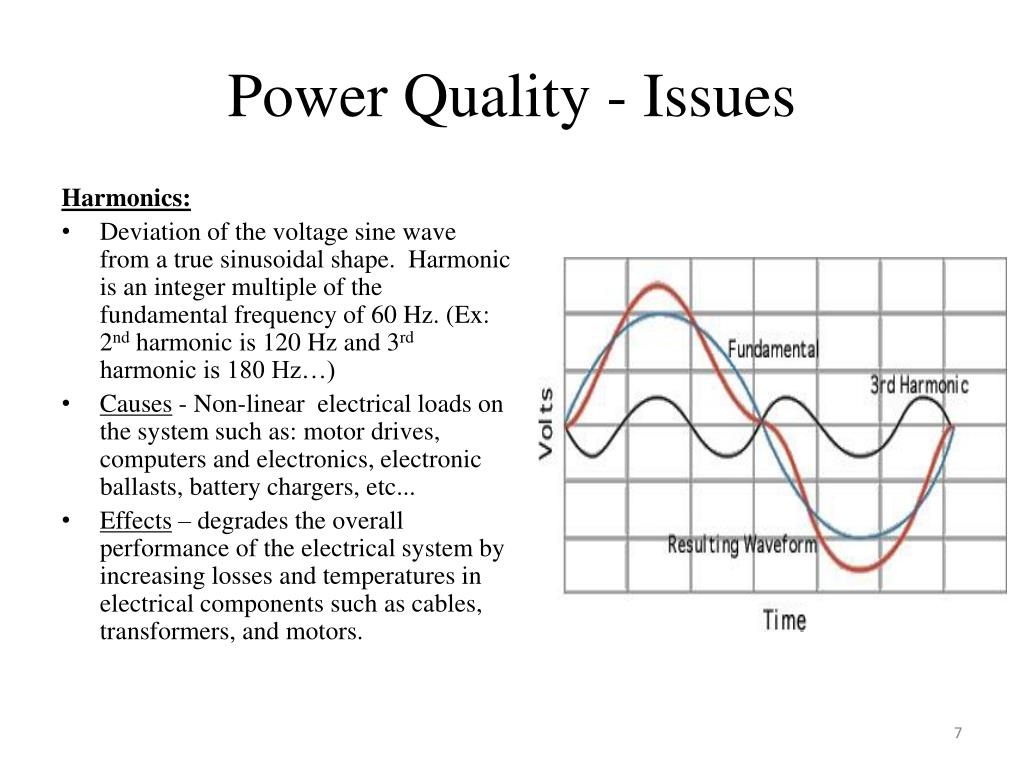
The more harmonics present, and the larger their magnitude, the more distorted the final waveform becomes.

To get a feel for this concept, the following video provides a great introduction.
How Do Electrical Harmonics Work?
The video 'How Do Electrical Harmonics Work?' from Electrician U offers a clear, practical explanation of what harmonics are and how they distort the ideal sine wave.
Watch the first 1 minute and 42 seconds of the video. The presenter explains the difference between a clean sinusoidal waveform and a distorted, non-sinusoidal waveform caused by harmonics.
The overall level of distortion is measured by a metric called Total Harmonic Distortion (THD). A high THD value indicates poor power quality.
3. Where Do Harmonics Come From?
Harmonics are generated by non-linear loads.
- A linear load (like a simple electric heater) draws current in a smooth wave that is directly proportional to the voltage wave.
- A non-linear load draws current in abrupt pulses or in a shape that does not follow the voltage waveform.
The primary culprits for creating harmonics in the modern grid are devices that use power electronics. This includes the very converters at the heart of the renewable generation technologies we've been discussing (wind, solar, batteries) and HVDC interconnectors. It also includes many common electrical devices.
The power converters in these devices work by rapidly switching electronic components (like transistors) on and off thousands of times per second. This switching action effectively "chops up" the electricity to convert it from AC to DC, or DC to AC, or to change its frequency. While this is essential for their operation, this rapid switching process inherently injects these choppy, non-sinusoidal currents back into the grid, which are rich in harmonic frequencies.
The following resources list the common sources of harmonics. You'll see that inverter-based resources are a key contributor.
How Do Electrical Harmonics Work?
Let's return to the Electrician U video, which identifies the types of equipment responsible for creating harmonics.
Watch the segment from 1:42 to 2:26, and then from 9:49 to 10:53. Notice the recurring theme: devices that perform AC-DC or DC-AC conversion and use fast switching, such as inverters, VFDs, and EV chargers, are the main sources.
Harmonics in Electrical Systems: Causes, Effects, Solutions
This article from Electrical Testing London also provides a comprehensive list of harmonic sources.
Read the short section titled 'Common sources of harmonics in modern installations'. Note the explicit mention of 'Inverter-based resources (DER/IBR)' alongside other modern electronic loads.
4. The Impact of Harmonics on the Grid
So, non-linear loads inject harmonic currents into the grid. The crucial next step is that these currents flow through the grid's own impedance (the electrical resistance and reactance of wires, transformers etc.). This creates harmonic voltages (Voltage = Current × Impedance). It is this resulting voltage distortion that is "seen" by all other equipment connected to the grid, leading to several negative effects.
Key Impacts of Harmonic Distortion:
- Overheating and Reduced Equipment Life: The extra harmonic frequencies cause additional currents to flow in grid components. This increases overall energy loss in the form of heat (
I²Rlosses) in transformers, cables, and motors. This persistent overheating can damage insulation and significantly shorten the lifespan of this expensive equipment. - Equipment Malfunction: Sensitive electronic devices, such as computers, control systems (PLCs), and medical equipment, are designed to operate on a clean sine wave. A distorted voltage supply can cause them to malfunction, lock up, reset, or produce corrupted data.
- Nuisance Tripping of Protection Devices: Circuit breakers and fuses are designed to detect overcurrents. The distorted waveforms and higher peak currents caused by harmonics can be misinterpreted by these protective devices, causing them to trip and disconnect circuits unnecessarily.
- Reduced System Efficiency: The energy contained in harmonic frequencies cannot be used to do productive work. It simply circulates in the system, creating extra heat and wasting energy. This lowers the overall efficiency of the power system.
The following video segment and reading selection provide excellent summaries of these damaging effects.
How Do Electrical Harmonics Work?
The Electrician U video clearly outlines the practical problems caused by harmonics.
Please watch from 7:20 to 9:58. The presenter details the effects we've just discussed, including overheating of neutrals and transformers, nuisance tripping, and equipment malfunction.
Test your understanding!
A large hospital is experiencing random resets of its diagnostic imaging equipment (like MRI and CT scanners) and its main circuit breakers are tripping for no apparent reason.
Based on what you've learned, what power quality issue might be the cause, and what could be a potential source of this issue within a modern building?
Show answer
The issue is very likely harmonic distortion. The symptoms described—malfunction of sensitive electronic equipment and nuisance tripping of circuit breakers—are classic signs of high harmonics.
Potential sources within a modern hospital are numerous. It could be large non-linear loads like variable speed drives (VFDs) in the HVAC systems, uninterruptible power supplies (UPS) for critical systems, or the cumulative effect of thousands of smaller switch-mode power supplies in computers, monitors, and the hospital's extensive modern lighting system (e.g., LEDs).
5. Harmonics in the Modern GB Grid
As the UK grid incorporates more large-scale renewable generation, the issue of harmonics becomes more significant. National Grid ESO (the Electricity System Operator) monitors and manages power quality as a core part of ensuring a secure and reliable system.
A key point that connects to our previous lesson is the relationship between system strength and harmonics.
Recall that a "weaker" grid has a higher impedance. Because harmonic voltage is the product of harmonic current and grid impedance (V_h = I_h × Z_h), a weaker grid will experience a higher level of voltage distortion for the same amount of harmonic current injection.
Furthermore, the combination of capacitance (from long underground or subsea cables) and inductance (from transformers and lines) in the grid can create resonance. If a harmonic frequency injected by a wind farm happens to match the grid's natural resonant frequency, that harmonic can be massively amplified, leading to severe voltage distortion and potential equipment damage.
The following document from National Grid ESO discusses these exact concerns for the GB transmission network.
Power Quality in the GB Transmission Network
This official report, 'Power Quality in the GB Transmission Network', details the real-world challenges the grid operator faces. It directly links the increase in Inverter Based Resources (IBRs) and declining system strength to power quality problems like harmonics.
Please read the 'Executive Summary' (page 4) and the section titled 'Harmonics' (pages 6-9). Focus on these key points: How IBRs contribute to power quality issues. The link between declining system strength and worsening harmonic distortion. The concept of resonance and how network changes can make it a bigger problem.
To manage these issues, grid operators and connecting developers use solutions like harmonic filters. These can be passive (circuits of inductors and capacitors tuned to trap specific harmonic frequencies) or active (power electronic devices that inject 'anti-harmonics' to cancel out the distortion).
Conclusion
The shift to a converter-dominated grid introduces a new layer of complexity beyond the physics of inertia and system strength. The very nature of how these devices operate pollutes the clean sine wave that the grid relies on.
Key Takeaways:
- Power Quality refers to how closely the grid's voltage matches a perfect 50Hz sine wave.
- Harmonic Distortion, the presence of unwanted higher-frequency waveforms, is a major power quality issue.
- Converter-based resources (wind, solar, batteries) are significant sources of harmonics due to the fast-switching nature of their power electronic interfaces.
- Harmonics cause negative effects, including equipment overheating, malfunctions, nuisance tripping of protection, and reduced efficiency.
- The impact of harmonics is worse in weaker grids (which have higher impedance), and there is a risk of resonance amplifying distortion to dangerous levels.
So far, we have examined the challenges that arise from the individual characteristics of converters—their lack of inertia, their low fault current contribution, and their generation of harmonics. In our next and final lesson of this module, we will look at an even more complex challenge: the risk of adverse control system interactions between multiple converter-based resources.