Hello! Welcome back to our course on the UK electrical grid.
In the last lesson, we followed the grid balancing timeline, culminating in the final hour before delivery. We saw that this is when the National Grid Electricity System Operator (ESO) takes direct control, using the Balancing Mechanism (BM) to correct any mismatch between planned generation and actual demand.
Today, we're going to dive deeper into that real-time balancing act. The BM is the marketplace, but what are the actual tools and products the ESO uses to keep the lights on? These are known as ancillary services. Our goal for this lesson is to explain how the ESO uses frequency response and other ancillary services to manage real-time deviations.
Ancillary Services: The Grid's Support System
Think of the main electricity market as delivering the bulk product—the megawatts of power. Ancillary services are the specialist support functions required to ensure that power is delivered safely, reliably, and at the correct technical specifications. The ESO procures these services from market participants like generators, battery storage operators, and even large consumers.
To get a high-level overview of what these services are and why the ESO needs them, let's watch this excellent introductory video.
Ancillary services for electricity (The Energy Academy - S3 E10)
This video from Modo Energy provides a great introduction to the main types of ancillary services that keep the GB grid stable.
Watch the first four minutes of the video (00:15 - 04:25). As you watch, make a note of the six main services mentioned: Frequency Response Reactive Power Voltage Management Inertia Reserve Services Restoration (Black Start)
As the video explains, these services are not optional extras; they are fundamental to the secure operation of the grid. Let's explore the most important ones in more detail.
Focus on Frequency: The Most Critical Service
As we've discussed before, the most critical parameter the ESO must manage is the system frequency. It's the primary indicator of the real-time balance between generation and demand.
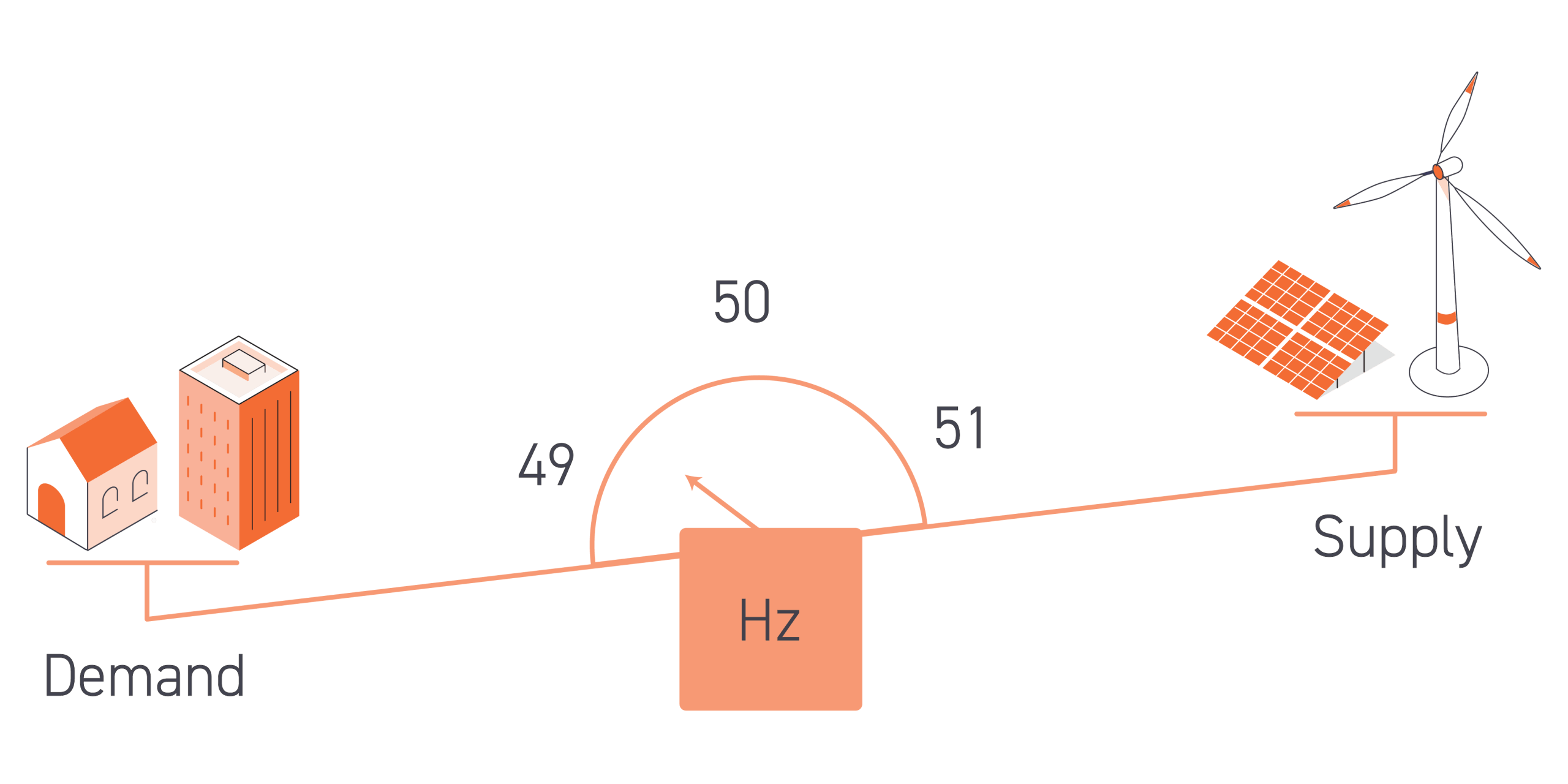
Frequency Response is a service where providers rapidly change their power output (either increasing generation/decreasing demand, or vice-versa) to counteract a frequency deviation. This is not a single action but a layered, coordinated response that happens at different speeds.

Let's break down these layers:
-
Primary Response (sub-second to ~10 seconds): This is the instantaneous, automatic first line of defence. When a large power station trips offline, the frequency starts to fall immediately. The spinning turbines of other online generators naturally slow down and release their stored kinetic energy (inertia), providing a passive, immediate response. To supplement this, the ESO procures dedicated fast-acting services, such as Dynamic Containment, which are often provided by batteries that can inject power in under a second to "contain" the frequency drop.
-
Secondary Response (seconds to minutes): Once the initial frequency drop is arrested, secondary response services are activated to begin restoring the frequency back towards 50 Hz. These services are still fast and automatic but take a little longer to ramp up. They take over from the primary response, allowing it to be ready for the next incident.
-
Tertiary Response (minutes to hours): This is the final, slower stage. Here, the ESO uses the Balancing Mechanism to dispatch larger, slower-starting power plants (like a gas-fired power station) or reduce demand over a longer period. The goal is to replace the energy lost from the original plant trip and relieve the faster-acting frequency response services, returning the system to a normal, stable state.
Essentially, a frequency event triggers a relay race: inertia and primary response grab the baton first to stop the immediate crisis, secondary response takes over to start the recovery, and tertiary response runs the final leg to bring everything back to normal.
A Quick Look at Other Key Services
While frequency is paramount, the ESO manages other issues in real-time too, using services we saw in the video:
- Reserve Services: These provide extra generation or demand reduction that can be called upon to handle larger or longer-lasting events, like an extended power plant outage or a major forecasting error. They are slower to activate than frequency response but provide sustained power.
- Voltage Control (Reactive Power): Voltage is like the 'pressure' in the system. It's not related to the supply-demand balance but to the physics of power flows. The ESO must manage voltage levels across the country to avoid equipment damage. It does this by instructing generators and other devices to inject or absorb reactive power.
- Restoration (Black Start): This is the ultimate insurance policy. In the event of a total grid shutdown (a blackout), certain power stations have the unique ability to start up without an external power source. A Black Start service procures this capability, allowing the ESO to systematically re-energise the grid, section by section.
The Providers: A Changing Landscape
Historically, these services were provided almost exclusively by large coal and gas power stations. However, the energy transition is changing the market completely.
Today, providers include:
- Batteries: Excel at providing very fast frequency response.
- Pumped Hydro Storage: Can provide both fast response and longer-duration reserve power.
- Interconnectors: The cables connecting GB to other countries can be used to import or export power quickly.
- Demand-Side Response (DSR): This is an increasingly important source of flexibility. Instead of turning up a power station, the ESO can pay a large factory to briefly turn down its machinery, or a collection of supermarkets to turn down their refrigerators.
This last point is crucial for the future grid. To understand how smaller businesses and consumers can participate in these complex markets, let's look at a key innovation.
The Balancing and Settlement Code For Dummies
How can a supermarket's fridge help balance the national grid? Through 'Demand-Side Response' and 'aggregation'. This guide from Elexon explains the concept of 'Wider Access' to the Balancing Mechanism, which allows new types of companies to participate.
Please read the section 'Wider Access to the Balancing Mechanism for Demand-Side Response Aggregators' (page 37) and the glossary definitions for 'Demand-side response', 'Virtual Lead Parties (VLPs)', and 'Wider Access' (pages 49 & 51). Focus on understanding how companies called 'aggregators' or 'VLPs' can bundle up small changes in electricity use from many sites and offer this as a single service to the ESO.
Test your understanding!
A large offshore wind farm suddenly stops generating due to a technical fault, causing a significant and rapid drop in grid frequency. Place the following ESO actions in the correct chronological order from first to last.
A. The ESO uses the Balancing Mechanism to instruct a gas power station to start up and ramp to full power over the next 30 minutes.
B. Batteries participating in the Dynamic Containment service instantly inject power into the grid, arresting the frequency fall within seconds.
C. Several fast-responding providers (e.g., pumped hydro, other batteries) are automatically instructed to increase their output to start bringing the frequency back towards 50 Hz.
Show answer
The correct order is:
- B (Primary Response): The instantaneous response from batteries and inertia is the first line of defence to stop the frequency from collapsing.
- C (Secondary Response): Once the fall is stopped, these faster services begin the recovery process, pushing the frequency back up.
- A (Tertiary Response): The slower, larger power station is brought online via the Balancing Mechanism to replace the lost wind generation for the long term and allow the faster services to stand down.
Conclusion
In this lesson, we've unpacked the ESO's real-time toolkit. We've seen that balancing the grid is more than just matching total energy; it's about managing a complex set of technical parameters second by second.
Key Takeaways:
- Ancillary services are procured by the ESO to ensure grid stability, security, and power quality.
- Frequency Response is the most critical service, providing a rapid, layered defence against generation-demand imbalances. It ranges from sub-second primary response to slower tertiary response managed through the Balancing Mechanism.
- Other key services include Reserve, Voltage Control, and Black Start.
- The providers of these services are diversifying, with batteries and Demand-Side Response playing an increasingly vital role alongside traditional power stations.
We have now learned what the ESO does in real-time and the services it uses. In our next lesson, we will get a glimpse inside the cockpit, exploring the role of the ESO's control room and the key software systems (like SCADA and EMS) used for grid monitoring and issuing dispatch instructions to these service providers.