Hello! Welcome to your next lesson in our journey through the UK's electricity grid.
In the last session, we learned about Transmission Network Use of System (TNUoS) charges, which are the fees for using the high-voltage electricity "motorways." We saw that there's a key difference in how these charges are calculated: generators pay based on their maximum potential output (their capacity), while large electricity users pay based on their actual consumption during a few critical peak periods.
Today, we're going to dive deep into that second part. This lesson will focus on the learning outcome: Explain the methodology for calculating demand-side TNUoS charges, focusing on the 'Triad' system and its influence on large energy users. We'll unravel exactly what these critical peak periods are, how they are used to calculate charges, and how this system shapes the behaviour of the UK's biggest electricity consumers.
1. What are the Triads?
As we briefly touched upon last time, the electricity bills for large industrial and commercial users are handled differently from those for households. These larger users are typically on "half-hourly settled" tariffs, meaning their electricity consumption is measured every 30 minutes. This detailed data allows for a more sophisticated charging system.
The TNUoS charge for these large users is determined by their electricity use during three specific half-hour periods each year. These three periods are known as the Triads.
To get a precise definition, let's turn to a guide from National Grid.
Electricity Transmission network charging
This document from National Grid provides a formal definition of the Triad system used for charging half-hourly settled customers.
Please read the paragraph under the heading 'How are suppliers and directly connected demand charged for TNUoS?'. Focus on the definition provided for 'Triads'.
As the guide states, the Triads are defined as:
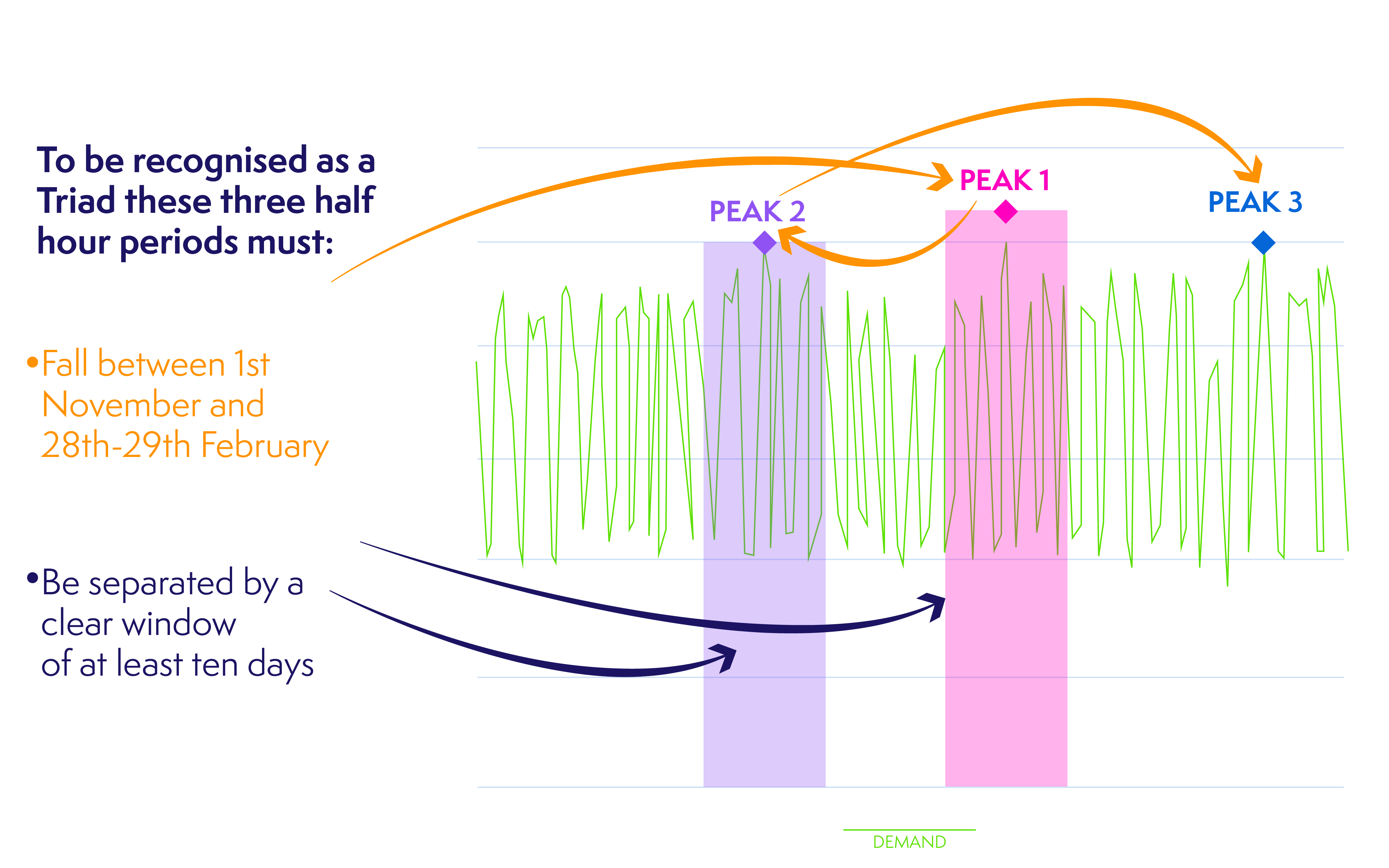
The three half-hours with the highest system-wide electricity demand between November and February, separated by at least ten clear days.
Let's break down these two crucial rules:
- The Winter Window (November - February): This period is chosen because it's when UK electricity demand is at its highest. It gets dark early and it's cold, so there is an overlap of industrial activity, commercial lighting, and residential heating and lighting, all putting maximum strain on the grid.
- Ten Clear Days Separation: This rule ensures that the three peaks are not all part of the same prolonged cold snap. It forces the system to identify three distinct moments of high stress on the grid, giving a more representative measure of peak usage throughout the winter.
The image below provides a great visual summary of these two conditions.
To see what this looks like with real data, the following chart shows the daily peak demand during the winter of 2022-2023. The three days on which the Triads occurred are highlighted in red.
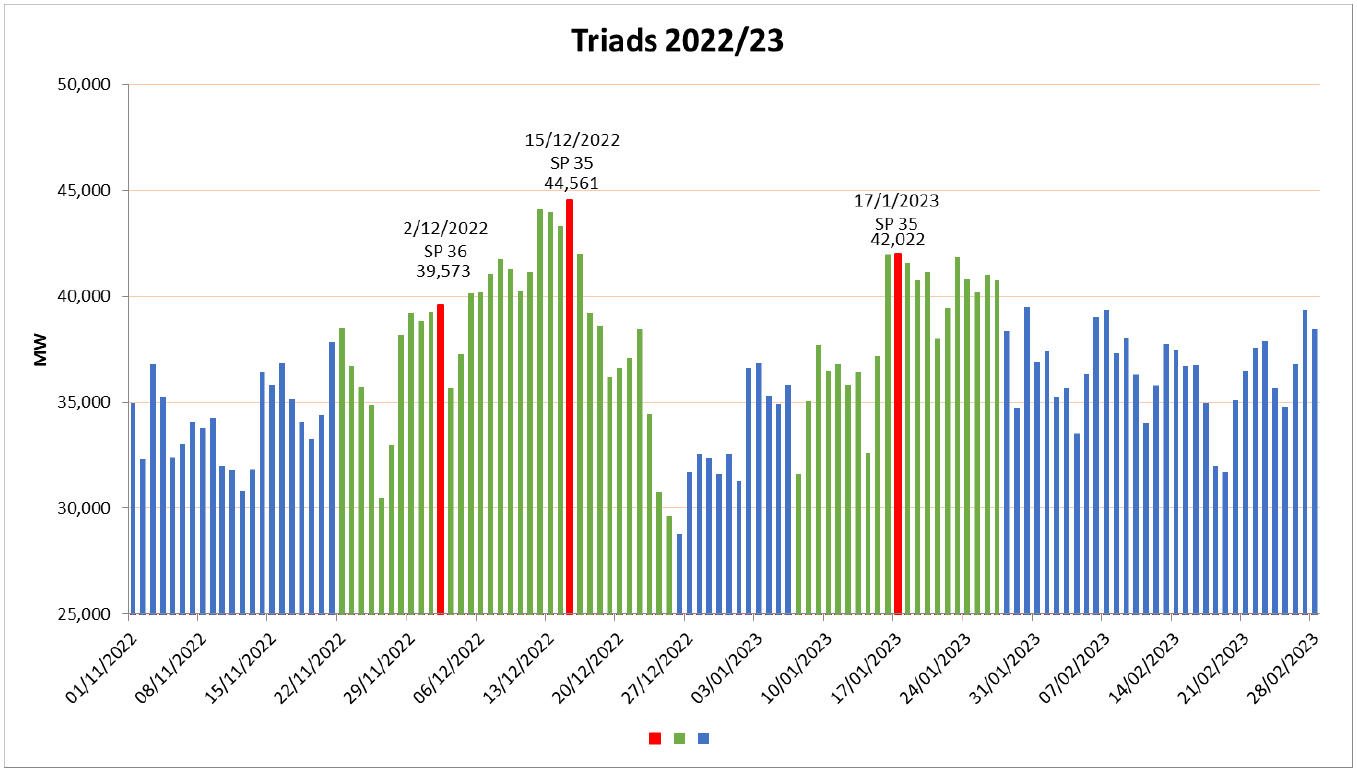
Notice how the Triad peaks are high, but not necessarily the three absolute highest points right next to each other, due to the 10-day separation rule.
2. How the Triad Charge is Calculated
The core idea of the Triad system is to charge large users based on how much they contributed to the three moments of maximum stress on the grid.
The annual TNUoS charge for a large user is calculated with a simple formula:
Let's look at each part:
-
TNUoS Tariff (£/kW): This is the rate set by the System Operator. As we learned in the previous lesson, this rate is composed of a locational part (it varies depending on where you are in the country) and a residual part. For now, just think of it as the "price per kilowatt" of peak demand. These tariffs can be significant, often in the range of £30 to £70 per kW.
-
Average Triad Demand (kW): This is the figure specific to the energy user. It's calculated by taking the user's average electricity consumption (in kilowatts) across the three half-hour Triad periods.
A Worked Example
Imagine a large factory and assume the TNUoS tariff for its location is £60/kW.
After the winter, the National Grid ESO analyses all the data and announces that the three Triads occurred on:
- Triad 1: 5th December, 17:00 - 17:30
- Triad 2: 19th December, 17:30 - 18:00
- Triad 3: 24th January, 17:00 - 17:30
The factory checks its half-hourly meter data and finds its electricity demand during these exact periods was:
- During Triad 1: 1,200 kW
- During Triad 2: 900 kW
- During Triad 3: 1,500 kW
First, we calculate the factory's Average Triad Demand:
Now, we calculate the factory's annual TNUoS charge:
This single charge of £72,000 is purely for using the transmission network, based on the factory's consumption in just three half-hour slots over the entire year.
3. "Triad Avoidance": The Impact on Energy Users
That £72,000 bill is a powerful motivator. The entire Triad system is designed to create a strong financial incentive for large businesses to reduce their electricity consumption during peak winter evenings. This practice is known as "Triad Avoidance" or "Triad Management."
To understand how this works in practice, let's explore an article that explains the user's perspective.
Nobody Panic However the Triads are Coming
This article provides excellent insight into how and why large energy users react to the Triad system.
Please read the entire article, focusing on the sections 'Triads', 'TNUoS', 'How Triads are Calculated', and 'The Pie Chart of Days and Times'. Pay attention to why the Triads are not announced in advance and what actions businesses take in response.
As the article explains, there's a crucial catch: the exact dates and times of the Triads are not announced in advance. The National Grid ESO only confirms them in March, after the winter is over.
This uncertainty leads to a strategic game:
- Energy managers at large companies spend the winter trying to predict when the Triads are likely to happen.
- They subscribe to "Triad warning" services that use weather forecasts and historical data to issue alerts on days with a high probability of a Triad.
- Historically, as the article notes, Triads most often occur on cold, dark weekday afternoons between 4:30 pm and 6:00 pm, when industrial demand overlaps with the domestic evening peak.
When a Triad warning is issued, a business might take several actions to reduce its demand from the grid:
- Shift energy-intensive production processes to other times of the day.
- Turn off non-essential machinery, heating, or lighting.
- Switch to on-site generation, such as backup diesel generators or large battery storage systems.
The collective effect of thousands of businesses doing this across the country is a significant reduction in the national peak demand. This is the ultimate goal of the Triad system: it flattens the national demand profile, reducing the strain on the grid and avoiding the need to build extra power stations that would only be used for a few hours each year.
Test your understanding!
A large supermarket chain is reviewing its energy costs. Its energy manager notices a very high TNUoS charge on their bill. They discover that during all three Triad periods last winter, their stores had all their lights on, refrigerators running at full power, and in-store bakeries operating.
What is the single most effective piece of advice you could give the energy manager to help them reduce their TNUoS charge for the next winter?
Show answer
The most effective advice would be to implement a "Triad avoidance" strategy. This would involve subscribing to Triad warning services and, on high-risk days (cold winter weekdays between 4pm and 6pm), acting to reduce electricity demand. For example, they could briefly dim non-essential lighting, use on-site backup generators if available, or adjust refrigeration cycles to avoid running compressors during the likely Triad windows. By lowering their average demand across the three eventual Triad periods, they will directly lower their next annual TNUoS bill.
Conclusion
Today we've unpacked one of the most influential charging mechanisms in the UK electricity system. While the Triad methodology will see some reforms in the coming years, understanding its principles is vital to grasping the economics of grid usage.
Key Takeaways:
- Demand-side TNUoS charges for large, half-hourly settled users are calculated using the Triad system.
- The Triads are the three highest national demand half-hours between November and February, separated by at least ten clear days.
- The charge is calculated by multiplying the user's average demand across the three Triads by a regional TNUoS tariff (£/kW).
- Because the financial penalty is high and the Triads are unpredictable, the system creates a powerful incentive for businesses to reduce consumption during peak winter afternoons, a practice known as Triad avoidance.
In our last lesson, we focused on the 'when' of grid use for demand. In our next lesson, we will turn our attention back to generators and explore the 'where'. We will examine the methodology for calculating generation-side TNUoS charges and see how powerful locational signals are used to influence where new power stations are built.