Hello! Welcome to your next lesson on the UK's electrical grids.
In our last lesson, we explored how large electricity users are charged for the transmission network. We focused on the 'Triad' system, which sends a temporal signal, influencing when businesses use power to avoid the three annual peaks of demand.
Today, we're flipping the coin to look at electricity generators. This lesson will address the learning outcome: Explain the methodology for calculating generation-side TNUoS charges and the role of locational signals in incentivizing network-efficient connections.
We'll discover that while demand-side charges are about 'when', generation-side charges are all about 'where'. You'll learn how these charges create a powerful financial map of Great Britain, guiding developers on where the grid needs new power sources the most.
1. Who Pays Generation TNUoS?
Transmission Network Use of System (TNUoS) charges are paid by generators for their use of the high-voltage transmission network—the 'motorways' of the grid. However, not every generator has to pay. The liability depends on the generator's size and how it's connected to the grid.
To get the official definitions, let's turn to a guidance document from the National Energy System Operator (NESO).
This guide from NESO (formerly National Grid ESO) explains the rules for Transmission Network Use of System (TNUoS) charges. We'll start by looking at which generators are required to pay.
Please read the section '1 What is TNUoS and who pays?', focusing on the part titled 'Who pays generation TNUoS charges?'. This will clarify the rules for different types of generators.
As the guide explains, the key rules are:
- Generators directly connected to the high-voltage transmission network always pay generation TNUoS charges.
- Generators connected to the lower-voltage distribution network (known as 'embedded' generators) only pay these charges if they have a contracted export capacity of 100 MW or more.
- Smaller embedded generators (below 100 MW) do not pay generation TNUoS.
This means these charges primarily apply to large-scale power plants, such as major wind farms, gas-fired power stations, and large battery storage facilities.
2. The Components of a Generator's TNUoS Bill
A generator's final TNUoS bill is not a single number but is built from several components. The total annual charge is calculated by multiplying a specific tariff rate (in £/kW) by the generator's contracted export capacity, known as its Transmission Entry Capacity (TEC).
The main components that make up the tariff rate are:
- The Wider Tariff: This is the most significant part of the charge and is strongly locational. It reflects the cost of adding generation at a specific point on the national grid. This is the component that sends the powerful economic signal we're focusing on today.
- Local Tariffs: These are smaller charges that relate to the specific, local assets (like circuits and substations) used to connect the generator to the main transmission 'motorway'.
We'll focus primarily on the Wider Tariff, as it is the key tool for influencing where generation is built.
3. The Wider Tariff: A Financial Map of the Grid
The central principle of the Wider Tariff is to charge generators based on the impact they have on the wider transmission system.
- Building a power plant in an area that is already exporting a lot of power (like the north of Scotland, rich in wind farms) puts more strain on the grid, as the electricity has to be transported long distances to reach demand centers (like London). Generators in these areas face high positive charges.
- Building a power plant in an area with high demand and little local generation (like the south of England) helps to balance the grid locally and reduces the need for long-distance transport. Generators in these areas face low charges or may even receive payments (negative charges).
To implement this, Great Britain is divided into 27 generation charging zones. Each zone has its own specific Wider Tariff.
The image below shows these zones and, crucially, how the charges (or payments) vary dramatically by location for different technologies.
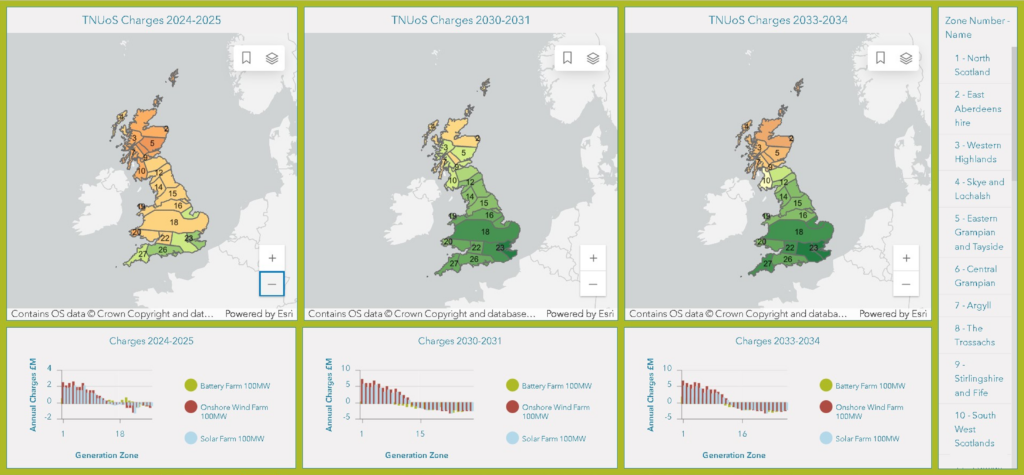
As you can see, a 100 MW wind farm in North Scotland (Zone 1) would face an annual charge of several million pounds, while the same wind farm in Southern England could receive a payment of hundreds of thousands of pounds each year. This difference has a massive impact on the financial viability of a new energy project.
4. How the Wider Tariff is Calculated
So, how is the specific tariff for each zone calculated? It's based on a formula that combines locational factors with an adjustment charge.
Let's look at a simplified breakdown of the calculation.

Let's break down this formula:
- Locational Charges: These are calculated using complex power system models that simulate the effect of adding 1 MW of generation in each zone. There are three main elements:
- Peak Tariff: Reflects the generator's contribution to network stress during peak demand periods.
- Year-Round Shared Tariff: Reflects the cost of using the main, interconnected "motorway" parts of the grid.
- Year-Round Not-Shared Tariff: Reflects the cost of the more local transmission assets used to get power to the main grid.
- Annual Load Factor (ALF): The two "Year-Round" elements are multiplied by the generator's ALF. The ALF is essentially the generator's average output over a year as a percentage of its maximum capacity. This means generators that run more often (higher ALF) will see this portion of their charge scaled up accordingly.
- Adjustment / Residual: This is a non-locational charge (or credit) that is the same for every zone in the country. Its purpose is to ensure that the total amount of money collected from all generators across GB matches the revenue target set by the regulator, Ofgem. Currently, this is a negative value, meaning it acts as a credit that slightly reduces the overall charge for everyone.
To learn more about the details and see how these components fit together, please study the following material.
Generation TNUoS: How does it work? - Research
This article from Modo Energy provides a clear explanation of how the Wider Tariff is structured. The guide we looked at earlier from NESO provides the official breakdown of the components.
Please read the sections titled 'The wider tariff depends on generation type, Annual Load Factor, and generation zone' and 'Regions further away from demand pay higher locational charges'.
Now let's go back to the official NESO guide to see the formal definitions of the components we've just discussed.
Please read the section '3 What are wider tariffs?'. This will reinforce your understanding of the generation zones and the different components (Peak, Year-Round, Residual) that make up the wider tariff.
Test your understanding!
A developer is planning to build a new 100 MW onshore wind farm. They have two potential sites:
- Site A: In Zone 2 (Northern Scotland), where the indicative TNUoS Wider Tariff is +£22/kW.
- Site B: In Zone 15 (Southern England), where the indicative TNUoS Wider Tariff is -£4/kW (a payment).
Ignoring all other costs, calculate the annual TNUoS bill for each site and the total difference between them. What does this tell you about the signal the grid is sending?
(Note: 100 MW = 100,000 kW)
Show answer
Site A (Scotland):
Annual Charge = 100,000 kW * £22/kW = £2,200,000
Site B (England):
Annual Charge = 100,000 kW * -£4/kW = -£400,000 (a payment of £400,000)
Difference: The total difference in financial outcome for the developer is £2,200,000 - (-£400,000) = £2,600,000 per year.
This tells us that the grid is sending a very strong financial signal that it would be much more efficient for the system if the new generation was built at Site B, closer to demand. The high charge at Site A reflects the significant cost of transmitting that power south, while the payment at Site B reflects the benefit of having local generation to serve local demand.
5. Why Locational Signals Matter: The Broader Context
The problem that TNUoS locational charging tries to solve is a real and expensive one. When there's too much generation in one area and not enough transmission capacity to move the power to where it's needed, the System Operator has to pay generators to reduce their output. These are known as constraint payments.
The following video discusses the problem of grid constraints and a related debate about 'zonal pricing', which is another way to send locational signals. The speaker mentions how TNUoS charges are being used as an alternative to this.
Britain's Energy Market U-Turn | Free the Power
This video from the Institute of Economic Affairs discusses the inefficiencies in the UK energy market, particularly the issue of grid constraints. It provides excellent context for why locational signals like TNUoS are so important.
Please watch the following clips: 2:28 - 4:03: This explains the core problem: generation in the North, demand in the South, and the limits of the network. 4:03 - 5:30: This details the consequence of those limits: 'constraint payments' paid to generators to switch off. 21:52 - 23:20: The speaker explains how the government is trying to use TNUoS charges to replicate the locational signals of a different market design ('zonal pricing'). This directly connects to our topic today.
This discussion highlights that TNUoS is not just a technical charging detail; it's a key policy tool used to make the grid more efficient and to manage the costs associated with the transition to renewable energy, which is often located far from cities.
Conclusion
Today we've seen the other side of the TNUoS coin. While demand-side charges incentivize when electricity is used, generation-side charges provide a clear and powerful incentive for where it is produced.
Key Takeaways:
- Generation-side TNUoS is a charge levied on large generators to pay for the transmission network.
- The charge is heavily influenced by location, via a Wider Tariff that is different for each of the 27 generation zones in Great Britain.
- The methodology results in high charges for generators in areas with excess generation (e.g., North Scotland) and low charges or even payments for generators in areas with high demand (e.g., South England).
- This system creates a strong locational signal, incentivizing developers to build new power plants in 'network-efficient' locations, which helps to reduce grid congestion and lower overall system costs.
In the previous lessons, we've built a solid foundation in AC power, generation technologies, and network charging. We are now ready to move into the next module, where we will start looking at the bigger picture of the UK's energy system.
Preview of the next lesson: Our next lesson will be "Describe the current generation mix in the UK and recent trends towards decarbonization." We'll explore what types of power stations make up the UK's electricity supply today and how that mix is rapidly changing as the country moves towards its net-zero goals.