Hello! Welcome back to Module 11 of your course on UK electrical grids.
In our last lesson, we explored how the UK's electricity industry was "unbundled" from a single state-owned monopoly into four distinct parts: Generation, Transmission, Distribution, and Supply. This created the complex market of different companies we have today.
This lesson focuses on a crucial distinction that arose from that separation. Our learning outcome is to explain the difference between electricity suppliers (retailers) and network operators. Understanding this difference is one of the most practical pieces of knowledge for anyone interested in the energy system, as it clarifies who is responsible for the physical grid versus who is responsible for your energy bill.
1. The Two Sides of the Coin
As a result of the market liberalisation we discussed, getting electricity to your home now involves two very different types of companies:
- Network Operators: The companies that own and operate the physical infrastructure—the poles, wires, cables, and transformers—that transport electricity.
- Electricity Suppliers (or Retailers): The companies that you buy electricity from. They handle your account, send you bills, and provide customer service.
Think of it like online shopping. Amazon is the supplier or retailer—you choose what to buy from them and pay them for it. Royal Mail or DPD is the network operator—they own the vans and infrastructure to physically deliver the package to your door. You choose your retailer, but you don't choose your delivery service; that's determined by geography and the retailer's contracts. The electricity market works in a very similar way.
Let's break down the roles of each of these players.
2. Network Operators: Managing the Grid
Network operators are responsible for the physical "pipes" of the electricity system. As we saw in the last lesson, these are natural monopolies, meaning you cannot choose your network operator; it's determined by where you live. Their operations and prices are heavily regulated by Ofgem to protect consumers.
There are two types of network operators:
- Transmission Operators (TOs): They manage the high-voltage "motorway" network that transports electricity in bulk across Great Britain.
- Distribution Network Operators (DNOs): They manage the lower-voltage "local road" networks that take electricity from the transmission system and deliver it to individual homes and businesses.
For most people, the DNO is the network operator they might interact with.
To understand their responsibilities, let's hear from a DNO itself.
What's the difference between you and my electricity supplier?
UK Power Networks is the DNO for London, the South East, and East of England. Their website has a clear page explaining what they do and how it differs from a supplier.
Please read the first section, also titled 'What's the difference between you and my electricity supplier?'. Focus on the bullet points that list the specific situations where you would contact them.
As you read, UK Power Networks is responsible for:
- Maintaining and upgrading the physical infrastructure (cables, lines, etc.).
- Responding to power cuts.
- Connecting new properties to the electricity grid.
- Ensuring safety around their equipment, like trimming trees near power lines.
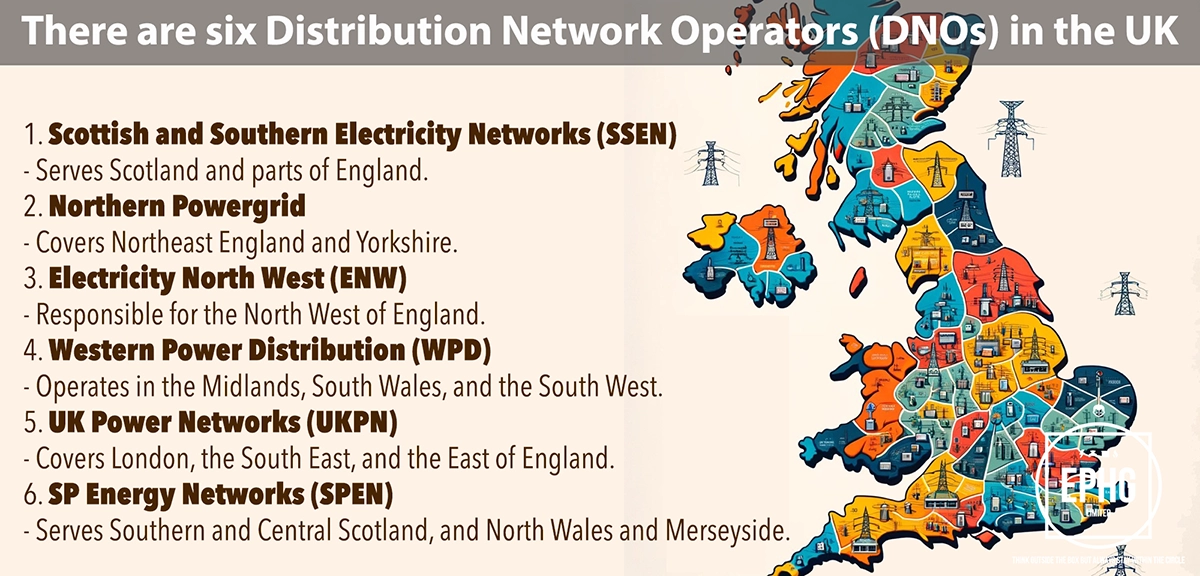
There are 14 distinct distribution network regions in Great Britain, managed by six large DNO groups.
3. Electricity Suppliers: Selling the Energy
While you can't choose your network operator, you can choose your electricity supplier. This is the competitive part of the market, with dozens of companies like British Gas, Octopus Energy, E.ON, and OVO Energy competing for your business.
The supplier's role is purely commercial and customer-facing. They don't own or manage any wires or transformers.
DNOs: Who is my distribution network operator?
Now let's look at this from a supplier's perspective. OVO Energy, a well-known supplier, provides a guide that neatly categorises the different businesses in the power network.
Please read the section 'What is a Distribution Network Operator (DNO)?'. Pay close attention to the list of the four business types, which recaps what we learned in the last lesson and clearly positions 'Suppliers' within that structure.
The core responsibilities of an electricity supplier are:
- Buying electricity from generators on the wholesale market.
- Selling that electricity to consumers.
- Managing customer accounts, including setting up new customers and handling billing.
- Providing customer service for queries about tariffs, payments, and account details.
Crucially, your supplier pays your region's DNO a fee to use its network to deliver the electricity to you. This "delivery charge" is bundled into the final price you pay on your electricity bill. The UK Power Networks page you read earlier mentions this: "Part of what you pay is given to UK Power Networks for running and maintaining the electricity cables in your area."
4. A Clear Distinction
The difference between these two roles is fundamental. Let's watch a short video that uses the "courier" analogy to make this distinction perfectly clear.
Distribution Network Operators: what are DNOs (and DSOs)?
This video from Modo Energy provides a concise explanation of a DNO's role and explicitly contrasts it with that of a supplier.
Please watch from 00:36 to 01:34. Listen for the analogy used to describe the DNO's function.
To summarise, here is a direct comparison:
| Feature | Network Operator (e.g., UK Power Networks) | Electricity Supplier (e.g., OVO Energy) |
|---|---|---|
| Main Role | Manages physical grid (wires, poles, cables) | Sells electricity to customers |
| Market Type | Regulated Monopoly (you can't choose) | Competitive (you can choose and switch) |
| Who you contact | Power cuts, safety issues, new connections | Billing queries, changing tariff, moving home |
| Analogy | The courier / delivery service (Royal Mail) | The shop / retailer (Amazon) |
Test your understanding!
For each of the following situations, decide whether you would need to contact your Network Operator or your Electricity Supplier.
- A tree in your garden is growing very close to the overhead power lines.
- You want to switch to a new tariff that offers cheaper electricity at night.
- All the lights in your house have gone out, and your neighbours' lights are also out.
- You think your monthly electricity bill is incorrect.
Show answer
- Network Operator: They are responsible for the safety and maintenance of the power lines.
- Electricity Supplier: They set the tariffs and manage your contract for buying electricity.
- Network Operator: A power cut affecting a whole area is a fault with the physical network. (In the UK, you can call the national freephone number 105 to be put through to your local network operator).
- Electricity Supplier: They handle all billing and account queries.
Conclusion
In this lesson, we have clearly defined the separate and distinct roles of network operators and electricity suppliers. This is a direct consequence of the market liberalisation we studied previously.
Key Takeaways:
- Network Operators (like DNOs) own and manage the physical infrastructure (the "wires") that transports electricity. This is a regulated monopoly based on your location.
- Electricity Suppliers (retailers) are the companies you buy electricity from. They handle billing and customer service in a competitive market.
- You contact your network operator for physical issues like power cuts and safety concerns.
- You contact your supplier for commercial issues like bills, tariffs, and your account.
- Your supplier pays your network operator for using their grid, and this cost is included in your final bill.
Preview of the next lesson:
Now that we understand who suppliers are, the next logical question is: how do they actually buy the electricity they sell to us? In our next lesson, we will begin to answer that by looking at the key trading timeframes in the wholesale market, from long-term forward markets to trading that happens just before the moment of consumption.