Hello! Welcome to the third lesson in Module 11 of your course on UK electrical grids.
In our last lesson, we established the crucial difference between electricity suppliers (who sell you energy) and network operators (who manage the physical grid). We learned that suppliers buy electricity on the wholesale market to sell to their customers.
This lesson dives into that wholesale market. Our learning outcome is to describe the key trading timeframes in the wholesale market, from forward markets to intraday. We'll explore when and why electricity is traded, creating a timeline that stretches from years in the future right up to the hour of delivery.
1. Why Trade Electricity in Advance?
Imagine you're an electricity supplier. You have millions of customers on fixed-price tariffs, and you've promised to supply them with all the electricity they need for the next year at a set price. If you waited until the last minute to buy all that energy, you'd be exposed to wild price swings, which could bankrupt you.
Conversely, imagine you run a large power station. You need to be sure you can sell the electricity you generate to cover your fuel, staff, and maintenance costs.
The wholesale market solves these problems by allowing market participants—like generators and suppliers—to buy and sell electricity for future delivery at a price agreed upon today. This process is often called hedging, as it protects (or 'hedges') both parties against future price volatility.
Let's watch a short video that introduces the wholesale market and this core concept of trading in advance.
Electricity Markets 101 - The Energy Academy (Series Two)
This clip from the Modo Energy video 'Electricity Markets 101' provides a great overview of the wholesale market, explaining who trades and why they trade in advance.
Please watch from 00:15:19 to 00:17:19. Pay attention to the distinction between buying long-term 'baseload' power and then 'adding shape' closer to the time of delivery. This is a key concept we'll be exploring.
As the video explains, trading happens across different timescales. We can think of this as a journey, starting years away from the delivery date and getting progressively closer to real-time. The main stages on this journey are the forward market, the day-ahead market, and the intraday market.
2. The Trading Timeline
Let's walk through these timeframes chronologically.
a) Forward and Futures Markets (Years, Months, or Weeks Ahead)
This is the long-range trading window. Here, participants trade electricity for delivery seasons, months, or even years into the future. This is where suppliers lock in the bulk of the energy they need to cover their long-term customer contracts, and where generators secure a large portion of their future revenue.
These long-term trades can take two main forms:
- Forward Contracts: These are often private, bilateral agreements between two parties (e.g., a generator and a supplier), sometimes called Over-The-Counter (OTC) trades. They can be highly customized.
- Futures Contracts: These are standardized contracts traded on an exchange, much like stocks or commodities. Their standard nature makes them easier to trade.
This next video explains this long-term market and the difference between these two contract types.
Electricity forward and futures markets (The Energy Academy - S3 E4)
This video, also from Modo Energy, focuses specifically on the forward and futures markets.
Please watch from the beginning to 00:04:59. Focus on understanding why these markets exist (to reduce risk) and the key difference between a customizable 'forward' contract and a standardized 'futures' contract.
To summarise, the forward market is for securing large blocks of power, like 'baseload' (a steady amount 24/7), well in advance to hedge against major price risks.
Now let's move closer to the day of delivery. For this, we'll use a single, well-structured article that covers all the remaining market stages.
Trading on the Wholesale Electricity Market | Explained
The article 'Trading on the Wholesale Electricity Market' provides a clear, step-by-step guide to the different trading sub-markets. We will read it section by section.
First, please read the introductory text under the heading 'How electricity is traded'. This sets the scene by listing the distinct sub-markets.
b) The Day-Ahead Market (One Day Ahead)
As we get to the day before delivery (D-1), forecasts for both electricity demand and renewable generation (like wind and solar) become much more accurate. The Day-Ahead market allows participants to refine the positions they took in the forward market.
For example, a supplier might realise they need slightly more power during the evening peak than they initially bought, or a wind farm owner might now have a very good idea of how much they will generate. This market is typically run as a large auction for each half-hour of the following day.
Trading on the Wholesale Electricity Market | Explained
Let's continue with the same article to learn about the day-ahead auction.
Now, read the section titled 'Day-ahead auction'. Focus on what it is (a structured auction for the next day) and its purpose.
c) The Intraday Market (On the Day of Delivery)
Even the best day-ahead forecasts aren't perfect. On the actual day of delivery (D-0), unexpected events happen: a power station might suddenly fail ('trip'), a factory might shut down unexpectedly, or clouds might cover a large solar farm.
The Intraday market is the last chance for participants to balance their books. It's a continuous market that runs right up until about an hour before the delivery time. It allows a generator that has tripped to buy energy to cover its contracted sales, or a supplier facing higher-than-expected demand to buy more power at the last minute.
Trading on the Wholesale Electricity Market | Explained
Finally, let's read about the last stage of trading.
Please read the section 'Intraday market'. Note when it operates and why it's so essential, especially for renewable generators with variable output.
This image provides a simple, clear illustration of how the day-ahead and intraday markets work together.

3. The Complete Trading Journey
These markets form a continuous timeline, allowing market participants to move from long-term, less certain positions to short-term, highly accurate ones.
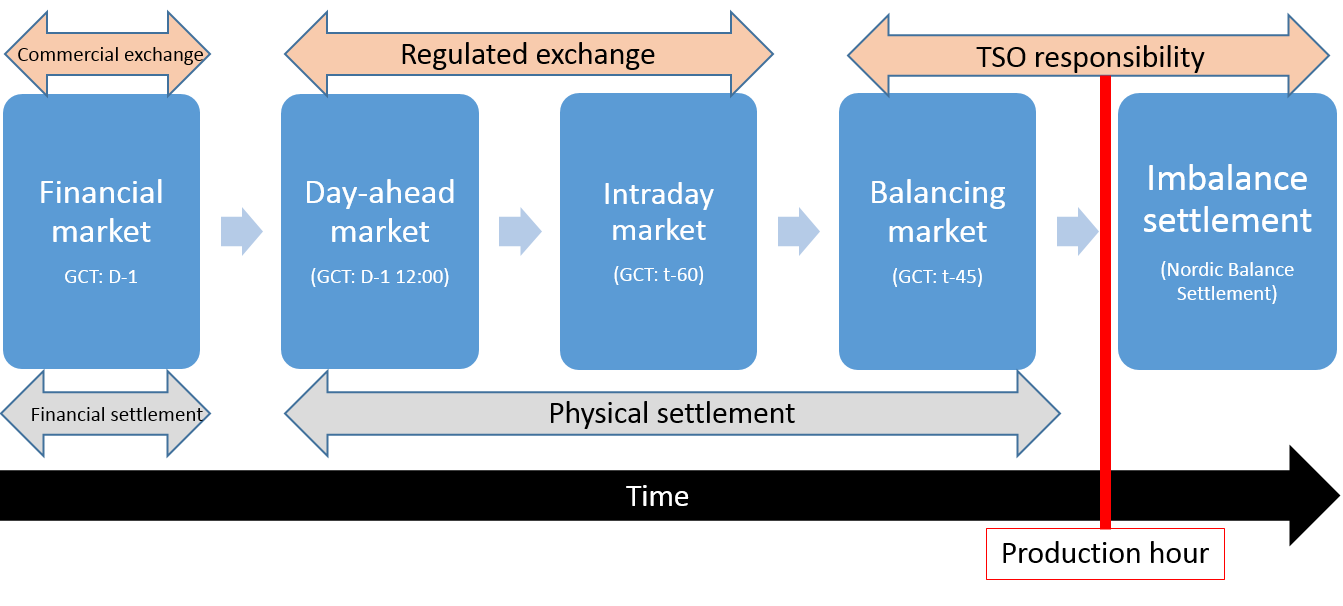
A sophisticated trader, like one managing a battery storage asset, might actively trade between these markets. For instance, they might agree to discharge (sell) power at 6 PM in the day-ahead auction. If the price in the intraday market for 6 PM becomes even higher, they might buy back their day-ahead position and re-sell it at the higher intraday price, a practice known as "churning".
This sequence of markets provides a robust framework for managing the complex task of matching electricity generation with demand every second of every day.
Test your understanding!
For each scenario, identify the primary market timeframe (Forward, Day-Ahead, or Intraday) where the trading activity would take place.
- Octopus Energy needs to secure the electricity to supply its 1-year fixed-rate tariff customers.
- A large wind farm's output for tomorrow is forecast to be much higher than average due to a predicted storm. The owner wants to sell this expected generation.
- At 2 PM on a Tuesday, a gas power plant unexpectedly has to shut down for emergency repairs. The plant's operator still has an obligation to provide power at 3 PM.
- National Grid ESO sees that demand forecasts for tomorrow's evening peak (5-7 PM) have increased due to a sudden cold snap being predicted. Suppliers need to adjust their energy procurement.
Show answer
- Forward Market: To hedge against price risk over a long period (one year), the supplier would buy the bulk of its energy in the forward or futures market.
- Day-Ahead Market: With a reliable weather forecast for the next day, the owner would sell this power in the day-ahead auction.
- Intraday Market: Since the event is unexpected and close to the delivery time, the operator must buy power in the intraday market to cover their commitment.
- Day-Ahead Market: This is a classic use of the day-ahead market—refining positions based on updated, more accurate forecasts for the next day.
Conclusion
In this lesson, we've journeyed through the timeline of the wholesale electricity market. We've seen how trading allows generators and suppliers to manage risk and adapt to new information as the moment of delivery approaches.
Key Takeaways:
- The wholesale electricity market is divided into different timeframes to allow participants to manage risk and refine their energy positions.
- Forward Markets operate years, months, or weeks in advance, allowing participants to "hedge" and lock in prices for the bulk of their energy needs.
- The Day-Ahead Market allows for more accurate positions to be taken the day before delivery, based on updated weather and demand forecasts.
- The Intraday Market is for last-minute adjustments on the day of delivery, dealing with unexpected events and forecast errors right up to the hour of consumption.
Preview of the next lesson:
We've now had an overview of the different trading windows. In the next lesson, we will zoom in on the most significant of these for daily price setting: the day-ahead market. We will explore exactly how the auction process works, how bids and offers are submitted, and how the final market price is determined for every half-hour of the day.