Hello! Welcome to the fourth lesson in Module 11 of your course on UK electrical grids.
In our last lesson, we charted the timeline of the wholesale electricity market, distinguishing between the long-term forward market, the day-ahead market, and the short-term intraday market. We identified the day-ahead market as the key stage where most electricity for the following day is traded and where the benchmark price is set.
Today, we're going to dive deep into that process. Our learning outcome is to explain the process of the day-ahead market, including bid/offer submission and price formation. We will break down how this daily auction works, what it means for generators and suppliers to "bid" and "offer", and see how a single price is calculated for every half-hour of the day.
1. The Day-Ahead Market: A Quick Refresher
As we learned previously, the day-ahead market is where market participants—primarily generators and suppliers—trade electricity for delivery on the following day. It's the main opportunity for them to refine their energy positions based on much more accurate forecasts. For example, a supplier has a better idea of customer demand, and a wind farm operator has a reliable weather forecast.
Let's start with a short video that recaps the role of the day-ahead market and introduces the platforms where this trading happens.
Day-ahead and intraday electricity trading (The Energy Academy - S3 E7)
This clip from Modo Energy's 'The Energy Academy' series provides a concise overview of the day-ahead market's function and names the main trading platforms, or 'power exchanges', used in Great Britain.
Please watch from 00:28 to 02:56. Pay attention to the role of power exchanges (like Nord Pool and EPEX SPOT) and the basic interaction: suppliers offer to buy, and generators produce to meet that need.
As the video explains, this trading happens on dedicated platforms called power exchanges. In Great Britain, the main ones are N2EX (part of Nord Pool) and EPEX SPOT. Think of them as specialised stock exchanges, but for electricity.
2. The Auction: Submitting Bids and Offers
The day-ahead market isn't a continuous frenzy of trading. Instead, it operates as a structured auction. In fact, it's a series of auctions—one for each half-hour trading period of the following day. So, 48 auctions take place every single day.
Participants submit their intentions to buy or sell power for each of these half-hour slots. These submissions are called bids and offers.
- Bids (to Buy): A bid is submitted by a buyer, like an electricity supplier. It specifies the volume of electricity they want to buy (in Megawatt-hours, MWh) and the maximum price they are willing to pay (£/MWh). For example, "I want to buy 50 MWh for the 6:00 PM slot, and I will pay up to £80/MWh."
- Offers (to Sell): An offer is submitted by a seller, like a power generator. It specifies the volume they want to sell and the minimum price they are willing to accept. For example, "I can sell 100 MWh for the 6:00 PM slot, but I need at least £60/MWh to cover my costs."
All participants must submit their bids and offers before a specific deadline, known as gate closure. In the UK, this is typically around 11:00 AM for the N2EX auction. Once the gate closes, no more submissions are accepted, and the exchange begins the process of setting the price.
This article provides a clear summary of this process.
Trading on the Wholesale Electricity Market | Explained
The article 'Trading on the Wholesale Electricity Market | Explained' describes the auction mechanism. We'll focus on its explanation of how the day-ahead auction works.
Please read the section titled 'Day-ahead auction'. Focus on understanding the submission process and the goal: to set a single price for each 30-minute period.
3. Price Formation: The Merit Order and Market Clearing
This is the most important part: how does the exchange use thousands of bids and offers to calculate a single price? The process involves two key concepts: the Merit Order and Market Clearing.
Step 1: Stacking the Offers (The Supply Curve & Merit Order)
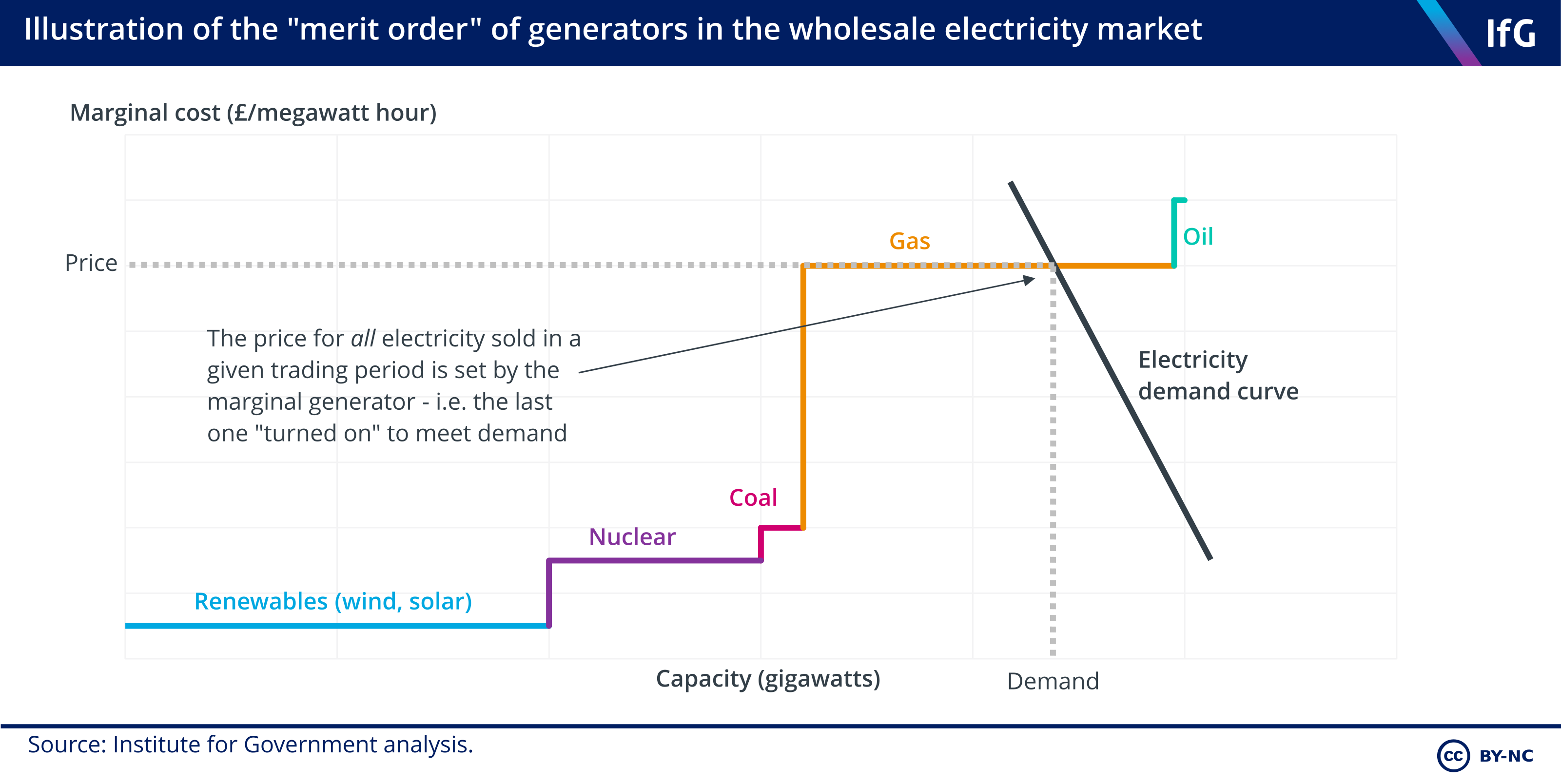
After gate closure, the exchange takes all the offers to sell for a specific half-hour and stacks them up in order from the cheapest to the most expensive. This stack is called the supply curve.
The order of this stack is known as the merit order. Generators with very low running costs offer their power at very low (sometimes zero or even negative) prices to ensure they get to run. These are typically renewables like wind and solar, whose "fuel" (the wind and sun) is free. They are followed by nuclear power stations (low running costs), and then by progressively more expensive thermal plants, like gas and coal, which have significant fuel costs.
Step 2: Stacking the Bids (The Demand Curve)
Simultaneously, the exchange takes all the bids to buy and stacks them from the most expensive (the highest price a buyer is willing to pay) down to the cheapest. This creates the demand curve.
Step 3: Finding the Market Clearing Point
The exchange now has a supply curve (offers) and a demand curve (bids). The price is set at the point where these two curves intersect. This is the Market Clearing Point.
- The price at this intersection is the Clearing Price.
- The volume at this intersection is the Clearing Volume.
This process is a pay-as-clear auction. This means that every successful seller gets paid the clearing price, and every successful buyer pays the clearing price, regardless of what price they originally offered or bid.
The graph below, from the article you just read, visualises this perfectly.

This pay-as-clear system encourages participants to bid and offer their true costs and values. A generator offers at their minimum running cost, knowing they'll get the (usually higher) market price if they are successful.
Test your understanding!
Imagine it's the auction for the 7:00 PM - 7:30 PM slot. The power exchange has received the following simplified offers (to sell) and bids (to buy).
| Offers to Sell (Supply) | Bids to Buy (Demand) | |
|---|---|---|
| Generator | Offer Price & Volume | Supplier |
| Wind Farm A | £0 / MWh for 100 MW | Supplier X |
| Nuclear Plant B | £10 / MWh for 150 MW | Supplier Y |
| Gas Plant C | £75 / MWh for 100 MW | Supplier Z |
| Gas Plant D | £90 / MWh for 50 MW |
- What is the total available supply at or below a price of £75/MWh?
- What is the total demand at or above a price of £75/MWh?
- Based on these bids and offers, what will the Market Clearing Price be?
- Which generators will be successful and get to run?
Show answer
- Total Supply at or below £75/MWh: Wind Farm A (100 MW) + Nuclear Plant B (150 MW) + Gas Plant C (100 MW) = 350 MW.
- Total Demand at or above £75/MWh: Supplier X (50 MW) + Supplier Y (150 MW) = 200 MW. The demand from Supplier Z is not included as their bid (£70) is below £75.
- Market Clearing Price: Let's find the intersection.
- At £70/MWh, supply is 250 MW (Wind A + Nuclear B) and demand is 300 MW (X+Y+Z). Demand > Supply.
- At £75/MWh, supply is 350 MW (Wind A + Nuclear B + Gas C) and demand is 200 MW (X+Y). Supply > Demand.
The price is set by the last generator needed to meet demand. The first 250 MW of supply (Wind A + Nuclear B) are cheaper than £75. To meet the full 300 MW of demand, we need 50 MW from the next cheapest generator, Gas Plant C, which offered at £75/MWh. Therefore, Gas Plant C is the 'marginal' generator, and the clearing price is £75/MWh.
- Successful Generators: Wind Farm A, Nuclear Plant B, and Gas Plant C will all get to run. They will ALL be paid £75/MWh. Gas Plant D's offer (£90) was too high, so it will not run.
Conclusion
In this lesson, we have unpacked the mechanics of the day-ahead wholesale electricity market. We've seen that it's not a place of chaotic trading, but a highly structured set of 48 daily auctions that are fundamental to how our electricity is priced and scheduled.
Key Takeaways:
- The day-ahead market is a series of pay-as-clear auctions, one for each half-hour of the next day, run by power exchanges like N2EX and EPEX SPOT.
- Generators submit offers (the minimum price to sell), while suppliers submit bids (the maximum price to buy).
- Offers are stacked from cheapest to most expensive, creating a supply curve based on the merit order of generation types (renewables first, then nuclear, then gas, etc.).
- The clearing price is found where the supply curve intersects the demand curve. This single price is paid to all successful sellers and by all successful buyers for that half-hour period.
Preview of the next lesson:
The day-ahead market produces a detailed plan for who will generate and who will consume electricity for every half-hour of the next day. But what happens when reality doesn't match the plan? What if a power station trips offline or demand is unexpectedly high? In our next lesson, we will explore the Balancing Mechanism, the real-time tool used by the National Grid ESO to handle these deviations and keep the lights on.