Hello! Welcome to the fifth lesson in Module 11 of your course on UK electrical grids.
In our last lesson, we focused on the day-ahead market, learning how it operates as a large-scale auction to set the price and schedule for most of the electricity needed for the following day. This creates a detailed plan for matching generation with demand.
However, plans made a day in advance rarely match reality perfectly. Forecasts can change, power plants can unexpectedly fail, and demand can shift. So, what happens in the hours and minutes leading up to real-time delivery? This is where the intraday market comes in.
Today's lesson will focus on this crucial market stage. Our learning outcome is to explain the purpose and operation of the intraday markets for refining positions closer to real-time. We will explore why this market is so important, especially in a system with lots of renewable energy, and see how it operates very differently from the day-ahead auction.
1. The Purpose: Refining Positions Closer to Real-Time
After the day-ahead market closes, generators and suppliers have a "contracted position"—a plan for how much electricity they will produce or consume for each half-hour of the next day. But many things can happen between the time that plan is made and the moment the electricity is needed.
- A wind farm operator gets an updated weather forecast showing stronger winds than anticipated, meaning they will generate more power.
- A supplier sees data showing that a large industrial customer has shut down a production line, meaning their demand will be lower than expected.
- A gas power station develops a technical fault and has to shut down, meaning it cannot generate the power it sold.
In all these scenarios, the participant's actual output or demand will not match their contracted position. This creates an imbalance. The intraday market is the platform where they can correct this imbalance by trading electricity closer to the time of delivery.
The following resource provides a concise explanation of this role.
Breaking down the UK power market
The article 'Breaking down the UK power market' by SQE Energy clearly explains why the intraday market exists and why its importance has grown.
Please read the short section titled 'Intraday Markets'. Focus on its role in managing energy balance and why the growth of renewables has made it more important.
As the article highlights, the intraday market allows participants to "continuously manage" their energy balance by acting on new information. This is particularly vital for intermittent renewables like wind and solar, whose output is harder to predict a full day in advance.
This image provides a simple illustration of how a generator might use the intraday market.

2. How it Operates: Continuous Trading and the Order Book
The most significant difference between the day-ahead and intraday markets is how they operate. The day-ahead market is a "pay-as-clear" auction that runs once a day to set a single price for each half-hour.
The intraday market, however, is a continuous trading platform, much like a stock market. Instead of one big auction, it's a constant flow of individual trades.
To understand how this works, let's explore the core mechanism: the order book.
Trading in the continuous intraday market: how does it work?
This article from Modo Energy, 'Trading in the continuous intraday market: how does it work?', gives an excellent breakdown of the trading mechanism.
Read the first two sections, 'The continuous market follows an order book format' and 'Prices in this market fluctuate throughout the day'. Pay close attention to how a trade is 'cleared' as soon as a buy and sell order match.
As the article explains, the process is as follows:
- Participants submit buy orders (bids) and sell orders (offers) to the exchange at any time. Each order states a price and a volume.
- These orders accumulate in an order book, which is visible to all participants.
- A trade happens the instant a new buy order is placed at a price that is equal to or higher than an existing sell order, or vice-versa.
- The trade is executed at the price of the existing order on the book.
- Unlike the day-ahead auction, each trade is priced individually. This means that within the same half-hour delivery period, electricity can be traded at many different prices.
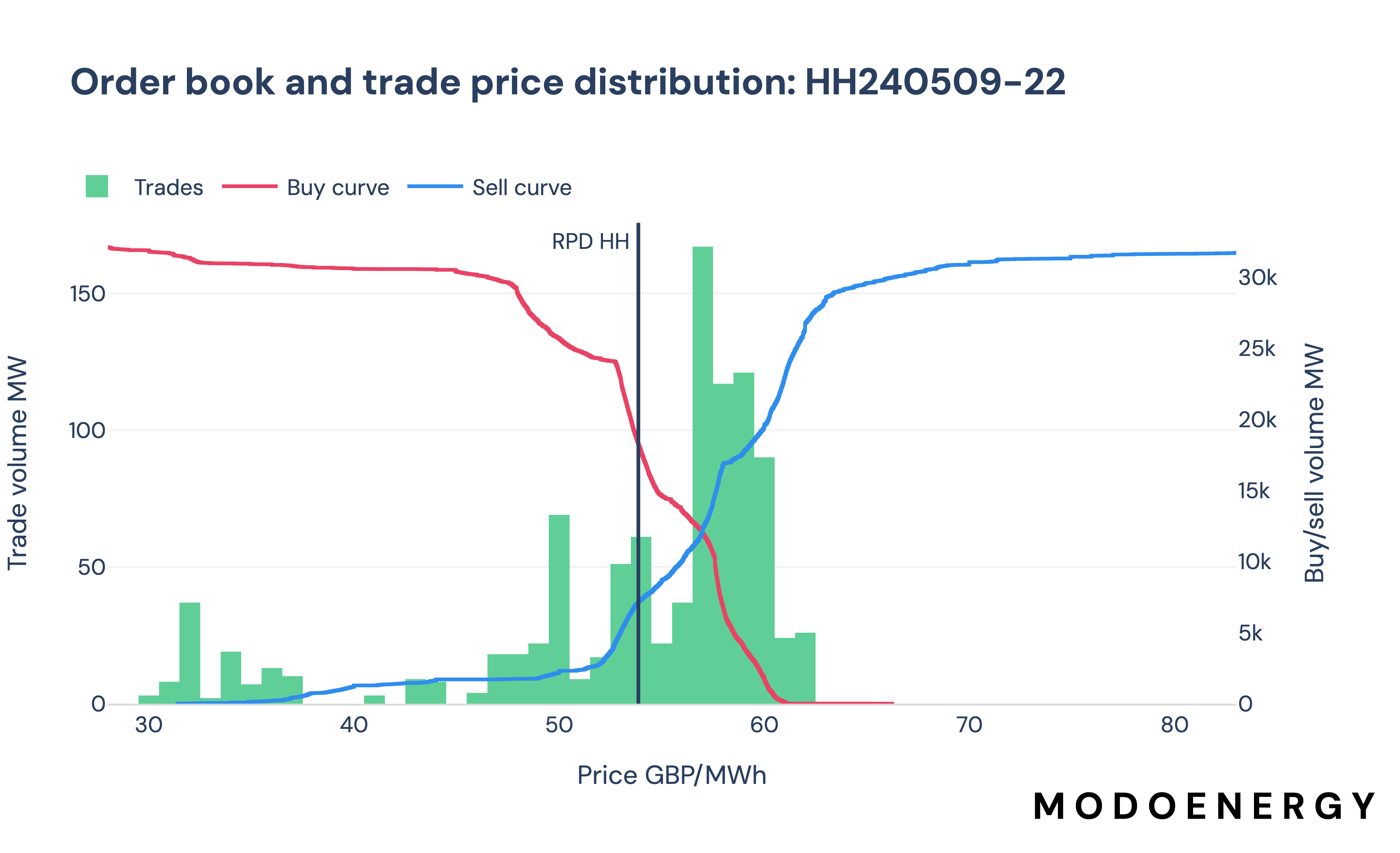
The image below shows a real example of an order book, illustrating the buy and sell orders waiting to be matched, and the trades that have already been executed at various prices.
Test your understanding!
Imagine you are an electricity supplier. Your latest forecast shows you will need 10 MWh more power for the 5:00 PM slot than you bought in the day-ahead market. You look at the intraday market order book and see the following sell orders:
- Seller 1: 5 MWh at £95/MWh
- Seller 2: 8 MWh at £98/MWh
- Seller 3: 15 MWh at £102/MWh
You need to buy 10 MWh immediately. You place a buy order for 10 MWh at a price of £100/MWh.
- Which seller(s) will you trade with?
- What will be the final price(s) you pay for the electricity?
- How is this different from what would happen in a day-ahead auction?
Show answer
- Your buy order for £100/MWh is high enough to match with the two cheapest sellers. You will trade with Seller 1 and Seller 2. You'll take all 5 MWh from Seller 1 and the first 5 MWh of the 8 MWh offered by Seller 2.
- You will pay two different prices. You will pay £95/MWh for the first 5 MWh (the price set by Seller 1) and £98/MWh for the next 5 MWh (the price set by Seller 2). Each trade is priced individually.
- In the day-ahead "pay-as-clear" auction, all successful buyers pay the single market clearing price, regardless of their original bid. In the continuous intraday market, you pay the price of the specific offers you match with.
3. The Motivation: Avoiding Imbalance Prices
Why is it so important for participants to balance their position in the intraday market? The alternative is to be "out of balance" and be exposed to the prices set in the Balancing Mechanism (BM).
The BM is the final tool the National Grid Electricity System Operator (ESO) uses to balance the grid in real-time. If you generate less than you sold, or consume more than you bought, you have to buy the shortfall from the system at a price called the "system price". If you generate more than you sold, you sell the surplus to the system. These prices can be very volatile and often punitive.
Therefore, the intraday market is the last chance for participants to sort out their own imbalances before the ESO steps in.
Trading in the continuous intraday market: how does it work?
Let's return to the Modo Energy article to understand how the risk of high imbalance prices drives trading activity.
Read the section 'Speculation on the system price drives intraday price development'. This section explains how traders watch the Balancing Mechanism and trade in the intraday market to avoid exposure to high system prices.
As the article shows, traders constantly speculate on what the final system price will be. If it looks like the system will be 'short' of power (demand > supply) and the ESO will have to pay a high price to a generator in the Balancing Mechanism, anyone who is also short will rush to buy power in the intraday market. This drives up intraday prices, but it is often still cheaper than paying the final system price.
In this way, the intraday market acts as a crucial buffer, allowing the market to self-correct and reducing the amount of work the System Operator has to do to keep the lights on.
Conclusion
In this lesson, we've explored the fast-paced world of intraday electricity trading. We've seen that it's the vital link between the day-ahead plan and the real-time reality of grid operation.
Key Takeaways:
- The purpose of the intraday market is to allow generators and suppliers to refine their energy positions closer to real-time, correcting for forecast errors or unexpected events.
- This is especially important for managing the intermittency of renewable generation.
- The intraday market operates via continuous trading on an order book, similar to a stock exchange, not a single daily auction.
- Trades are cleared instantly whenever a buy and sell order match, and each trade is priced individually.
- A key driver of activity is the desire to avoid being exposed to potentially punitive imbalance prices set in the Balancing Mechanism.
Preview of the next lesson:
We've now seen how market participants try to balance their own books right up to the last minute. But what happens when the system as a whole is still out of balance? In our next lesson, we will finally dive into the Balancing Mechanism, exploring how the National Grid ESO takes control in the final moments to instruct generators to increase or decrease their output to keep the grid stable and the frequency at a steady 50Hz.