Hello! Welcome to Module 11 of your course on UK electrical grids.
In our last lesson, we completed our look at network charges by examining Distribution Use of System (DUoS) charges, which pay for the local electricity networks. We saw how these networks are operated by regional Distribution Network Operators (DNOs). This raises a bigger question: why are the electricity grids split up into so many different companies?
Today's lesson addresses that question directly. We will explore the learning outcome: Describe the liberalization of the UK electricity market and the separation of generation, transmission, distribution, and supply. We'll travel back in time to the 1980s to understand the old, state-owned system and then trace the massive changes that created the market structure we have today. This will lay the foundation for understanding how electricity is bought and sold, which we'll cover in the rest of this module.
1. The "Before" Picture: A Nationalised Monopoly
Before the 1990s, the electricity system in England and Wales was structured very differently. It was a vertically integrated, state-owned monopoly. This means one single, government-owned organisation was responsible for almost everything.
This organisation was the Central Electricity Generating Board (CEGB).
- It owned and operated nearly all the power stations (generation).
- It owned and operated the high-voltage national grid (transmission).
The final step of getting power to homes and businesses was handled by 12 regional Area Electricity Boards. They managed the local distribution networks and also acted as the supplier, sending out bills to customers in their region.
In this system, there was no competition. You couldn't choose your electricity provider; you simply bought power from your regional board at a price set by the government.
To get a feel for this historical context, let's watch a short video from Modo Energy.
Electricity Markets 101 - The Energy Academy (Series Two)
This clip from the video 'Electricity Markets 101' explains the pre-privatisation era and contrasts it with the system that came after.
Please watch the segment from 10:22 to 13:06. Focus on the description of the CEGB and the key differences between the pre-privatisation and post-privatisation markets, such as the introduction of competition and consumer choice.
2. The "Why": The Drive for Privatisation
This entire structure was dismantled in the late 1980s and early 1990s under the government of Prime Minister Margaret Thatcher. This process of selling state-owned assets to private companies is known as privatisation or liberalization.
There were three main motivations behind this policy:
- Budgetary: Selling large state assets like the electricity industry generated significant income for the government, which could be used to fund other policies, such as tax cuts.
- Efficiency and Competition: The core belief was that state monopolies were inefficient. The government argued that introducing competition would force private companies to be more efficient and innovative, ultimately leading to lower prices for consumers.
- Ideological: Privatisation was a key part of a political ideology focused on reducing the size and influence of the state in the economy and promoting free-market principles.
The following video explains these motivations and provides more detail on the pre-privatisation structure.
Energy Privatisation is Bankrupting Britain
The video 'Energy Privatisation is Bankrupting Britain' by Tom Nicholas gives a detailed account of the history and motivations behind these changes.
Please watch two segments. First, from 07:52 to 09:47, which covers the three main motivations for privatisation. Then, watch from 18:18 to 19:45, which describes the simple, pre-privatisation structure under the CEGB.
3. The "How": Unbundling the Electricity Industry
The process of liberalizing the electricity market wasn't just about selling the CEGB as a single entity. The goal was to break it up—or unbundle it—to create separate markets where competition could exist.
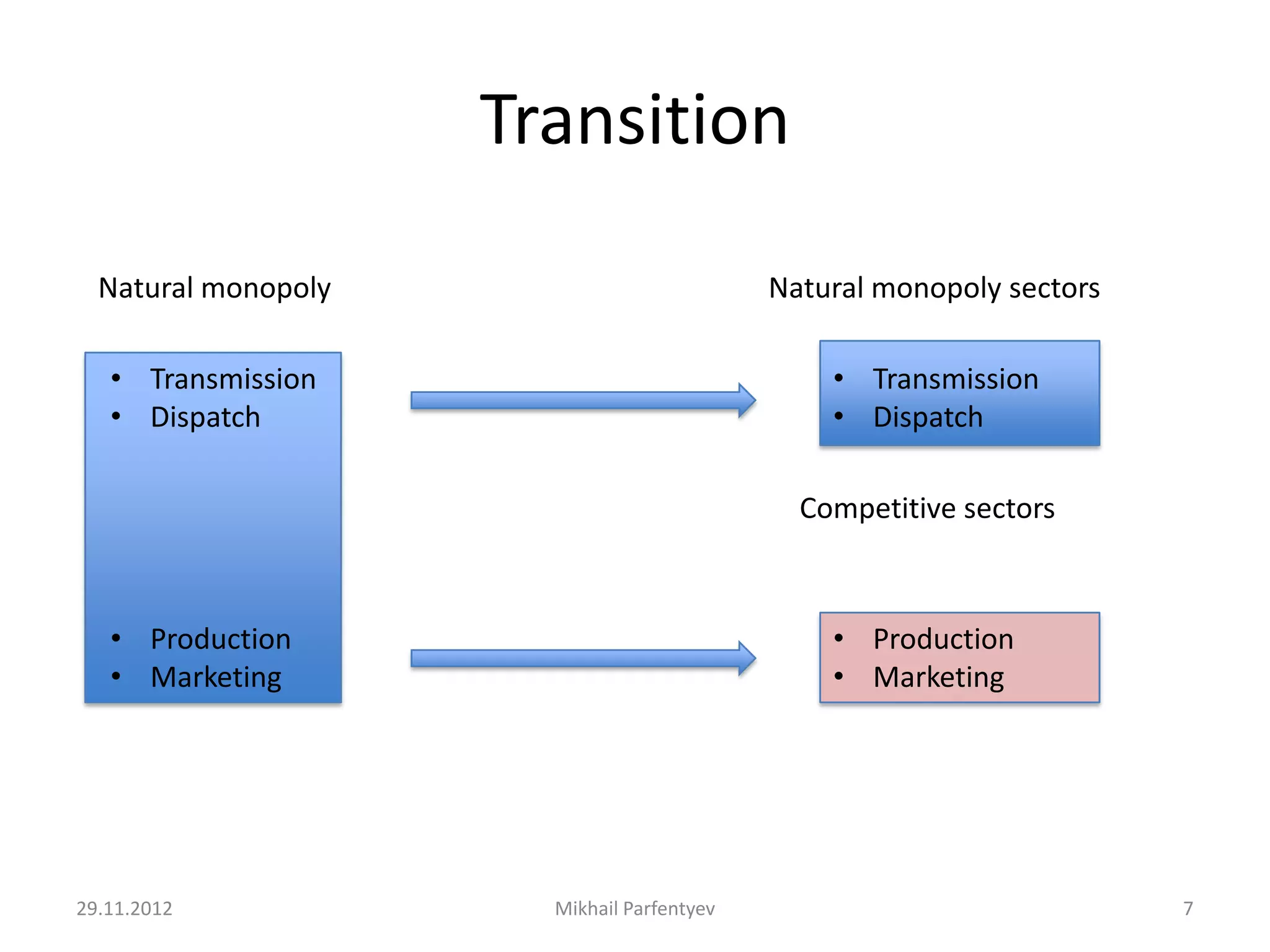
The key idea was to separate the parts of the industry that could be competitive from those that are natural monopolies.
- Competitive Sectors: It's possible for many companies to compete to generate and sell electricity.
- Natural Monopolies: It doesn't make sense to build multiple competing sets of transmission towers or distribution cables to every street. Therefore, these network parts of the industry remain as single, regulated monopolies for a given area.
The diagram below shows this conceptual split.
The Electricity Act of 1989 was the legislation that made this happen. The CEGB was broken up as follows:
- Generation: Its power stations were divided among three new companies: National Power, PowerGen, and the state-owned Nuclear Electric. This created instant competition in the generation market.
- Transmission: The high-voltage grid was transferred to a new private company, the National Grid Company (NGC).
- Distribution and Supply: The 12 regional Area Boards were privatised into separate companies, which were initially responsible for both distributing electricity and supplying it to customers in their region.
This video segment describes the breakup in detail.
Energy Privatisation is Bankrupting Britain
Let's return to the Tom Nicholas video to see exactly how the CEGB was split apart.
Watch the section from 20:33 to 21:56. This clip details the creation of the new generation companies, the National Grid Company, and the privatisation of the area boards.
The image below gives a snapshot of the new structure, showing how the single CEGB was replaced by a range of different companies.

4. The "After" Picture: Four Distinct Roles
Following privatisation, the industry was permanently separated into four distinct parts. Understanding this separation is fundamental to understanding the modern UK electricity system.
Introduction to the domestic energy market
A briefing paper from the House of Commons Library provides clear, official definitions for these four parts of the energy market. Let's read through them.
Please read the section '1. How is the energy market structured?' on page 13. It gives a concise definition of the four key parts of the system.
Let's summarise those four roles:
- Generation: This involves producing electricity. This is now a fully competitive market with dozens of companies operating power plants of all types, from gas and nuclear to wind and solar.
- Transmission: This is the high-voltage "motorway" that moves electricity in bulk across the country. It is a natural monopoly. In Great Britain, the physical assets are owned by three Transmission Owners (TOs), and the system is managed in real-time by the National Grid Electricity System Operator (ESO).
- Distribution: This is the lower-voltage "local road network" that takes power from the transmission system and delivers it to end-users. This is handled by the 14 regional Distribution Network Operators (DNOs) we encountered in the previous lesson. Each DNO is a natural monopoly in its geographic area.
- Supply (or Retail): This is the customer-facing part of the industry. Suppliers buy electricity on the wholesale market from generators and sell it to homes and businesses. They handle billing and customer service. This is a competitive market, and it's the part of the industry where you can "switch supplier" to find a better deal.
Test your understanding!
Imagine a new offshore wind farm has been built. Match each of the following activities to the correct part of the liberalised electricity market (Generation, Transmission, Distribution, or Supply).
- The wind turbines spin to create electricity.
- The electricity travels from the wind farm via a high-voltage undersea cable to a substation on the mainland.
- A company sends a monthly bill to a homeowner for the electricity they've used.
- The electricity is transported from a major substation along overhead lines and underground cables to a local town.
Show answer
- Generation: The creation of electricity.
- Transmission: Moving electricity in bulk at high voltage over long distances.
- Supply: The retail function of billing and customer service.
- Distribution: Delivering electricity on the local, lower-voltage network.
Conclusion
In this lesson, we've seen how the UK electricity industry underwent a radical transformation, moving from a single, state-owned monopoly to a liberalised and unbundled market.
Key Takeaways:
- Before the 1990s, the Central Electricity Generating Board (CEGB), a state-owned body, controlled most electricity generation and transmission.
- The government privatised the industry to introduce competition, aiming for greater efficiency and lower prices.
- The industry was unbundled into four separate functions:
- Generation: Producing power (now competitive).
- Transmission: High-voltage national grid (a regulated monopoly).
- Distribution: Low-voltage regional grids (a regulated monopoly).
- Supply: Selling electricity to customers (now competitive).
- This separation created the complex landscape of different companies—generators, network operators, and suppliers—that make up today's market.
Preview of the next lesson:
This separation of roles is crucial. In our next lesson, we will focus on a key distinction that resulted from this unbundling: "Explain the difference between electricity suppliers (retailers) and network operators." This will help clarify who is responsible for what in the modern UK electricity system.