Hello! Welcome to the first lesson in Module 12 of your course on the UK electrical grid.
In our previous module, we explored the design of the UK's electricity markets. We finished by looking at the Capacity Market, a long-term mechanism that acts as an insurance policy to guarantee we have enough generation capacity available years in advance.
Today, we shift our focus from the long-term horizon to the hours and minutes just before electricity is delivered. While long-term contracts provide security, the actual buying and selling to meet real-time demand happens in fast-paced, short-term wholesale markets.
This lesson will address the learning outcome: Describe the role and operation of wholesale electricity trading platforms (e.g., N2EX, EPEX SPOT). We will uncover the "marketplaces" where electricity is traded for delivery on the same day or the next, connecting the generators who produce power with the suppliers who need it.
1. From Long-Term Plans to Short-Term Reality
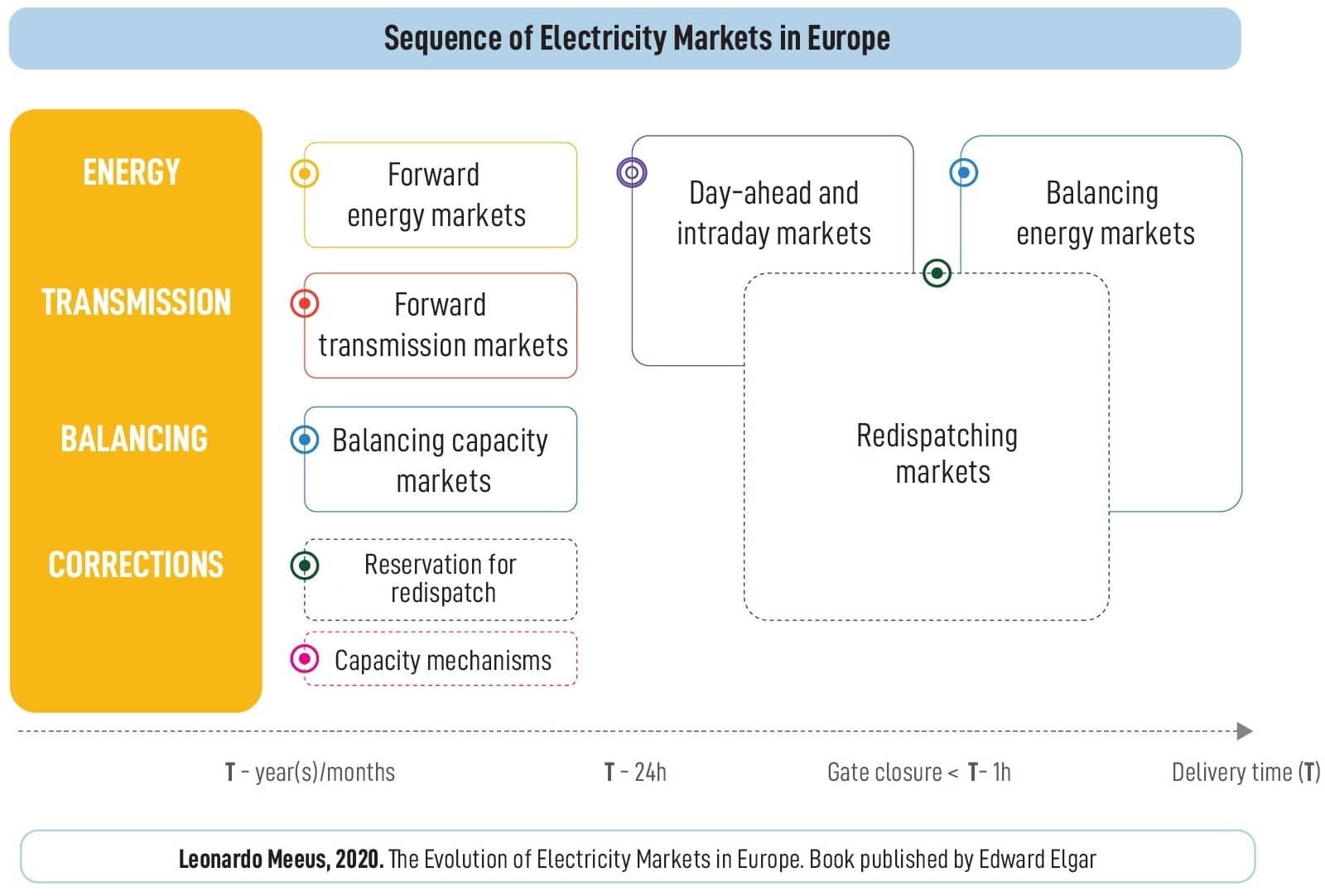
As we've seen, electricity suppliers try to predict their customers' demand months or even years in advance, buying large, simple blocks of power in what are called forward markets. However, these are just forecasts. What happens when, a day before delivery, the weather forecast changes, a power plant has an unexpected outage, or a factory plans to shut down its production line?
The actual demand and supply can differ significantly from the long-term plan. This is why a series of short-term markets exist, allowing participants to fine-tune their positions as they get closer to the moment of delivery. These are collectively known as the spot market.
To get a feel for how these spot markets work from a supplier's perspective, let's watch a short video.
Day-ahead and intraday electricity trading (The Energy Academy - S3 E7)
This video from Modo Energy introduces the concept of the spot market, explaining why suppliers use day-ahead and intraday trading to 'add shape' to their electricity procurement based on updated forecasts.
Please watch from the beginning until 01:53. Focus on understanding the difference between day-ahead and intraday trading and the concept of 'adding shape'.
As the video highlighted, these short-term trades don't just happen randomly. They take place on highly organized electronic platforms known as power exchanges.
2. The Power Exchanges: Where GB Trades Electricity
In Great Britain, the main wholesale trading platforms are run by two key organisations:
- Nord Pool: A European power exchange that operates the GB market under the name N2EX.
- EPEX SPOT: Another major European power exchange that also runs trading markets in GB.
Think of these as the stock exchanges for electricity. They are not physical trading floors, but sophisticated electronic platforms where registered members (generators, suppliers, and traders) can post anonymous orders to buy or sell electricity for specific time slots. Their primary role is to provide a transparent and liquid marketplace, meaning it's easy to find a buyer or seller at a fair, market-driven price.
These exchanges run several distinct markets, each with different timings and rules. Let's explore the most important ones.
3. The Auction Markets: Setting the Price
The most significant trading happens in a series of auctions. The key principle behind most of these auctions is "pay-as-clear".
In a pay-as-clear auction, all the bids to buy and offers to sell are collected. The exchange then calculates a single price—the clearing price—at which supply equals demand. Every successful participant, whether buying or selling, gets this same price.

The exchanges run auctions at different times leading up to delivery.
A Deeper Dive Into Wholesale Energy Markets in GB
This article from Gridcog provides a detailed breakdown of the different wholesale markets. The appendix is particularly useful for understanding the specifics of each auction.
Please read the following descriptions in the 'Appendix' section: 'Day Ahead Hourly Auction', 'Day Ahead Half-Hourly Auction', and 'Intraday 1 and Intraday 2 Auctions'. Focus on the 'When' and 'Granularity' for each to understand their timing and purpose.
Based on that reading, here is a summary of the main auction sequence:
-
Day-Ahead Auctions: These are the largest and most important auctions, held the day before the electricity is delivered.
- Hourly Auction (N2EX & EPEX): This is the main event. It determines the price for each of the 24 hours of the following day. Because of its high volume (liquidity), its prices are often used as the main reference for the GB wholesale market.
- Half-Hourly Auction (EPEX): This happens a few hours after the hourly auction and allows participants to trade in more granular 30-minute blocks, using more up-to-date forecasts that have become available.
-
Intraday Auctions (EPEX): These are smaller "top-up" auctions that run even closer to the delivery time (e.g., one on the evening before delivery and another on the morning of delivery). They allow for further adjustments but have much lower trading volumes.
Test your understanding!
A wind farm operator reviews the forecast at 4 PM on Tuesday. The wind is now expected to be much stronger on Wednesday morning than was predicted on Monday. The operator now expects to generate significantly more electricity than they have pre-sold.
Which auction market have they already missed for Wednesday's trading, and which auction could they still participate in?
Show answer
They have missed the main Day-Ahead auctions (both hourly and half-hourly) for Wednesday, as these would have run on Tuesday morning. However, they could still participate in the EPEX Intraday 1 Auction (IDA1), which runs on Tuesday evening, to sell their expected extra generation.
4. The Continuous Intraday Market: Last-Minute Trading
What if you need to make an adjustment between the auctions, or even minutes before delivery? For this, the exchanges run a Continuous Intraday Market.
Unlike the auctions, this market operates more like a traditional stock exchange.
- It runs 24/7 right up until about 15-60 minutes before the delivery time (this deadline is known as "gate closure").
- It uses a "pay-as-bid" or continuous order book system. Participants can see an anonymous list of bids and offers.
- A trade happens instantly whenever a buyer's bid matches a seller's offer price. The trade is executed at that price, not a single clearing price for everyone.
This market is crucial for managing last-minute changes, such as a sudden power plant trip or a rapid change in wind speed. It is where flexible assets, like battery storage, are particularly active, as they can react very quickly to price fluctuations.
Wholesale trading: what are the different markets and how ...
This article from Modo Energy provides a clear explanation of how the continuous market differs from the auctions.
Read the sections 'The Continuous Intraday Market' and 'Why trade across these markets?'. Focus on how the pay-as-bid mechanism works and the reasons participants use this market for fine-tuning.
The existence of these different markets creates a clear timeline for trading, allowing participants to balance two competing factors:
- Minimising Risk: Trading far in advance in the forward and day-ahead markets locks in a price and provides certainty.
- Maximising Accuracy: Trading closer to real-time in the intraday markets allows for decisions based on the most accurate forecasts.
Typically, suppliers secure the bulk of their required electricity in the day-ahead auctions and then make progressively smaller adjustments in the intraday auctions and the continuous market.
Conclusion
In this lesson, we have opened the door to the engine room of the wholesale electricity market, revealing the platforms where the price of electricity is discovered on a daily basis.
Key Takeaways:
- Wholesale electricity trading platforms, run in GB by N2EX (Nord Pool) and EPEX SPOT, are electronic exchanges for buying and selling power for short-term delivery.
- They host a series of markets, starting with the main Day-Ahead Auctions, which set a single pay-as-clear price for each hour of the next day.
- Smaller Intraday Auctions allow participants to refine their positions based on newer forecasts.
- The Continuous Intraday Market operates like a stock exchange, allowing for pay-as-bid trading right up until shortly before delivery, which is vital for last-minute adjustments.
- This sequence of markets allows participants to manage the trade-off between securing prices early and using the most accurate information available closer to real-time.
Preview of the next lesson:
Now that we understand how electricity is traded, a crucial question arises: how does the system ensure all these trades are financially settled correctly? And what happens if a generator doesn't produce the electricity they sold, or a supplier's customers use more than they bought? In our next lesson, we will explore the rules and processes that govern this by looking at the Balancing and Settlement Code (BSC) and the role of Elexon as its administrator.