Hello! Welcome back to your course on the UK electrical grid.
In our last lesson, we looked at the fast-paced world of wholesale trading, where electricity is bought and sold on platforms like N2EX and EPEX SPOT for delivery the next day or even just hours ahead. We saw how generators and suppliers use these markets to fine-tune their plans right up to "gate closure," about an hour before delivery.
But what happens after the trading stops? The contracts are signed, but reality often has other plans. A power station might fail, or a sudden change in weather could cause millions to turn on their air conditioning. This creates a gap between what was contracted and what is physically happening on the grid. This lesson addresses the crucial question of how the system deals with these discrepancies.
Today's lesson will cover the learning outcome: Describe the purpose and structure of the Balancing and Settlement Code (BSC) and the role of Elexon as its administrator. We will explore the official rulebook that governs the entire wholesale market and the organisation that makes sure everyone plays by those rules and settles their accounts correctly.
1. The Problem of Imbalance
In the electricity system, supply must match demand on a second-by-second basis to keep the grid stable at 50Hz. The trades made on wholesale platforms are essentially financial contracts for the delivery of a certain amount of electricity in a specific half-hour slot.
However, the real world is unpredictable:
- A wind farm might generate less power than it sold because the wind dropped.
- A supplier's customers might use more electricity than the supplier bought because of an unexpectedly cold evening.
This difference between the amount of electricity a company contracted to produce or consume and the amount they actually produced or consumed is called imbalance.
National Grid ESO, the System Operator, steps in to fix the physical imbalance in real-time, for example, by instructing a power station to generate more power. But this action has a cost. The system needs a fair and transparent way to handle the financial consequences. This is where the Balancing and Settlement Code comes in.
2. The BSC: The Rulebook for the Wholesale Market
The Balancing and Settlement Code (BSC) is the legal and contractual framework that governs the electricity wholesale market in Great Britain. Think of it as the comprehensive rulebook for a very high-stakes game. Every major participant—including generators, suppliers, traders, and network operators—must sign up to the BSC and agree to abide by its rules.
Its core purpose is to ensure two critical processes are managed effectively:
- Balancing: It provides National Grid ESO with the tools it needs to balance the grid, primarily through the Balancing Mechanism we touched upon previously.
- Settlement: It defines the process for calculating the financial differences between contracted electricity volumes and actual delivered volumes, and ensuring that payments are made correctly.
To understand this better, let's turn to a guide written to make this complex topic more accessible.
The Balancing and Settlement Code
This guide, 'The Balancing and Settlement Code For Dummies', provides an excellent, high-level introduction to the purpose of the BSC and the key players involved.
Please read the 'Introduction' and the first chapter, 'Getting to Know the BSC'. Pay close attention to the sections 'Balancing and Settlement – What’s It All About?' and 'THE STORY OF THE BSC'. Focus on why the BSC is necessary and the difference between the physical balancing done by National Grid ESO and the financial settlement process.
As the guide explains, the BSC creates a financial incentive for everyone to be as accurate as possible. If you create an imbalance, you will be financially responsible for the cost of fixing it.
3. Elexon: The Administrator and Accountant
A detailed rulebook like the BSC needs a referee or an administrator to oversee it. In Great Britain, this role is performed by Elexon.
Elexon is an independent, not-for-profit company created specifically to manage the BSC. It doesn't generate, transmit, or sell electricity. Its job is to be the impartial "accountant" for the entire wholesale market.
Elexon's key responsibilities include:
- Comparing what each market participant contracted to do with what they actually did (using data from over 30 million meters).
- Calculating the costs of imbalance for every half-hour settlement period.
- Settling the financial accounts, ensuring money flows from those who caused imbalances to those who helped correct them.
- Managing the process for changing the BSC rules as the industry evolves.
- Providing data and support to all market participants.
The video below provides a quick recap of the Balancing Mechanism and introduces Elexon's role in the process.
How the Balancing Mechanism works (The Energy Academy - S3 E8)
This video from Modo Energy, which we have seen parts of before, briefly touches upon the role of the BSC and Elexon in managing the system.
Please watch the segment from 00:53 to 01:43. It clearly positions the BSC as the rulebook and Elexon as the organisation responsible for managing it.
Test your understanding!
Imagine a power plant unexpectedly breaks down and stops generating. Based on what you've learned, match the organisation to its most likely primary role in this situation:
Organisations:
- National Grid ESO
- The power plant's operator
- Elexon
Roles:
A. Will be financially charged for the imbalance between its contracted generation and its actual (zero) generation.
B. Will calculate the cost of the imbalance and process the financial charge.
C. Will immediately take action, such as instructing another generator to increase output, to keep the grid physically stable.
Show answer
- National Grid ESO -> C. Takes immediate physical action.
- The power plant's operator -> A. Is financially responsible for its imbalance.
- Elexon -> B. Manages the financial settlement process after the event.
4. The Structure of the BSC
The term "Balancing and Settlement Code" doesn't refer to just a single document. It's a large, structured collection of documents that work together. This hierarchical structure allows the high-level legal principles to be separated from the detailed, day-to-day operational procedures.
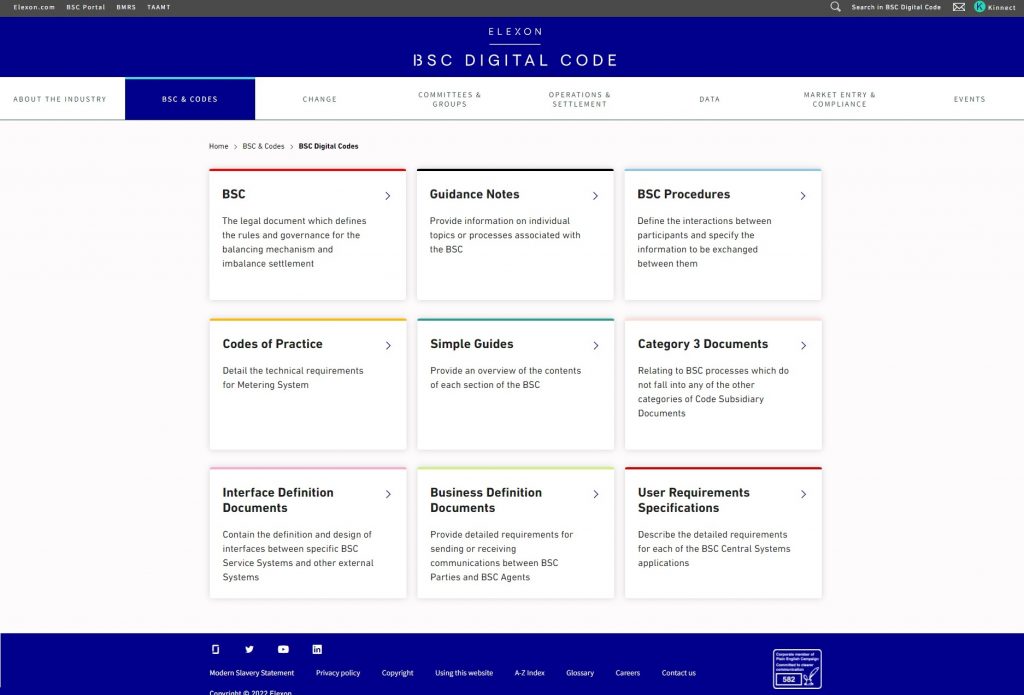
The main components of the BSC's structure are:
- The BSC itself: This is the core legal document establishing the high-level rules, principles, and governance arrangements.
- Code Subsidiary Documents (CSDs): These provide the detailed "how-to" information. The most important types are:
- BSC Procedures (BSCPs): These are the operational manuals. They define the step-by-step processes for almost every activity under the BSC, from registering a new power station to submitting metering data.
- Codes of Practice (CoPs): These set the technical standards for metering systems. Accurate metering is the foundation of the entire settlement process, and these documents ensure all equipment meets the required standards.
- Explanatory Material: Elexon also produces documents like Simple Guides to help new entrants and stakeholders understand the complex rules.
To get a better sense of this structure, let's look at the source.
This webpage from Elexon lists the various documents that make up the BSC framework. You don't need to understand what each one does, but looking at the list helps to appreciate the overall structure.
Skim through this page, reading the short description for the 'Balancing and Settlement Code', 'BSC Procedures (BSCPs)', 'Codes of Practice', and 'BSC Simple Guides'. This will reinforce your understanding of the BSC's layered structure.
5. The Settlement Process at a Glance
So, how do the BSC rules and Elexon's administration come together in practice? The entire process revolves around half-hourly Settlement Periods.

Here’s a simplified breakdown of the timeline shown in the image:
- Before the Period (Pre-Gate Closure): Generators and Suppliers finalise their trades and submit their final contract positions to Elexon.
- During the Period (The Half-Hour): Electricity is generated and consumed. National Grid ESO performs real-time actions to keep the grid physically balanced.
- After the Period (Settlement):
- Meter data is collected and sent to Elexon.
- Elexon's systems compare each party's contracted position with their actual metered volume to calculate their imbalance volume.
- Elexon calculates the imbalance price for that half-hour, based on the cost of the balancing actions taken by the ESO.
- Parties with an imbalance are either charged (if their imbalance cost the system money) or paid (if their imbalance happened to help the system) for their imbalance volume at the imbalance price. This is often called "cash out".
This entire process, from the physical event to the final financial payment, ensures that the costs of maintaining grid stability are fairly allocated to those who deviate from their contracted positions.
Conclusion
Today, we've pulled back the curtain on the complex but essential process of balancing and settlement that underpins the entire GB electricity market.
Key Takeaways:
- The Balancing and Settlement Code (BSC) is the legal and contractual rulebook for the wholesale electricity market, designed to manage the financial consequences of imbalance.
- Elexon is the independent, not-for-profit administrator of the BSC. It acts as the market's central accountant, ensuring fair and accurate financial settlement.
- The BSC has a hierarchical structure, comprising the main legal code and detailed Code Subsidiary Documents (like BSCPs and CoPs) that define operational processes and technical standards.
- The settlement process involves Elexon comparing contracted positions with actual metered data for each half-hour and charging or paying participants for their imbalances based on a calculated imbalance price.
Preview of the next lesson:
We have now established what the BSC is and what the settlement process aims to achieve. In our next lesson, we will dig a little deeper into this process. We will follow the journey from the electricity flowing through a meter to the final financial transactions, exploring how data is collected, validated, and used in this critical market function.