Hello! Welcome to the final lesson in Module 11 of your course on UK electrical grids.
In our last lesson, we looked at the specialised IT systems (EDT, EDL, CT, and BMRA) that enable the real-time operation of the Balancing Mechanism. We saw how the Electricity System Operator (ESO) uses these tools to instruct generators to change their output second-by-second to keep the grid stable.
However, all of these real-time actions depend on a fundamental assumption: that there is enough generation capacity available on the system to be called upon in the first place. What happens on a cold, still winter evening when demand is very high, but there's little wind or sun? This brings us to the crucial concept of generation adequacy.
Today, we will describe the role of the Capacity Market in ensuring generation adequacy. We will explore how this mechanism acts as an insurance policy for Great Britain's electricity system, making sure the lights stay on, even during times of extreme stress.
1. The Challenge of Generation Adequacy
Generation adequacy simply means having enough total power generation capacity available to meet the country's highest possible electricity demand, plus a healthy safety margin.
As the UK grid incorporates more intermittent renewables like wind and solar, ensuring adequacy becomes more complex. While these are essential for decarbonisation, they can't be relied upon to be available 24/7. The system needs a backup of reliable, dispatchable power sources (like gas plants, biomass, or energy storage) that can be turned on when needed.
The problem is that these backup plants might only be needed for a few hours a year. This makes it difficult for them to earn enough money in the main electricity markets to stay in business. If they were to close down, the UK could face a shortage of power during periods of high demand and low renewable output.
This is where the Capacity Market comes in.

2. The Capacity Market: An Insurance Policy for the Grid
The Capacity Market (CM) is a mechanism designed to ensure generation adequacy. It was introduced in 2014 to make sure there is sufficient reliable capacity to meet demand, even during severe system stress.
The core idea is simple: the CM pays capacity providers not for the electricity they generate, but for being available to generate when the system needs them most. It's effectively an insurance policy against blackouts.
To understand the fundamentals, let's watch a short video.
How the Capacity Market works (The Energy Academy - S3 E3)
This video from Modo Energy provides an excellent overview of why the Capacity Market exists and how it works.
Watch the first two minutes of the video (00:00 - 01:49). Focus on how it explains the purpose of the CM and the difference between paying for availability versus paying for electricity.
As the video explains, providers who win a Capacity Market contract receive a steady payment. In return, they have an obligation to be available and to deliver power at four hours' notice if the ESO declares a potential shortage.
3. How the Capacity Market Works
The process of securing this capacity is run through a series of competitive auctions, managed on behalf of the government by National Grid ESO.
The official National Grid ESO page on the Capacity Market provides a clear, step-by-step overview of the process.
Read the sections titled 'Capacity Market' (introduction), 'Capacity Setting', 'Pre-qualification', and 'Capacity Market Auction'. This will walk you through the formal stages of the process.
Let's break down the key stages described in the reading:
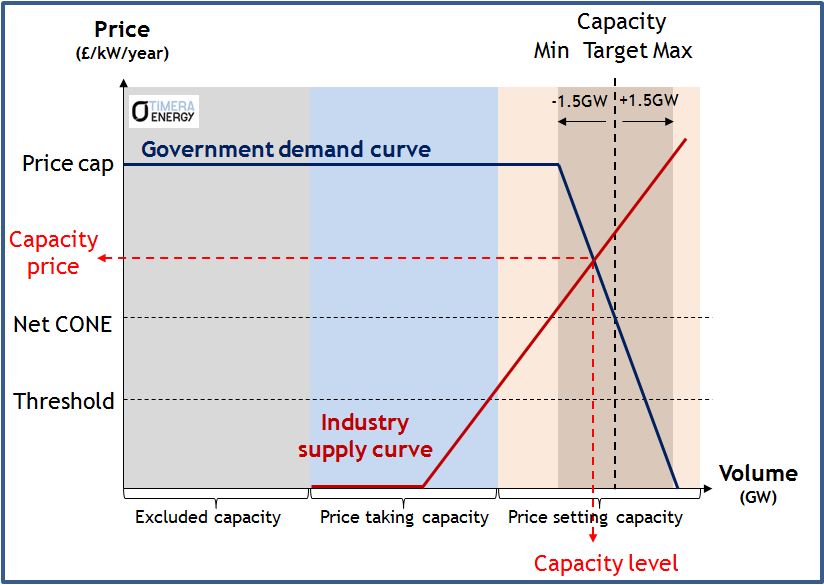
- Capacity Setting: First, the government, using analysis from the ESO (in the Electricity Capacity Report), determines the total amount of capacity the country will need for a future year.
- Pre-qualification: Any organisation that wants to provide capacity—whether it's an existing power station, a new one to be built, a large battery, or a business that can reduce its demand (Demand Side Response)—must go through a pre-qualification process to prove it can meet the technical requirements.
- The Auction: Pre-qualified providers then bid into a descending clock auction. The price starts high and is lowered in successive rounds. Bidders must decide at which price point they will "drop out" of the auction. The auction stops when the volume of capacity from the bidders remaining in the auction equals the target volume. Everyone who is left wins a contract at that final clearing price.
4. Securing Capacity for the Future: T-4 and T-1 Auctions
A key feature of the Capacity Market is its forward-looking nature, which is crucial for encouraging investment in new power plants. This is achieved through two main types of auctions.
How the Capacity Market works (The Energy Academy - S3 E3)
Let's return to the Modo Energy video to understand these two auction types.
Watch the sections explaining the T-4 and T-1 auctions (01:49 - 03:34 and 04:45 - 05:10). Pay attention to the different timings and purposes of each auction.
- T-4 Auction: This is the main event, held four years ahead of the delivery year. Its main purpose is to provide long-term revenue certainty, giving investors the confidence to finance and build new power stations. New-build projects can win contracts for up to 15 years. This auction secures the bulk of the required capacity.
- T-1 Auction: This is a smaller, "top-up" auction held just one year ahead of the delivery year. It allows the ESO to fine-tune the capacity level based on the latest demand forecasts and to account for any power plants that may have closed since the T-4 auction.
5. Levelling the Playing Field: De-rating Factors
Not all types of capacity are equally reliable. A gas power station can run for as long as it has fuel, but a lithium-ion battery might only be able to deliver its full power for one or two hours. To compare these different technologies fairly, the Capacity Market uses de-rating factors.
How the Capacity Market works (The Energy Academy - S3 E3)
The final concept to cover is 'de-rating'. The Modo video explains this well.
Watch the section on de-rating factors (03:34 - 04:45). Focus on why they are needed and how they affect different technologies, like batteries.
A de-rating factor is a multiplier applied to a generator's capacity to reflect its expected availability during a system stress event.
- A highly reliable combined-cycle gas turbine (CCGT) might have a de-rating factor of over 95%.
- A 1-hour battery, while useful, cannot provide sustained power. Its de-rating factor will be much lower, meaning it gets paid for a much smaller fraction of its nameplate capacity.
This ensures that the auction procures a truly reliable amount of capacity, not just a headline number, and that the payments are proportional to the provider's contribution to security of supply.
Test your understanding!
Imagine two companies are bidding into the T-4 Capacity Market auction.
- Company A is proposing to build a new gas-fired power plant that can run for days on end.
- Company B is proposing to build a new 2-hour battery energy storage system.
Which project is likely to receive a 15-year contract and why? How will their de-rating factors differ?
Show answer
- Company A's gas plant is the one eligible for a 15-year "new build" contract. This long-term revenue stream is designed to underwrite the large upfront investment required for such a project. Its de-rating factor will be very high (e.g., >95%) because it is a reliable, long-duration asset.
- Company B's battery is also a "new build" but is less likely to secure a 15-year agreement in the same way. More importantly, its capacity will be significantly de-rated because of its limited 2-hour duration. It contributes less to security of supply during a prolonged stress event compared to the gas plant, and its de-rating factor will reflect this.
6. Has it Worked?
The primary objective of the Capacity Market is to ensure security of supply. So, has it been successful?
Capacity Market: 10-year review
This government review provides a high-level assessment of the Capacity Market's performance.
Read the sections 'Introduction' (first paragraph only), 'Security of Supply' (first paragraph only), and 'Conclusion' (the paragraph under the 'Security of Supply' heading). These short excerpts summarize the CM's purpose and its success.
As the review highlights, the CM has been very effective. The auctions have successfully procured sufficient capacity for future years. Critically, since the Capacity Market began, there have been no "System Stress Events" where the ESO has had to call on its emergency reserves. This demonstrates that the mechanism is working as intended—providing the insurance needed to keep the system secure.
Conclusion
Today we've seen how the UK ensures it has enough power available in the long term, complementing the real-time balancing we studied previously. The Capacity Market provides a vital function in a system with growing levels of intermittent renewables.
Key Takeaways:
- Generation adequacy is about ensuring there's enough total generating capacity to meet peak demand with a safety margin.
- The Capacity Market (CM) is a mechanism that pays providers for their availability, acting as an insurance policy against power shortages.
- It uses competitive T-4 and T-1 auctions to procure capacity years in advance, with the T-4 auction being crucial for incentivising investment in new power plants via long-term contracts.
- De-rating factors are used to level the playing field, ensuring different technologies are valued based on their reliability and duration.
- The CM has been successful in its primary goal: there have been no system-wide supply emergencies since its introduction.
Preview of the next module:
This lesson concludes our look at the UK's wholesale market design and balancing services. In the next module, we'll begin our journey into Module 12: Market Infrastructure and Settlement. We will start by exploring the platforms where day-to-day electricity trading actually happens, describing the role and operation of wholesale electricity trading platforms like N2EX and EPEX SPOT.