Hello! Welcome to the sixteenth lesson in the course.
In our last lesson, we took a high-level look at the major market and regulatory barriers holding back the UK's transition to a clean energy system. We saw that the traditional regulatory philosophy, which prioritized avoiding upfront costs, is no longer suitable for the massive, proactive investment needed to build a grid for the future.
Today, we're going to dive much deeper into this specific topic. Our goal is to explain how the regulatory framework for networks can both incentivize and hinder investment and innovation. We will dissect the rules that govern the monopoly network companies, exploring the specific mechanisms designed to spur progress and the ways in which this same framework can sometimes slow it down. This is the delicate balancing act at the heart of the UK's energy transition.
The Regulator's Dilemma: Cost vs. Progress
The companies that own and operate the UK's electricity transmission and distribution networks are, for the most part, regional monopolies. If you live in London, you can't choose to get your electricity delivered by the network operator in Scotland. Because of this lack of competition, these companies are regulated by an independent body called Ofgem (the Office of Gas and Electricity Markets).
Ofgem's primary role is to protect consumers by simulating the effects of competition. Without a regulator, a monopoly network company could charge excessive prices or fail to invest in maintaining its assets, and customers would have no alternative.
This creates a fundamental tension:
- On one hand, Ofgem must protect today's bill-payers from paying for unnecessary or overly expensive projects.
- On the other hand, it must ensure the network companies invest enough to keep the grid reliable and, crucially, to enable the transition to a net-zero future.
As we discussed in the last lesson, this second point requires huge amounts of anticipatory investment—building the grid of tomorrow, today. This is the regulator's dilemma: how do you encourage massive, forward-looking investment without writing a blank cheque for the network companies at the expense of consumers?
To manage this, Ofgem uses a specific regulatory model called RIIO.
The RIIO Framework: The Rules of the Game
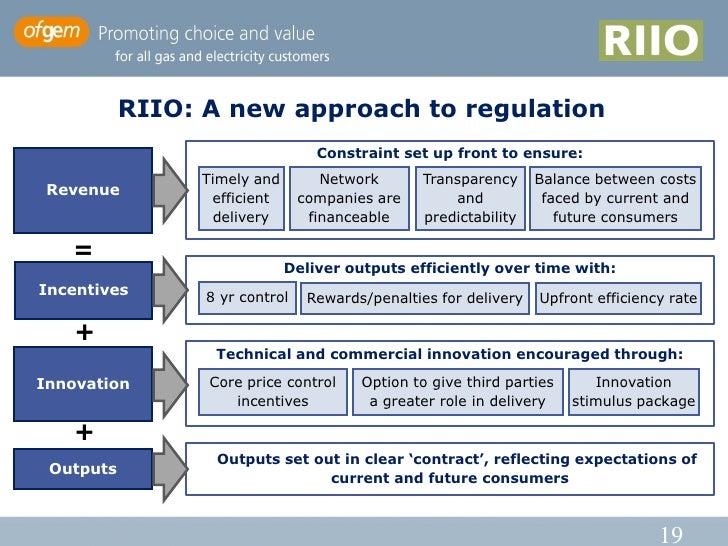
RIIO stands for Revenue = Incentives + Innovation + Outputs. It's the framework that determines how much revenue network companies are allowed to earn from their customers.
Instead of the old model where companies could simply spend money on approved projects and add it to customer bills, RIIO is designed to be more performance-based. It sets the rules of the game for a set period (typically 5-8 years), known as a 'price control' period.
Let's break down the components.
To get a clear official summary of how RIIO works, let's look at how National Grid describes it.
This page from National Grid, 'How we're regulated', provides a concise overview of the RIIO framework from the perspective of a regulated company.
Please read the introduction and the first two paragraphs under the heading 'How we earn our revenue'. Focus on the stated purpose of the RIIO model: to incentivize innovation and investment for a sustainable network at the lowest cost.
As the reading explains, the RIIO model tries to move away from simply funding expenditure and towards rewarding the delivery of desired outcomes. Let's see how each part of the RIIO acronym is supposed to encourage investment and innovation.
How Regulation Incentivizes Investment and Innovation
The RIIO framework has several tools designed to push network companies to invest efficiently and embrace new ideas.
1. Outputs: Defining What to Invest In
The "Outputs" are a list of specific, measurable targets that network companies must deliver. These are agreed with Ofgem after extensive consultation. By making revenue dependent on delivering these outputs, the framework directly steers investment towards key priorities.
Let's return to the 'How we're regulated' page to see what these outputs look like.
Read the section titled 'Outputs' and look at the five categories listed. Note how they cover everything from safety and reliability to environmental impact and customer service.
For example, by setting an output target for connecting new low-carbon generation quickly, the framework directly incentivizes the company to invest in the staff, systems, and grid upgrades needed to make that happen.
2. Incentives: The "Carrot and Stick"
The "Incentives" are financial rewards and penalties tied to the outputs. If a company outperforms its targets (e.g., restores power after faults faster than required), it can earn extra revenue. If it underperforms, it faces a financial penalty.
Crucially, this also applies to cost efficiency. If a company finds a way to deliver its required work for less than the forecast cost, it gets to keep a share of the savings, with the rest passed back to consumers. This provides a powerful incentive to find smarter, more efficient ways of working—in other words, to innovate.
3. Innovation: Dedicated Funding for New Ideas
Perhaps the most direct tool is the "Innovation" component. RIIO includes specific funding mechanisms to help companies fund projects that are too risky or long-term to be covered by the core business-as-usual budget.
This chapter from a National Grid business plan explains the purpose of these dedicated innovation funds.
First, read the section 'Our current performance on innovation' to understand the context. Then, read 'Support for innovation through regulatory incentives'. Pay attention to the three mechanisms mentioned (NIA, NIC, IRM) and the explicit statement that without them, companies would lack a strong reason to pursue innovation.
The Network Innovation Allowance (NIA) provides an annual budget for smaller-scale research and development projects. The Network Innovation Competition (NIC) is an annual competition for a smaller number of large, flagship projects with the potential for major industry-wide impact.
These funds allow companies to experiment with new technologies and processes. Let's watch a video for a concrete example.
Innovating for a Clean Energy Transition: Part 1 | The Clean Energy Revolution Podcast S3: E6
In this clip from 'The Clean Energy Revolution Podcast', a representative from National Grid discusses how regulatory funding is enabling cutting-edge work.
Please watch from 03:54 to 05:47 and from 32:49 to 36:03. Notice the specific examples given: How regulatory funding supports projects like 'intelligent substations' and making networks more modular. How regulation can be reshaped to better promote future innovation, rather than just iterating on the past.
How Regulation Can Hinder Investment and Innovation
While the RIIO framework is designed to promote progress, its structure can also create barriers.
1. The Payback Problem and Shared Gains
As we've just seen, when a company innovates and saves money, it shares the benefit with consumers. This is fair, but it can also reduce the incentive to innovate.
Furthermore, these savings are often used to set a tougher, lower-cost target in the next price control period. A company might rightly ask: "Why should I invest heavily in a radical innovation if the financial benefit will be short-lived before it's passed on to consumers and becomes the new normal?"
This issue is explained very clearly in the National Grid innovation document.
This section of the innovation chapter directly addresses the ways in which a regulatory framework can stifle innovation if not designed carefully.
Please read the section titled 'The need for innovation funding'. Focus on the three bullet points that explain why a lack of funding—or the wrong kind of incentive structure—stifles innovation.
As the text highlights, short price control periods are a poor fit for long-term, high-risk innovation projects that may take more than 5-8 years to pay off.
2. Cultural and Procedural Hurdles
Regulation is, by its nature, a process-driven and often slow-moving field. It involves extensive consultation, evidence-gathering, and justification. This methodical approach can clash with the "fail fast" culture of modern innovation.
Moreover, decades of operating as a conservative, risk-averse monopoly (a culture encouraged by the old regulatory model) can't be changed overnight. Even with innovation funding available, there can be internal resistance to taking risks.
Innovating for a Clean Energy Transition: Part 1 | The Clean Energy Revolution Podcast S3: E6
Let's return to 'The Clean Energy Revolution Podcast' to hear about these non-financial barriers.
Please watch from 09:51 to 11:53 and from 29:06 to 30:16. Listen for: The discussion of how a 'risk-averse' culture in utilities can be the biggest barrier to scaling up new technologies. The point that regulation, if 'poorly conducted', can get in the way of innovation and act as an 'obfuscator' rather than a 'facilitator'.
Test your understanding!
A network company develops an AI-powered system that can predict cable faults with incredible accuracy, potentially saving millions of pounds in repair costs and preventing power cuts.
Using the concepts you've just learned, describe one way the RIIO framework would incentivize the company to roll out this technology, and one way it might hinder them from doing so.
Show answer
-
Incentive: The framework would incentivize the rollout through the efficiency incentive. By using the AI to reduce repair costs, the company would spend less than its Ofgem-approved allowance. It would be able to keep a share of these savings as profit, directly rewarding the innovation. It would also perform better against its reliability "Output" targets, avoiding penalties and potentially earning rewards.
-
Hinderance: The framework might hinder the rollout due to the "payback problem". The company knows that in the next price control period, Ofgem will see these cost savings and set a much lower budget for cable maintenance. The long-term financial benefit to the company is therefore limited. If the initial R&D and rollout cost for the AI system was very high, the company might calculate that it won't make its money back before the savings are passed on to consumers.
Broadening the View: Other Regulatory Incentives
It's important to remember that regulating networks via RIIO is just one part of the picture. The government and regulator use other market frameworks to incentivize investment in other parts of the system, particularly generation.
A key example is the Capacity Market. This is a mechanism designed to ensure there is always enough dispatchable generation capacity available to keep the lights on, especially during winter peaks. It works as a sort of insurance policy. At regular auctions, power plant owners (or those planning to build new plants) can bid for contracts that pay them simply to be available.
This provides a secure, long-term revenue stream that makes it easier for investors to fund new power plants, particularly the flexible ones needed to back up intermittent renewables.
Electricity Markets in Great Britain - The Energy Academy (Series Three)
This video from Modo Energy's 'The Energy Academy' series explains the purpose of the Capacity Market.
Watch from 04:02 to 08:16. Focus on understanding: Why the Capacity Market is described as an 'insurance policy'. How winning a 15-year contract can make a new power plant project 'appealing to investors'. How this mechanism 'determines the makeup of Great Britain's generation stack'.
The Capacity Market is another clear example of how a regulatory framework can be used to directly incentivize the specific types of investment needed to ensure the grid remains reliable.
Conclusion
In this lesson, we have examined the intricate role of the regulatory framework in shaping investment and innovation in the UK's electricity networks.
Key Takeaways:
- Regulation is a Balancing Act: Ofgem must balance protecting current consumers from high costs with encouraging the massive investment needed for the future grid.
- RIIO as an Incentive: The RIIO framework (Revenue = Incentives + Innovation + Outputs) incentivizes progress by setting clear performance targets, offering financial rewards for efficiency, and providing dedicated funds (like NIA and NIC) for innovative projects.
- Regulation as a Hindrance: The same framework can inadvertently hinder innovation due to the short-term nature of price controls, the sharing of efficiency gains (which reduces long-term payback), and the inherent risk aversion of a regulated environment.
- Beyond Networks: Regulatory tools like the Capacity Market are also used to incentivize investment in other critical areas, such as generation capacity.
Preview of the next module:
We have now concluded our module on the market and regulatory barriers facing the grid. We have diagnosed many of the key problems and inefficiencies. In our next module, "Opportunities for System Improvement," we will shift our focus to the solutions. We'll begin by exploring how smart technologies, starting with smart meters, are creating new possibilities for managing the grid more efficiently and empowering consumers.