Hello! Welcome to the final lesson in our module on network inefficiencies.
In our last lesson, we looked at the massive "traffic jam" in the grid connection queue, a major administrative barrier preventing new clean energy projects from being built and connected. Today, we shift our focus from the challenges of connecting new resources to the challenges of operating the grid once they are connected.
As the UK grid decarbonizes, replacing traditional power stations with wind, solar, and interconnectors, a new set of technical problems emerges. This lesson will describe the three most significant technical barriers to running a stable and reliable grid powered mainly by renewables: low inertia, weak system strength, and network congestion.
1. The Inertia Problem: Losing our Shock Absorbers
The first major challenge is the decline of system inertia.
In a traditional grid, inertia is provided by the huge, heavy, spinning metal turbines and generators found in coal, gas, and nuclear power stations. Think of them as massive flywheels, rotating in sync with the grid's 50 Hz frequency. The kinetic energy stored in all this spinning mass is called inertia.
This inertia acts like a giant, invisible shock absorber for the entire electricity system.
Our new approach to inertia and other stability services
This article from National Grid ESO, 'Our new approach to inertia and other stability services', provides a clear, non-technical definition of inertia and why it's so important.
Please read the short section titled 'First things first – what is inertia?'. Pay close attention to the car suspension analogy.
As the article explains, inertia is crucial for stability. If a large power station or interconnector suddenly trips offline, there's an immediate mismatch between electricity generation and demand. The grid frequency starts to fall. Inertia resists this change. The kinetic energy from all the other spinning generators is automatically and instantly released into the grid, slowing down the rate of the frequency fall. This gives the grid operator precious seconds to activate backup power sources (like batteries) to restore the balance.
The Decarbonization Challenge
The problem is that wind turbines and solar panels do not provide inertia in the same way. While wind turbines spin, their generators are connected to the grid via power electronic inverters, which decouple them from the grid's frequency. Solar panels have no spinning parts at all. As we replace old synchronous power stations with these inverter-based resources, we lose the system's natural "shock absorbers".
The following video explains this transition and its consequences, including a real-world example from 2019.
Why Is Grid Stability Getting Harder? The Hidden Challenge of Renewable Integration
This video from Modo Energy, 'Why Is Grid Stability Getting Harder?', features an expert from Statkraft explaining the core stability challenges of a decarbonized grid.
Please watch from the timestamp 07:05 to 13:57. The speaker explains: Why replacing synchronous machines with inverter-based resources is a problem (07:05 - 09:12). How inertia works to slow down frequency changes and why low inertia is dangerous (09:12 - 11:52). The consequences of low inertia, using the August 2019 UK power cut as a case study (11:52 - 13:57). The reason why wind turbines don't inherently provide inertia (13:57).
Without enough inertia, a fault on the grid can cause the frequency to drop so quickly that protection systems don't have time to react, leading to automated disconnection of customers (as happened in 2019) or, in a worst-case scenario, a widespread blackout.
2. The System Strength Problem: A "Spongy" Grid
The second, related challenge is declining system strength. This is a more complex concept but is just as critical as inertia.
- Inertia is about the system's ability to resist changes in frequency.
- System Strength is about the system's ability to maintain a stable voltage level, especially during and after a fault (like a lightning strike on a transmission line).
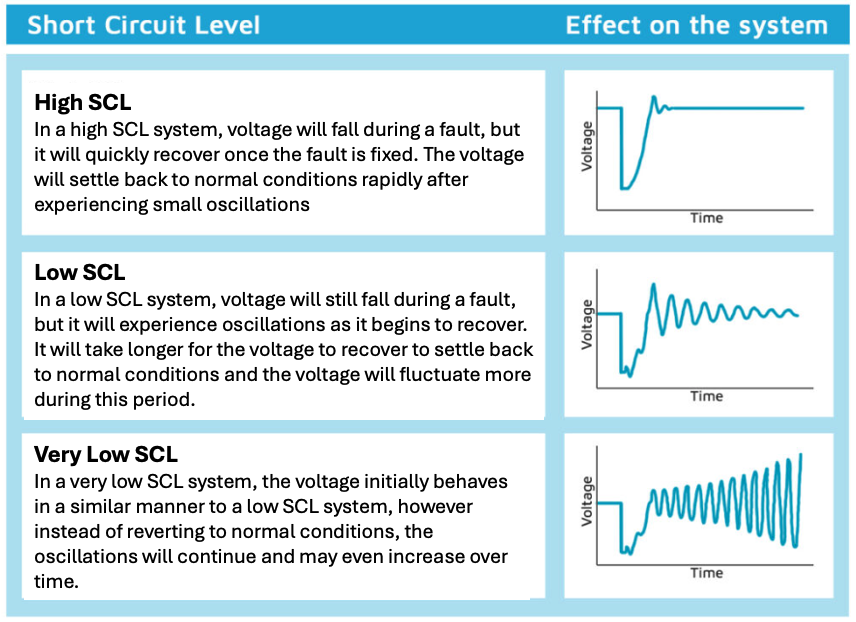
A "strong" grid has a very stable, or "stiff," voltage. When a fault occurs, the voltage dips but recovers very quickly and smoothly. A "weak" grid has a "soft" or "spongy" voltage. After a fault, the voltage can fluctuate wildly and take a long time to recover, or it might not recover at all.
The Decarbonization Challenge
System strength is largely determined by the short circuit level (SCL), which is the amount of current that can flow during a fault. Traditional synchronous generators can deliver a massive surge of current (many times their normal operating current) into a fault, which helps to "hold up" the voltage across the rest of the grid and ensures a rapid recovery.
Inverter-based resources like wind, solar, and batteries are different. Their power electronics are sensitive and are designed to protect themselves by strictly limiting the amount of current they can produce, even during a fault. They do not provide the same powerful response as a synchronous machine.
As a result, a grid with high levels of inverter-based resources becomes "weaker" and its voltage becomes "spongier" and more fragile.
Why Is Grid Stability Getting Harder? The Hidden Challenge of Renewable Integration
Let's return to the Modo Energy video, where the speaker introduces the concept of system strength as a new and emerging challenge.
Please watch the segment from 44:54 to 46:48. The speaker explains system strength in the context of an inverter-dominated grid and highlights the risk of unpredictable interactions between different control systems.
The consequences of weak system strength include:
- Voltage Instability: The grid voltage can become unstable and collapse, leading to blackouts.
- Protection Malfunction: The systems designed to detect and clear faults may not operate correctly.
- Control System Conflicts: The sophisticated control systems of thousands of different inverters can begin to interact with each other in unpredictable and harmful ways.
Test your understanding!
In your own words, what is the key difference between the problem of low inertia and the problem of weak system strength?
Show answer
Low inertia is a frequency stability problem. It means the grid's speed (frequency) can change too quickly after a generation or demand imbalance, not leaving enough time for backup systems to respond.
Weak system strength is a voltage stability problem. It means the grid's voltage level is not "stiff" enough to recover quickly and smoothly after a disturbance like a short circuit, leading to oscillations or voltage collapse.
3. The Congestion Problem: Gridlock on the Energy Superhighway
The final technical barrier is one we've touched on before: network congestion. This occurs when there is not enough capacity on the transmission lines to move electricity from where it's generated to where it's needed.
The Decarbonization Challenge
This isn't a new problem, but it's made much worse by the rollout of renewables. The best places for wind farms are in the windiest parts of the country (like Scotland and offshore) and the best places for solar farms are in the sunniest parts (like the South West of England). These locations are often far from the major demand centres, like London and the South East.
The existing grid wasn't designed to move massive amounts of power over these specific routes. On very windy and sunny days, the transmission lines act as bottlenecks, just like a motorway at rush hour.
This video from Sky News provides a clear and concise summary of the problem.
Wind Power: Why some wind farms are being paid to stop producing energy
This news report explains the practical and financial consequences of network congestion, specifically the bottleneck between Scotland and England.
Please watch the video from the beginning to 02:42. Focus on why wind farms are asked to turn off and the financial costs involved.
As the video explains, the only way the grid operator can manage this congestion is to curtail the renewable generation. This means paying the wind or solar farm to stop producing cheap, clean electricity, and simultaneously paying an expensive gas power station located closer to the demand to turn on instead. This is not only economically inefficient but also undermines our decarbonization goals by wasting renewable energy.
Conclusion
Operating a fully decarbonized grid is not as simple as just building more wind and solar farms. As we've seen, the shift away from traditional power stations introduces fundamental technical barriers that threaten the stability of the entire system.
Key Takeaways:
- Low Inertia: The loss of large, spinning synchronous generators removes the grid's natural shock absorbers, making the system's frequency highly vulnerable to sudden changes and increasing the risk of blackouts.
- Weak System Strength: The replacement of synchronous generators with inverter-based resources reduces the grid's ability to maintain a stable voltage during faults, leading to a "spongy" grid susceptible to voltage collapse and control system issues.
- Network Congestion: The geographical mismatch between where renewable energy is best generated and where it is most needed creates physical bottlenecks on the transmission network, forcing the costly and wasteful curtailment of clean power.
Preview of the next lesson:
We've now seen the administrative barriers to connecting new assets and the technical barriers to operating them. Many of the solutions to these problems involve new technologies like grid-scale energy storage (batteries, pumped hydro). However, these technologies face their own set of challenges. In the first lesson of our next module, we will describe the main types of energy storage and analyze the market and regulatory barriers that are currently hindering their deployment.