Hello! Welcome to the first lesson of our new module, "System Inefficiencies: Market and Regulatory Barriers".
In our last lesson, we explored the critical technical challenges arising from a decarbonizing grid: low inertia, weak system strength, and network congestion. We saw how replacing traditional power stations with renewable sources like wind and solar fundamentally changes how the grid behaves, making it more vulnerable to instability.
Today, we turn our attention to one of the most important solutions to these problems: grid-scale energy storage. If renewables generate power intermittently, the obvious solution is to store it for when we need it. This lesson will describe the main types of grid-scale storage technologies used in the UK and explain the vital services they provide to keep our electricity system balanced and secure.
Why Do We Need to Store Electricity?
Before diving into specific technologies, let's first establish why large-scale energy storage is becoming so crucial. The core challenge with renewable sources like wind and solar is their variability—we can't control when the wind blows or the sun shines.
This creates a fundamental problem for a grid that must match electricity supply and demand perfectly in real time. Energy storage solves this by allowing us to "time-shift" energy: capturing it when there's a surplus and releasing it when there's a deficit.
Grid-Scale Energy Storage: 5 Technologies Explained
To start, let's watch a short introduction from the video 'Grid-Scale Energy Storage: 5 Technologies Explained' by Gaurav J - TheElectricalGuy. It clearly explains why the rise of renewable energy makes storage an essential component of a modern power grid.
Please watch from the beginning until 02:04. Focus on the core problem that storage solves: the intermittent nature of renewable energy.
As the video explains, storage provides the necessary buffer to create a reliable grid from unreliable energy sources. It helps us fill the gaps when renewables aren't available, paving the way for a decarbonized electricity system.
1. Pumped Storage Hydropower (PHS): The Original Grid-Scale Battery
The oldest and most established form of grid-scale energy storage isn't a battery at all—it's a mountain with two lakes. Pumped Storage Hydropower (PHS) has been a cornerstone of the UK grid for decades.
The concept is simple: use excess, cheap electricity (for example, overnight when demand is low) to pump water from a lower reservoir to an upper one. This stored water now holds gravitational potential energy. When the grid needs power, the water is released, flowing back down through turbines to generate electricity.

The UK is home to one of the most impressive PHS facilities in the world, Dinorwig Power Station in Wales, also known as "Electric Mountain."
Britain's largest battery is actually a lake
This video from Tom Scott, 'Britain's largest battery is actually a lake', gives you a fantastic tour of Dinorwig and explains its operation and importance to the grid.
Please watch the following segments: 00:00 - 01:44: This explains the basic principle and operational mechanism of the pumped hydro system at Dinorwig. 04:10 - 04:31: This highlights why storage like Dinorwig is becoming even more critical with the growth of renewables.
Key Characteristics & Grid Services of PHS
Based on what you've seen, let's summarize the key features of PHS:
- Maturity: It's a proven, reliable technology that has been used for over 50 years.
- Scale and Duration: PHS provides massive storage capacity (gigawatt-hours) and can generate power for many hours (medium to long duration), making it ideal for shifting large amounts of energy from off-peak to peak periods.
- Fast Response: While not as fast as a battery, a PHS station can go from standstill to full power in seconds. This allows it to respond quickly to sudden demand spikes or generation outages. National Grid ESO often relies on PHS to handle demand surges during commercial breaks in popular TV shows.
- Grid Stability (Inertia): Crucially, PHS uses large, spinning synchronous generators—the very same type found in the traditional power stations we discussed in the last lesson. This means they provide system inertia, acting as a shock absorber to slow down frequency changes and enhance grid stability.
However, PHS has a major limitation: it is geographically constrained. You need a mountain with the right geology and space for two large reservoirs, which severely limits where new plants can be built.
2. Battery Energy Storage Systems (BESS): The Fast, Flexible Newcomer
The fastest-growing type of energy storage is the Battery Energy Storage System (BESS). These systems use large banks of rechargeable batteries, typically lithium-ion, housed in containers the size of a shipping container.
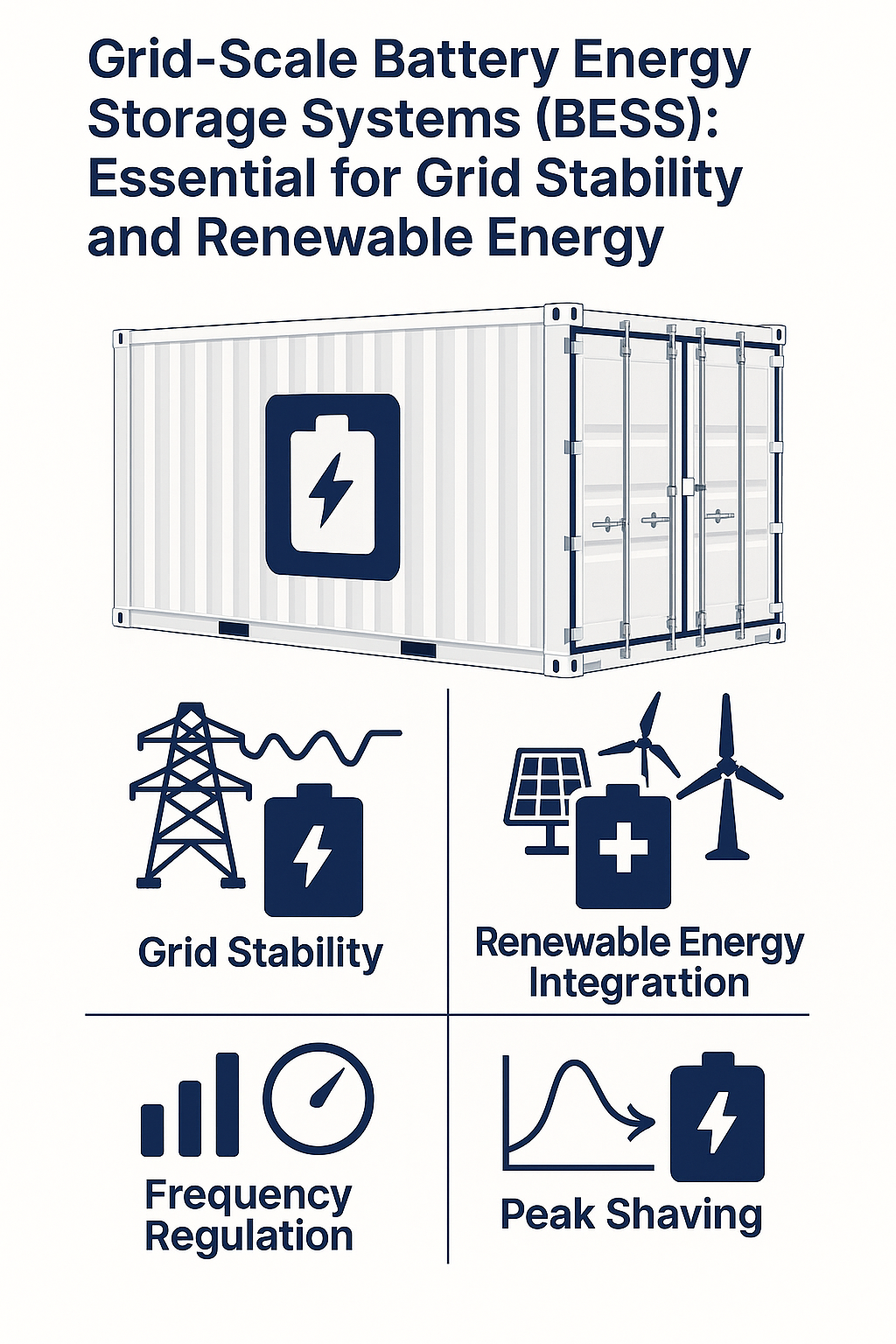
Unlike PHS, batteries are not geographically constrained and can be deployed almost anywhere on the grid, from a dedicated site connected to the transmission network to a small unit at a local substation.
Grid-Scale Energy Storage: 5 Technologies Explained
Let's return to the 'Grid-Scale Energy Storage' video, which provides an excellent overview of the advantages that make BESS such a transformative technology.
Please watch the section on Battery Energy Storage Systems from 09:49 to 14:30. Pay close attention to the numerous advantages it offers compared to other technologies.
Key Characteristics & Grid Services of BESS
As the video highlights, BESS offers a powerful and versatile set of capabilities:
- Location Flexibility & Scalability: BESS can be installed wherever they are needed on the grid and can be easily scaled up by adding more battery containers.
- Extremely Fast Response: Batteries can respond in milliseconds (thousandths of a second). This makes them exceptionally good at providing frequency regulation services, instantly injecting or absorbing power to correct small deviations from the grid's 50 Hz frequency. This is a critical service for managing a low-inertia grid.
- Short to Medium Duration: Most grid-scale batteries currently installed have a duration of 1-4 hours. This is perfect for "peak shaving" (discharging during the evening peak demand) and absorbing excess solar power in the middle of the day.
- Voltage Support: The power converters used in BESS can provide reactive power, which helps to support and stabilize grid voltage. This directly addresses the "weak system strength" problem we covered in the last lesson.
- Renewable Integration: By storing excess generation, batteries reduce the need to curtail (waste) cheap renewable energy during times of network congestion.
Test your understanding!
Imagine there's a sudden, large drop in grid frequency because a power station has tripped offline. Which energy storage technology, PHS or BESS, is better suited to respond first, and which is better suited to provide a large amount of energy over several hours to cover the loss?
Show answer
BESS would be the first to respond. Its ability to react in milliseconds makes it ideal for arresting the initial frequency drop almost instantly.
PHS would be better suited to provide a large, sustained amount of energy over several hours to replace the output of the lost power station while the grid operator arranges for other generation to come online.
3. A Glance at Other Storage Technologies
While PHS and BESS are the dominant technologies in the UK today, several other types are being developed, each with unique characteristics. It's useful to be aware of them, as they may play important roles in the future.
The National Grid Electricity System Operator (ESO) continuously evaluates these options. The table below summarizes some key technologies.
Potential Electricity Storage Routes to 2050
The National Grid ESO's thought piece, 'Potential Electricity Storage Routes to 2050', provides a concise summary of various storage technologies. We will use it to populate a comparative table.
You don't need to read the whole document. Just skim 'Table 1: Selected electricity storage technology characteristics' and 'Table 2: Technical characteristics of the selected electricity storage technologies' to familiarise yourself with the names and basic principles.
Here is a summary of the main contenders and their potential roles:
| Technology | How it Works | Key Feature / Use Case |
|---|---|---|
| Flywheel Storage | Stores kinetic energy in a rapidly spinning rotor. | Very fast response (<1 second), but very short duration (seconds to minutes). Good for frequency regulation. |
| Compressed Air (CAES) | Uses electricity to compress air and store it underground. The air is later released to drive a turbine. | Large scale, long duration (many hours). Similar role to PHS but with different geographical needs (e.g., salt caverns). |
| Liquid Air (LAES) | Uses electricity to cool air until it liquefies (-196°C). The liquid air is stored and later expanded to drive a turbine. | Long duration, not geographically constrained like PHS or CAES. |
| Hydrogen Storage | Uses electricity to create hydrogen gas via electrolysis. The hydrogen is stored and can be used later in a fuel cell or turbine to generate electricity. | Very long duration (days, weeks, or even months). Seen as a key option for seasonal storage—storing excess summer solar power for use in winter. |
Conclusion
In this lesson, we've seen that energy storage is not a single concept but a diverse family of technologies, each with unique strengths. They are the essential toolkit for managing the variability of a renewable-powered grid.
Key Takeaways:
- Energy storage is crucial for balancing a grid with high levels of intermittent renewables by "time-shifting" energy.
- Pumped Storage Hydropower (PHS) is the mature, large-scale workhorse, providing long-duration storage and valuable system inertia with its synchronous generators.
- Battery Energy Storage Systems (BESS) are the fast, flexible, and rapidly growing solution, excelling at near-instantaneous frequency control and providing valuable voltage support.
- A range of emerging technologies like hydrogen offer the potential for very long-duration, seasonal storage, which will be vital for a fully decarbonized system.
- Together, these technologies provide services that directly counteract the challenges of low inertia, weak system strength, and network congestion that we discussed in the previous lesson.
Preview of the next lesson:
We've established what energy storage is and why it's so important. But if these technologies are so useful, why don't we have more of them? It turns out that building and operating storage profitably is complex. In our next lesson, we will analyze the market and regulatory barriers that can hinder investment in new energy storage projects.