Welcome back. In the previous lesson, you separated a firm’s value-creating work from an attempt to win a preferential rule. This lesson follows the suspected favor more closely. You will map a hypothesized path from a political connection, through a specific public decision, to an economic reward—and mark where the evidence stops short of proving that path.
That distinction is central to judging claims about crony capitalism. A connection and a profitable contract can coexist without the connection having caused the contract. A useful map names the decision that might have made the difference.
The missing link is a public decision
Imagine learning that a business owner supported a politician’s campaign and that the business later won a government contract. Those are two observations, not yet an explanation. A causal account needs to identify who could influence the buyer, what the buyer did differently, and how that difference improved the business’s prospects.
A working map has five parts:
- Connection: A relationship between someone linked to the business and a political or public official.
- Possible channel of influence: An opportunity to convey a request, share information, or exert pressure. A connection alone does not establish that this happened.
- Public decision: A particular choice—such as shortening a bid period, narrowing eligibility, granting an exemption, or approving a payment.
- Effect on competition or access: The reason that choice might help this business relative to other capable businesses.
- Economic reward: A contract, subsidy, protected sales, or potentially higher profit.
The middle parts prevent an easy mistake: treating a politician as though they personally made every decision taken by a public agency. The official who knows a supplier may have no authority over a tender. Conversely, a purchasing official’s seemingly minor choice about when to publish a tender may matter greatly to firms that need time to prepare bids.
This brief fictional example illustrates a complete proposed mechanism. Watch the part of Rent Seeking: Taking Without Giving by Sprouts in which advocacy for protecting a fishery leads to restricted access and gains for an incumbent fisher.
Rent Seeking: Taking Without Giving
Sprouts’ “Rent Seeking: Taking Without Giving” offers a short, fictional example in which a public rule changes who can participate in a market.
Watch the fishery story. Notice the distinct roles of the advocate, the ruler who authorizes the restriction, the fishers who lose access, and the fisher who benefits. Treat the story as a model of a possible mechanism, not evidence that restricting access for conservation is always unjustified.
A rule limiting fishing could serve a real conservation purpose. Establishing favoritism would require evidence about the condition of the fishery, how permits were assigned, and whether the restriction was broader or narrower than that purpose required. The same discipline applies to procurement.
What the connection actually tells you
A political connection is not a single kind of relationship. A business might donate to a campaign; an owner might be related to an official; or an employee might previously have held public office. Each relationship suggests a different possible route to influence. None establishes, by itself, that the business sought or received a favor.
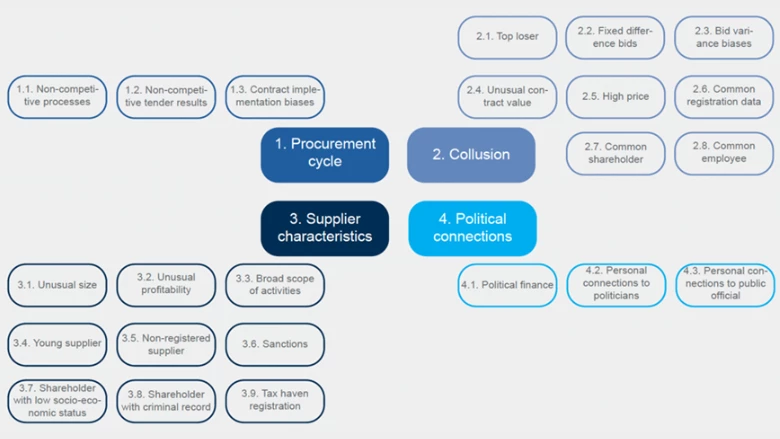
Read the political-connections portion of the World Bank’s Governance Risk Assessment System (GRAS). Its indicators are useful here because they distinguish the existence of a relationship from contracts won after that relationship. They also make clear why investigating indirect links requires joining several kinds of records.
Governance Risk Assessment System (GRAS)
Read the World Bank’s account of political-connection risk indicators to see how a proposed path begins with a specific relationship rather than a general claim that a firm is “connected.”
In “Risk Group 4: Political Connections” (p. 18), read the explanation of links. Then scan Table 4 (p. 19), particularly the political-finance indicators. Focus on the difference between recording a donation and recording subsequent contracts from a relevant public body. Do not treat the latter measure as proof that the donation caused an award.
The identity of the public decision-maker matters as much as the identity of the connected person. A donation to a politician with no involvement in a purchasing agency gives a less direct proposed channel than a documented relationship with the person who set the tender conditions. Even the more direct relationship remains a risk indicator until the relevant decision and its circumstances are examined.
A real audit example: a map with gaps
The same World Bank report describes an audit team examining a supplier that had won 11 contracts worth more than R$16 million in total. The records revealed several risk indicators, including two distinct connections: one shareholder worked as a social worker at a public hospital, while another had supplied an influential politician’s campaign. Most of the supplier’s contracts concerned food supply for hospitals.
Read the case as an investigator would: retain the recorded facts, but do not fill its missing steps with assumptions.
Governance Risk Assessment System (GRAS)
Return to the World Bank report for its concrete example of how multiple red flags can guide an investigation without settling its result.
In Section 3.2, “Illustrative Examples and Purposes of the System,” find “Example 1. Identifying multiple red flags for a selected supplier” (pp. 24–25). Begin where the audit team receives a tip and read the supplier example through “Risk pattern #4 - Political finance.” Separate the reported contracts and relationships from any proposed explanation of how the contracts were awarded.
The case can be mapped without claiming more than the report establishes:
| Part of the proposed path | What the example supports |
|---|---|
| Connection | Records identify a shareholder’s campaign-supplier relationship and another shareholder’s public-hospital employment. |
| Possible channel | These ties suggest people or institutions worth examining. The example does not show that either shareholder influenced the purchasing decision. |
| Public decision | Public bodies awarded contracts to the company. The example does not identify a particular tender rule changed for it. |
| Economic reward | The company received contracts of substantial total value. The excerpt does not establish its profit on them, much less profit attributable to a favor. |
One especially important gap concerns authority. Employment at a public hospital does not mean the employee selected food suppliers for the contracts described. Likewise, supplying a politician’s campaign does not show that the politician directed a purchasing office. These connections make a line of inquiry plausible; they do not complete it.
Contract value also differs from economic rent. A supplier paid to deliver food incurs costs and fulfills an obligation. To claim an extra return from favoritism, an investigation would need a credible comparison with what the supplier could have earned under genuinely competitive conditions, as well as evidence about the contract’s performance and costs.
Constructing a complete hypothesis without overstating it
Consider this invented tender case, designed to expose every step in the map. A water-treatment supplier’s owner makes a disclosed campaign donation to a councilor. A public calendar shows the councilor meeting a purchasing director before a tender for replacement filters; the agenda says “water procurement” but records no discussion. The purchasing office advertises the tender for seven days, whereas its previous similar tender allowed 21. Only the donor’s firm bids. It wins a contract for 1.2 million in the relevant currency, above the office’s initial estimate of 1.05 million.
A careful map distinguishes observed events from proposed mechanisms:
- Observed connection: The owner donated to the councilor’s campaign. The calendar also records a meeting between that councilor and the purchasing director.
- Hypothesized channel: The councilor might have urged the director to set a shorter bidding period or might have passed along advance information. The meeting record does not say either occurred.
- Observed public decision: The purchasing office chose a seven-day advertisement period and then awarded the contract. Its reason for the shorter period is not yet known.
- Hypothesized competitive effect: Seven days might have left other qualified suppliers too little time to bid. That would be more concerning if the winning firm had the specifications in advance, but the case supplies no evidence that it did.
- Observed reward and possible additional reward: The firm won the contract. The initial estimate makes its price worth examining, but the difference alone does not establish overpayment or economic rent.
This map is useful precisely because its claims have different strengths. The donation, meeting, tender period, single bid, and award are stipulated facts of the invented case. Influence over the director, advance notice, exclusion of capable rivals, and excess profit are hypotheses.
The same facts permit another account. The agency may have faced a genuine deadline; few suppliers may have been able to provide compatible filters; and the estimate may have omitted necessary work. Those possibilities do not prove the decision was sound. They show what evidence would be needed before deciding that the apparent connection shaped the reward. The test is whether the proposed explanation survives scrutiny of the decision, not whether the people involved carry a political label.
How patterns strengthen—but do not finish—the map
A single tender often leaves uncertainty. Patterns across many tenders can help locate the weak link. For example, if connected firms disproportionately win tenders with restricted competition, but do not disproportionately win more open tenders, that difference is more informative than the bare fact that connected firms win contracts.
A study of public procurement illustrates this approach. Its researchers identify practices that can restrict competition, then compare connected and unconnected firms. The research is more technical than the audit example, so focus on the proposed mechanism and the contrast between tender types rather than its statistical formulas.
Procuring low growth: The impact of political favoritism on ...
Read this procurement study for an evidence-based example of how a possible public decision—restricting access to a tender—can be linked to connected firms’ chances of winning.
In Section 4.1, “Measuring the risk of favoritism in public procurement” (pp. 13–15), read the tender mechanisms. Note both the warning that a single bid can have an innocent explanation and the example of how a short advertisement period could disadvantage other bidders. Then, in Section 6.1, “Favoritism in public procurement is driven by politically connected firms” (pp. 26–28), read the tender comparison. Focus on how the pattern differs between higher-risk and more competitive contracts.
That comparison lends support to investigating the decision stage rather than assuming all awards to connected businesses are alike. It still cannot tell you that the councilor in the invented case spoke to the purchasing director, or why that director chose seven days. Population-level patterns can make a mechanism more credible without proving its operation in a particular contract. Later lessons will examine procurement warning signs and causal evidence in greater depth.
Key takeaways
To map a claim of political favoritism, specify the relationship, a possible route of influence, the particular public decision, its effect on access or competition, and the resulting reward. Label each part as observed or hypothesized. A contract award is an economic reward, but contract revenue is not automatically excess profit or economic rent.
The strongest map makes its gaps visible. A donation does not establish influence; a short tender does not establish an improper motive; a single bid does not establish that capable competitors were excluded. Together, such facts can justify closer examination of the decision and its alternatives. The next module turns to the public-interest reasons governments intervene in markets, providing a basis for distinguishing a defensible policy choice from an unnecessary preference.