This module examines why a government might intervene in a market even when it is not trying to favor a particular business. That distinction matters for your broader goal: a rule, subsidy, or public contract can benefit a firm and still address a genuine public problem. Conversely, naming a public problem does not establish that the chosen policy addresses it well.
In about 40 minutes, you will learn to match proposed interventions to four common rationales: externalities, public goods, information problems, and market power. The aim is to identify the problem a policy claims to solve before judging its design or its beneficiaries.
Start with the problem the policy claims to solve
A useful first distinction is between a rationale and a verdict. “This product is unsafe” states a possible rationale for safety rules. It does not yet show that a particular rule improves safety, that its requirements are proportionate, or that officials applied it impartially.
Read the short framework below for the logic behind this distinction.
Infrastructure and Industrial Policy in South Asia
Read the framework in the World Bank paper for deciding whether government involvement is warranted. Its value here is the decision rule, not the paper's regional setting.
In Section 3.1.1, “What Should Motivate Government Involvement?”, and the immediately following Section 3.1.2, “The Form of Government Intervention” (printed p. 6), begin with the framework. Stop before Section 3.1.3, “How to Intervene.” Focus on the separate requirements to identify a market failure, consider whether intervention could improve matters, and choose a policy suited to that failure.
A market failure is a reason that decisions made by buyers and sellers alone may not produce an efficient outcome. The four diagnoses in this lesson concern different missing pressures on those decisions:
| Diagnosis | What the decision-maker may fail to account for |
|---|---|
| Externality | A cost or benefit experienced by someone outside the transaction |
| Public good | Benefits that people can receive without paying and without reducing others’ enjoyment |
| Information problem | Relevant quality or risk that one side cannot adequately assess |
| Market power | Competitive pressure that would otherwise constrain a seller’s price or conduct |
These are not four names for “government should act.” Each diagnosis points toward a different kind of remedy. Some policies also pursue goals such as fairness or access rather than these four efficiency rationales. Recognizing that difference keeps the categories useful.
Externalities: effects outside the transaction
Suppose a factory pays for its equipment, labor, and materials but releases waste that harms downstream residents. The factory and its customers do not bear all the costs of producing its goods. The harm to others is a negative externality. If those costs do not enter the factory’s decisions, it may produce more than it would if it had to account for the harm.
The reverse is possible. A firm funding research may develop knowledge that other researchers can use without paying for all of its creation. That is a positive externality: some benefits reach people beyond the firm and its customers. The firm may invest less in research than would be worthwhile considering the wider benefits.
Market Failures, Taxes, and Subsidies: Crash Course Economics #21
Watch “Market Failures, Taxes, and Subsidies: Crash Course Economics #21” from CrashCourse for concrete examples of spillover costs and benefits, followed by two approaches to addressing them.
Watch spillover examples for the factory-pollution and education cases. Then watch policy responses for rules, taxes, and subsidies. Focus on who experiences the effect outside the original transaction; do not assume every tax or subsidy successfully corrects such an effect.
The proposed intervention should connect to the spillover. A pollution charge or emissions rule can aim to make the producer account for harm to others. Support for research can aim to encourage activity whose wider benefits the researcher cannot fully capture. In either case, the rationale is not simply that production is good or pollution is bad. It is the gap between the effects considered in a private decision and the effects on everyone affected.
This also explains why the identity of a beneficiary is insufficient evidence of favoritism. A research grant may benefit a company because it supports knowledge spillovers—or it may chiefly reward a politically favored applicant. The externality supplies a possible public-interest rationale; the grant’s eligibility, selection, and results would need separate examination.
Public goods: when benefiting without paying is difficult to prevent
Consider a shared protective service such as national defense. People within the protected area benefit whether or not each person pays toward it. One person’s protection also does not, in the ordinary sense, use up the protection available to another. Economists describe a pure public good as both non-excludable—non-payers cannot feasibly be kept from benefiting—and non-rival—one person’s benefit does not diminish another’s.
Because prospective providers may struggle to collect payment from everyone who benefits, private provision can fall short even when the service is valuable. Tax financing and public provision or contracting are possible responses. The rationale is the difficulty of financing shared benefits through individual purchases, not a general preference for government ownership.
Market Failures, Taxes, and Subsidies: Crash Course Economics #21
Return to CrashCourse’s “Market Failures, Taxes, and Subsidies” for its explanation of the free-rider problem and the two defining features of a public good.
Watch public goods. Concentrate on non-exclusion and non-rivalry, using national defense as the clearest example. The video also mentions tax-supported services such as schools and parks; do not infer that every tax-supported service meets the strict definition of a pure public good.
That last distinction matters when matching rationales. Education can have positive externalities without being a pure public good: access to a classroom can be restricted, and a crowded classroom has limited space. A policy financing education may therefore be defended on spillover, access, or other grounds; “the government pays for it” does not identify its rationale.
Public goods and externalities overlap. Both concern effects beyond an individual purchase. The public-good diagnosis is more specific: the combination of shared enjoyment and difficulty excluding non-payers creates a financing problem.
Information problems and market power: two different constraints on choice
The remaining diagnoses concern what buyers can know and what sellers can do when competition is weak. Read the linked sections together, then distinguish the two mechanisms.
Infrastructure and Industrial Policy in South Asia
Return to the World Bank paper for its account of public goods, asymmetric information, and market power. Pay particular attention to how its proposed responses differ.
In Section 3.2, “What Kind of Intervention?” (printed pp. 11–13), read from Section 3.2.6, “Public goods,” beginning with public goods, through the end of Section 3.2.12, “Competition vs. Provision, Contracting out or Regulation.” Stop before Section 3.2.13, which begins “Note that many industries.” Within that range, focus especially on Sections 3.2.7–3.2.8 for safety standards and entry, and Sections 3.2.11–3.2.12 for competition and networks.
An information problem arises when a participant lacks information needed for a sound choice. For example, a seller may know more than buyers about a product’s safety, while buyers cannot readily verify it before purchase. If buyers cannot distinguish safer products from unsafe ones, a claim of safety may not command enough trust—or enough of a price premium—to reward the cost of making the product safer.
A testing or disclosure requirement can be matched to this rationale: it aims to make relevant qualities verifiable. But the details matter. If businesses that meet an appropriate safety standard can enter, the rule addresses the information problem while preserving competition. A rule that permits only three named suppliers, regardless of whether others meet the standard, needs a separate justification. A safety rationale does not by itself justify a limit on the number of competitors.
Market power is different. Here, buyers may understand the product perfectly, yet have few practical alternatives. A seller with sufficient market power can raise its price without losing all its customers. Policy may respond by protecting entry, scrutinizing conduct that suppresses competition, or regulating prices where competition is not feasible.
The graph below illustrates one possible consequence of monopoly. It is a simplified model, not a test for political favoritism.
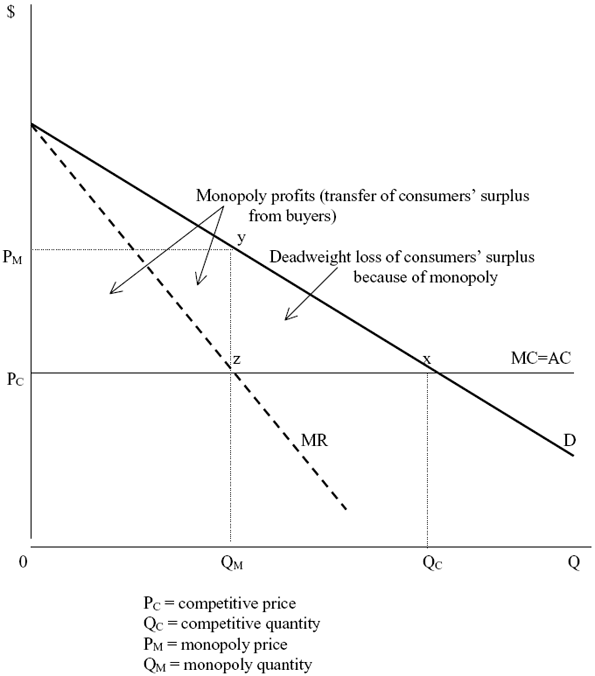
In the graph, the monopolist chooses the lower quantity , and buyers pay the higher price . Some buyers who would value additional units above their production cost do not buy them at that price. The resulting lost gains from trade are the deadweight loss. The graph helps explain why market power can provide a public-interest rationale for competition policy.
It does not explain why a seller has market power. An artificial entry restriction, control of a scarce input, and the high fixed costs of a shared network can present different situations. For a network that is impractical to duplicate, regulating a single provider may be more sensible than trying to create several competing networks. Where entry is feasible, removing an unnecessary barrier may be the more direct response. Nor does a firm’s profit alone show that its position came from political connections.
Match the mechanism, then reserve judgment
To classify a proposal, identify the defect it claims to address and how the intervention is meant to address that defect. The same policy instrument can serve different rationales: public funding might pay for a shared service or encourage beneficial research. The instrument’s name is not enough.
| Proposed intervention | Stated public-interest rationale | Claimed mechanism |
|---|---|---|
| Charge factories for harmful emissions | Negative externality | Make producers account for costs borne by others |
| Offer research support under stated eligibility rules | Positive externality | Encourage knowledge creation that benefits others beyond the researcher |
| Finance broadly shared street lighting | Public good | Pay collectively for a service whose benefits are difficult to confine to purchasers |
| Require verifiable product-safety information | Information problem | Help buyers assess a quality they cannot readily observe |
| Remove an exclusive license where multiple firms can operate | Market power | Allow entrants to put competitive pressure on the incumbent |
| Set a price cap for a network that is impractical to duplicate | Market power | Constrain a provider where direct competition may not work |
A proposed intervention may address more than one problem. A health measure, for instance, might respond both to information buyers lack and to costs imposed on others. The strongest match identifies the mechanism actually stated or supported, rather than forcing every policy into exactly one category.
Matching is only the first stage of an evidence-based judgment. A pollution rule could reduce harm while placing needless burdens on new firms. A safety standard could protect customers while being written so that only incumbents qualify. Conversely, a rule that benefits existing businesses is not automatically preferential if it addresses a real problem and is appropriately designed. Later lessons will examine those design and evidence questions in detail.
Key takeaways
The four rationales diagnose different problems: unaccounted-for effects on others, underfunded shared benefits, inadequate information, and weak competitive pressure. Match an intervention by its claimed mechanism, not by whether it involves a tax, subsidy, rule, or contract. Then keep the match separate from the harder verdict: whether the intervention works, is proportionate, and treats potential participants fairly.
The next lesson examines regulatory capture—how a regulator’s reliance on industry information or personnel can influence decisions even when regulation began with a legitimate public-interest rationale.