Welcome back. In the previous lesson, you identified economic rent as a return above what is needed to keep a resource in its current use. That return might come from scarce land, an innovation, or a government-created privilege. Today the focus shifts from the return to the activity: what does someone do to obtain or preserve an advantage?
By the end of this lesson, you should be able to distinguish rent-seeking for preferential benefits from work that creates value—and recognize that a business can do both at once. This distinction matters when political connections appear to shape rewards: the presence of a subsidy, a lobbyist, or a profitable firm is a reason to investigate, not a conclusion by itself.
A rent is a return; rent-seeking is an activity
Suppose a firm develops a better production method and earns more than it could in its next-best use of its resources. That extra return is economic rent, as you learned previously. Now suppose the firm asks officials to prohibit competing firms from using similar methods. The invention and the request for protection are different activities, even if both help the same firm earn more.
Economists commonly use rent-seeking in political economy to mean trying to obtain or protect an economic advantage through a public decision that grants preferential treatment. A firm might seek a subsidy available only to itself, an import restriction that shields it from rivals, or a rule tailored to exclude otherwise qualified competitors. The attempt counts even if officials reject it: seeking describes what the firm is trying to obtain, not whether it succeeds.
Read David R. Henderson’s “Rent Seeking” for the distinction between earning an economic rent and seeking a special political privilege. His example of asking an employer for a raise makes the terminology less misleading.
Read David R. Henderson’s Econlib article to separate the economic meaning of “rent” from the narrower political-economy meaning of “rent-seeking,” then see why efforts to secure privileges can consume resources.
Under the article’s title, begin where the opening discussion says “People are said to seek rents” and read the distinction through the paragraph that proposes “privilege seeking” as a clearer name. Notice why asking an employer for a raise is not the kind of rent-seeking at issue here. Then read the cost explanation, from the paragraph beginning “It has been known for centuries” to the end of the steel-import example. Focus on the difference between a gain to the firm and a gain to society.
The terminology is easy to overextend. A gifted worker may earn economic rent without asking the government for anything. A firm can lobby unsuccessfully for a privilege and therefore engage in rent-seeking without ever receiving the hoped-for rent. And seeking a higher price through an ordinary voluntary sale is not, by itself, the political activity described here.
The question to ask is not simply “Did someone seek a larger reward?” Most workers and businesses do. Ask instead: “What activity was expected to produce that reward?”
Competing by serving customers or by securing a favor
Two firms may spend heavily in pursuit of the same market. One hires engineers to reduce defects, tests its product, and tries to win customers on quality and price. The other asks officials for an exemption that its rival cannot obtain. Both are competing; their means of competition differ.
The first firm’s effort can create value because it improves what buyers receive or reduces the resources needed to provide it. It can fail, and it may also earn a substantial economic rent if it succeeds. Neither outcome changes the nature of the development work. The second firm’s request aims to improve its position by changing the rules in its favor rather than improving its offering. If granted, the exemption might raise its return while leaving buyers with fewer alternatives.
This short video presents that contrast. It uses rents mainly to mean government-created advantages, which is narrower than the definition from the previous lesson: scarcity and innovation can generate economic rents too.
Rent Seeking - Public Choice Theory - Michael Munger
Watch “Rent Seeking – Public Choice Theory,” presented by Michael Munger on the Institute for Humane Studies channel, for a quick contrast between competition for customers and competition for political benefits.
Watch two kinds of competition to see how the video contrasts product improvements with government-created advantages. Continue with diverted effort for its hypothetical example of a firm changing an investment decision to attract political support. Keep in mind that neither employing a lobbyist nor receiving public funding, on its own, proves preferential treatment.
Why might rent-seeking be costly even when it pays off for a firm? The firm may devote staff time and money to obtaining an advantage rather than improving its product. Competitors may spend resources trying to win or resist the same favor. If the resulting rule protects a less effective supplier, customers or taxpayers may bear further costs. A private gain is not necessarily a net gain for society.
That does not mean every government payment is wasted, or that profit alone measures all value. For example, an activity might benefit people who do not buy its product, or impose costs on people who do not buy it. Public policy can have a legitimate role in either situation. The issue for this lesson is whether the advocacy in question seeks a defensible public objective under fairly designed rules, or a special advantage that cannot be explained by that objective. Later modules will examine how to assess those claims with evidence.
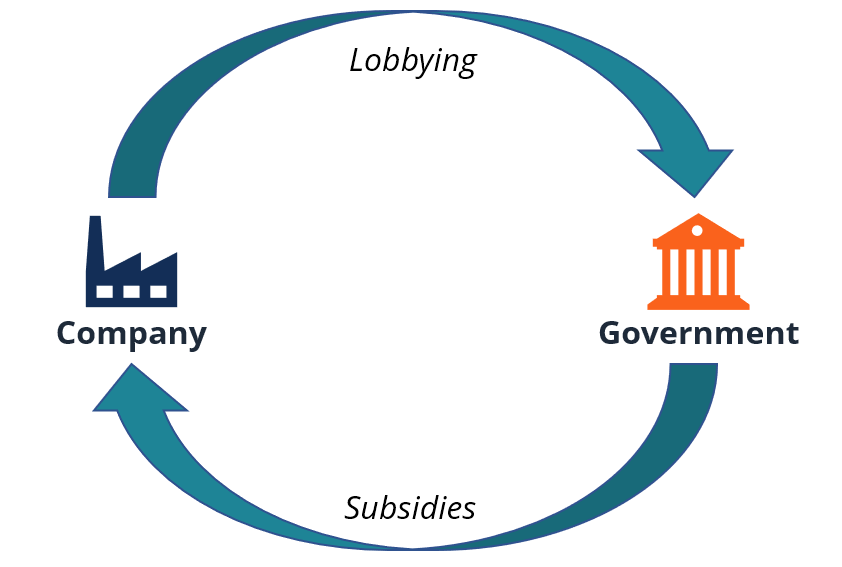
A useful correction to the diagram is that the government’s decision needs its own explanation. Did officials apply a general program’s published criteria, or change criteria to favor one applicant? The arrows alone cannot tell you.
When production and rent-seeking occur together
Consider a public agency that needs reliable water-treatment equipment. A manufacturer invests in a more durable filter, demonstrates its performance, and offers to supply it. Designing and producing a useful filter can create value. Supplying equipment through a public contract can create value too: the public agency needs a product, and someone must make it.
Now add another activity. The manufacturer asks officials to write the contract so that only its particular brand qualifies, even though other filters meet the agency’s actual performance needs. If the brand-specific condition has no sound public justification, advocating for it is an attempt to obtain a preferential advantage. The firm’s engineering and production do not erase its rent-seeking, and its rent-seeking does not make the physical filters worthless.
The following course reading makes this mixed case explicit in its discussion of a government contract. Its language strongly emphasizes the costs of pursuing favors. Read it alongside an important qualification: preparing a useful technical proposal or demonstrating product quality to a public buyer is not automatically wasteful or preferential. The purpose and effect of the effort matter.
Rent-Seeking and Regulatory Capture | EBF 200
Read the “Rent-Seeking” subsection of the Penn State course page for an example in which obtaining a public contract and fulfilling it are distinct activities.
In “Rent-Seeking,” pass the opening discussion of theft and begin with the paragraph starting “Now, putting aside the notion of simple theft.” Read the contract discussion through the paragraph ending with resources spent acquiring a contract rather than producing its goods. Focus on the author’s distinction between seeking a government favor and making the contracted product; do not treat every cost of preparing a bid as evidence of a favor.
To classify a mixed case accurately, describe the activities separately. In the filter example:
- Value-creating activity: developing a durable filter and supplying one that meets a genuine public need.
- Potential rent-seeking activity: pressing for an unnecessary brand-specific requirement that excludes capable competitors.
- Possible economic reward: extra profit from facing less competition. Whether that profit is economic rent still depends on the next-best return, as in the previous lesson.
Notice what is not enough to settle the case. The firm’s employment of lawyers does not establish its aim; lawyers might help it meet legitimate requirements. Nor does its investment in engineering prove that its proposed contract terms are fair. You need to know what the firm requested, why the agency adopted it, and whether other suppliers could meet the underlying need.
The same separation applies to a subsidy. A business might develop a useful technology and also lobby for funding restricted to its own technology, despite other approaches achieving the stated public goal. The technology may create value while the request for narrow eligibility seeks preferential treatment. Alternatively, advocating for a generally available program to address a well-supported public problem is not automatically rent-seeking merely because the advocate might benefit. The program’s justification and design matter.
A practical way to classify an activity
When a case combines business success with political advocacy, start with the specific action, not a label for the whole firm or industry.
First, identify what the firm does for customers or the public. Is it making a product, improving quality, lowering costs, or providing a needed service? Then identify what it asks government to do. Is it seeking a rule that applies on relevant, consistent terms, or one that gives it a selective exemption, payment, or shield against capable competitors? Finally, keep the observed outcome separate from the suspected motive. A request for a narrow rule may raise a question, but evidence about its purpose, alternatives, and effects is needed to judge it.
This approach avoids three common shortcuts:
- “It earns extra profit, so it must be rent-seeking.” Extra returns can arise from scarcity or innovation without any effort to gain political protection.
- “It lobbied, so it must be rent-seeking.” Advocacy can convey information about a genuine public problem. What was requested, and who could qualify, matter more than the job title of the person making the request.
- “It makes something useful, so it cannot be rent-seeking.” A valuable product and an attempt to secure an unjustified privilege can coexist.
These distinctions are especially important when costs and benefits fall on different people. A restricted market may bring a substantial benefit to a small group while imposing modest costs on many customers. The beneficiaries have a strong reason to pursue the rule even if the aggregate costs exceed the benefits. That possibility helps explain why a firm might seek preferential treatment; it is not evidence that any particular firm did so.
Key takeaways
Economic rent names a return; rent-seeking names an effort to obtain or preserve an advantage. In this course, the relevant effort is aimed at preferential benefits through public decisions. Improving a product, lowering costs, or fulfilling a useful contract can create value. Seeking an unjustified rule that excludes capable rivals can be rent-seeking. A firm may do both, so classify its actions separately rather than giving the entire business a single label.
The next lesson will make the political mechanism more precise: you will trace a proposed path from a connection, through a public decision, to an economic reward, while distinguishing a plausible story from an established one.