In our last lesson, we conducted a thorough assessment of the long-term commitments involved in duck ownership, covering lifespan, finances, and daily time requirements. With this foundational understanding of the resources needed, we can now move to a more specific planning stage. This lesson addresses a critical decision that directly impacts your future daily routine, costs, and overall experience: the size and gender composition of your flock.
Your goal is to keep runner ducks primarily as pets and for garden pest control, with egg production as a secondary benefit. By the end of this lesson, you will be able to compare the pros and cons of different flock sizes and compositions, enabling you to choose the structure that best aligns with your goals and capacity for care.
The First Rule of Flock Size: Never Just One
Before we analyze different gender compositions, we must establish the most fundamental rule of duck keeping: you can never have just one duck. Ducks are highly social animals, and their well-being is intrinsically tied to living in a flock. A solitary duck will experience significant stress and loneliness, which is detrimental to its health.
The following resource provides a clear rationale for this rule.
Ducks 101: What To Know BEFORE You Bring Them Home! | Beginner Duck Care Guide 🦆
This clip from the "Ducks 101" guide by Cheese and Quackers Homestead explains why ducks are flock animals and gives a minimum recommended number.
Please watch the section from First one being, where the speaker discusses the mistake of keeping a single duck. Note the recommendation for a minimum of two, but ideally a group of three or more. This ensures that if one duck passes away, the other is not left alone.
With this non-negotiable social requirement in mind, let's analyze the three primary options for flock composition: an all-female flock, an all-male flock, and a mixed-gender flock.
Flock Composition: Analyzing the Options
A survey of duck owners shows that mixed-gender flocks are the most common arrangement. However, "most common" does not necessarily mean "best," especially for a first-time owner. Each composition has distinct advantages and disadvantages related to behavior, health, and management effort.
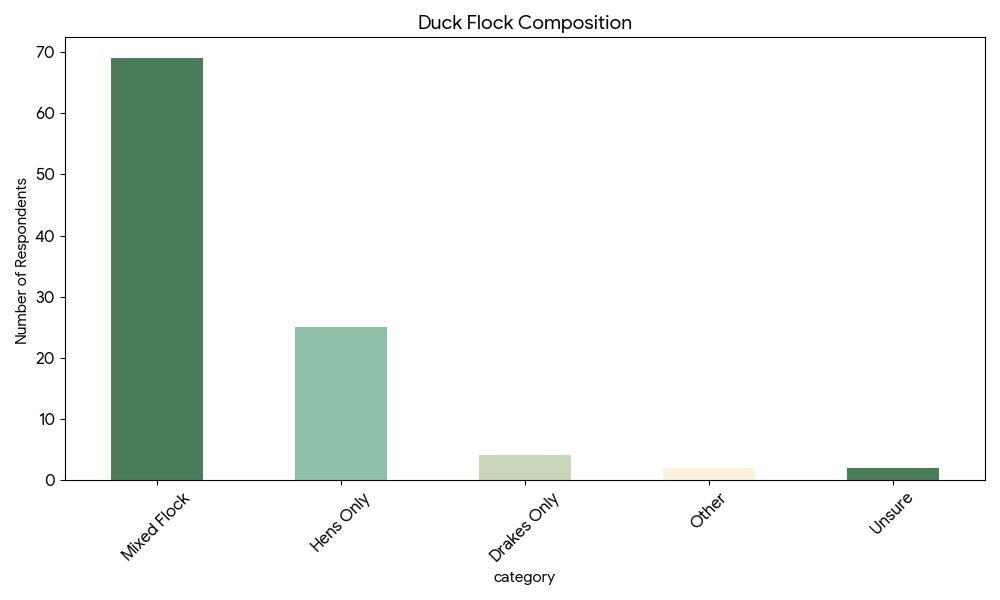
Let's break down the pros and cons of each option to determine the best fit for your specific goals.
Option 1: The All-Female (Hen) Flock
An all-female flock is often recommended for beginners. It offers a straightforward and harmonious entry into the world of duck keeping.
-
Pros:
- Egg Production: You will receive a steady supply of eggs (your secondary goal) without needing a male. Hens will lay eggs regardless of whether a drake is present.
- Lower Aggression: While hens establish a pecking order, their social dynamics are generally far less aggressive and complex than those in a mixed flock.
- Simplified Management: You avoid all the challenges associated with managing hormonal drakes, which we will detail shortly.
-
Cons:
- Reproductive Health Risks: Prolific egg-laying can predispose hens to health issues like egg binding (when an egg gets stuck) or oviduct infections. We will cover these conditions in Module 5.
- Dominance Displays: You may occasionally observe female ducks mounting each other. This is a normal hormonal or dominance behavior, not a sign of same-sex pairing, and is usually harmless.
This option is ideal if: Your interest in eggs is a significant factor and you prefer a lower-maintenance, less behaviorally complex flock to start with.
Option 2: The All-Male (Drake) Flock
An all-male flock is a less common but highly viable option, particularly well-suited for owners whose primary goal is companionship and pest control.
Should you get male or female ducks? - Tyrant Farms
This article from Tyrant Farms directly addresses the question of an all-drake flock in its FAQ section, outlining several compelling benefits.
Please read the answer to the question Does it ever make sense? Focus on the author's reasoning for why drakes can require less care and may live longer.
-
Pros:
- No Egg-Related Health Issues: As the article notes, drakes are not subject to the physiological stress and potential complications of egg-laying, which can contribute to a longer, healthier life.
- Peaceful Dynamics (without females): When raised together from a young age without any hens present, a group of drakes will typically coexist peacefully.
- Addressing a Rehoming Need: Many people who buy unsexed ducklings end up with too many males. As a result, there is a "rehoming crisis" for drakes. Choosing to keep an all-drake flock provides homes for animals that are often difficult to place.
-
Cons:
- No Eggs: This is the most obvious drawback.
- Cannot Add Females: Introducing hens to an established group of drakes would trigger intense competition and aggression. This composition is a final decision.
This option is ideal if: You prioritize ducks as pets and pest controllers and have no strong desire for eggs. It aligns perfectly with your primary goals and offers a lower-risk path regarding reproductive health management.
Option 3: The Mixed-Gender Flock
This is the most natural composition but also the most complex to manage. It requires a deep understanding of duck biology and behavior to ensure the welfare of all flock members.
The Biological Driver: Drake Hormones
The primary challenge of a mixed flock is managing the male reproductive drive. Unlike the courtship dances of many other birds, duck mating can appear aggressive. This is not maliciousness, but a hardwired evolutionary strategy.
Duck Mating Season: Managing Aggression, Ratios, and Reproductive Health
This article from "Ducks of Providence," written by a fellow PhD scientist, provides a superb, biologically-grounded explanation of duck mating behavior and the critical importance of flock ratios.
To understand the complexities, please read the following sections: Start with The Biological Reality to understand the evolutionary basis for drake behavior. Next, read the section Spring Surge. This explains the behavior of neck-grabbing and the risks of overmating. Finally, read the section on The Ideal Ratio to learn the most important management rule for mixed flocks.
Pros and Cons of a Mixed Flock
-
Pros:
- Fertile Eggs: You have the option to hatch your own ducklings.
- Natural Flock Dynamics: You can observe the full spectrum of duck social behaviors.
-
Cons:
- The Drake-to-Hen Ratio is Crucial: As the article emphasizes, you must maintain a ratio of at least 1 drake to 3-5 hens. Any fewer hens per drake will result in overmating, leading to stress, feather loss, and serious injuries for the females.
- Risk of Physical Harm: This is a point where your scientific background is particularly relevant. Mating poses two significant physical risks, especially in mixed-breed flocks:
- Skeletal & Respiratory Trauma: A heavy drake can fracture a smaller hen's pelvis (the synsacrum) or compress her chest, causing asphyxiation.
- Drowning: Because birds lack a diaphragm, they rely on rib cage expansion for breathing. A heavy drake can exceed a small hen's buoyancy threshold in the water, holding her submerged and preventing her from breathing.
- High Management Effort: To protect hens during the spring breeding season, you will likely need a separate enclosure, or "drake jail," to give the hens a rest. This adds complexity and cost to your setup.
- Drake-on-Drake Aggression: Keeping more than one drake in a mixed flock almost always leads to intense fighting. While exceptions exist, such as the bonded brothers in the video below, it is not a recommended setup for a beginner.
Why The Runner Ducks Are Perfect for Your Backyard!
The presenter at Lilac Oaks Farm shares her personal experience managing Runner Duck drakes.
Watch the segment from I try to separate and then from you cannot have. She describes drakes as "overbearing" and explains her unique situation with two bonded brothers, highlighting that this is not typical and that managing drakes is a key challenge.
Summary and Recommendation
Choosing your flock composition is a trade-off between your goals and the level of management complexity you are willing to undertake.
| Flock Composition | Egg Production | Behavioral Complexity | Aggression Risk | Key Advantage | Best For |
|---|---|---|---|---|---|
| All-Female | Yes | Low | Low | Eggs with harmony | Beginners wanting eggs. |
| All-Male | No | Low | Low | Low health risk, ethical | Owners wanting only pets. |
| Mixed-Gender | Yes (Fertile) | High | High | Natural behavior, breeding | Experienced owners. |
Given your primary goals are pets and pest control, and you are a first-time owner, the analysis points strongly toward either an all-female flock or an all-male flock.
- An all-female flock (of 3-4 hens) would be an excellent starting point. It fulfills your secondary goal of eggs while keeping the social dynamics simple and manageable.
- An all-male flock (of 3-4 drakes) aligns perfectly with your primary goals, offers unique benefits in terms of health and longevity, and helps address the ethical issue of unwanted drakes.
Starting with a mixed-gender flock is not recommended until you have at least a year of experience and are prepared for the significant management challenges involved.
Conclusion
You can now systematically analyze the trade-offs between different flock compositions. You understand the non-negotiable need for a flock of at least three ducks and the distinct pros and cons associated with all-female, all-male, and mixed-gender groups. The key takeaway is that the "best" flock is the one that fits your goals and management capacity, ensuring a positive experience for both you and your ducks.
In our next lesson, we will tackle the practical question of where to find your future flock members. We will evaluate the different sources for acquiring runner ducks—including breeders, hatcheries, and rescues—to ensure you start with healthy, well-adjusted animals.