Welcome back. The previous lesson showed why a successful memory task does not reveal exactly what someone experienced while doing it. Dreaming raises a related problem: a dream happens during sleep, but researchers usually learn about it from a report made after waking. This lesson separates three claims that are often treated as interchangeable: inability to visualize voluntarily while awake, imagery experienced during a dream, and remembering and reporting that dream afterward.
The aim is to evaluate evidence without replacing one stereotype with another. “People with aphantasia cannot dream visually” is too broad; so is “dreaming is entirely unaffected.” Plan on about 35–40 minutes, including the short video and readings.
Waking visualization and dreaming are different situations
Voluntary visualization means deliberately trying to picture something while awake. A dream image, if experienced, arises during sleep without the same kind of deliberate waking effort. A person could therefore report no picture when asked to visualize a familiar face, yet report seeing a face in a dream. That combination is not a contradiction: the two reports concern different circumstances and different demands on imagery.
In this short excerpt, researcher Adam Zeman describes reports of visual dreams from people who reported lacking waking visualization. Listen for the distinction between some participants reporting visual dreams and a claim about everyone with aphantasia.
Blind Mind's Eye - The Science of Aphantasia with Dr. Adam Zeman
In “Blind Mind’s Eye,” presented by Adam Zeman on Aphantasia Network, two brief passages introduce the waking-versus-dreaming distinction and its variation across individuals.
Watch early reports, where Zeman describes a small initial group in which more than half reported visual dreams. Then watch dreaming distinction, where he discusses people who report visual dreams and others who do not. Treat the reported proportion as a result from particular participants, not a percentage established for all people with aphantasia.
The video offers a plausible reason that waking and sleeping imagery might differ: brain activity and neurochemistry change across states. That is an explanation worth investigating, not proof of a specific mechanism that produces dream images in a particular person. First, we need to be clear about what the dream evidence actually measures.
What a dreaming questionnaire can—and cannot—show
A study titled A cognitive profile of multi-sensory imagery, memory and dreaming in aphantasia compared questionnaire responses from participants with aphantasia and control participants. It used two relevant instruments. The Imaginal Process Inventory (IPI) asked about reported daydreaming and night dreaming; one example item concerns how vividly someone recalls night dreams. The Subjective Experiences Rating Scale (SERS) asked people to rate qualities they generally experience in dreams, such as color, other sensations, and awareness.
Read the methods before the results. The wording of the questions determines what a score can mean.
A cognitive profile of multi-sensory imagery, memory and dreaming in aphantasia
This research paper describes the questionnaires and then reports group differences. Read it to distinguish a response about recalled dreams from a direct observation of dreaming during sleep.
In “Dreaming and daydreaming questionnaires,” read the measures, from the description of the IPI through the description of the SERS components. Notice the example item about recalling night dreams and the separate example about colors during dreams. Then, in “Day and night dream results,” read the results, from the opening comparison of daydreaming and night dreaming through the final finding about thinking during dreams. Focus on which findings concern reported frequency and which concern reported qualities.
In this sample, the aphantasia group reported fewer night dreams than controls. They also gave lower ratings for the sensory qualities of dreams they reported, across visual and other sensory domains. The researchers found a group difference in reported dream awareness and control, too. They did not find a significant group difference on every feature: for example, their comparisons of within-dream cognition and spatial complexity did not show significant differences. The daydreaming-frequency comparison did not remain significant after the study’s correction for multiple comparisons.
The chart below displays the questionnaire-score distributions across several domains. Its “Night” and “Day” rows are useful here, but the horizontal scale represents median-centered questionnaire scores, not a count of dreams observed by researchers.
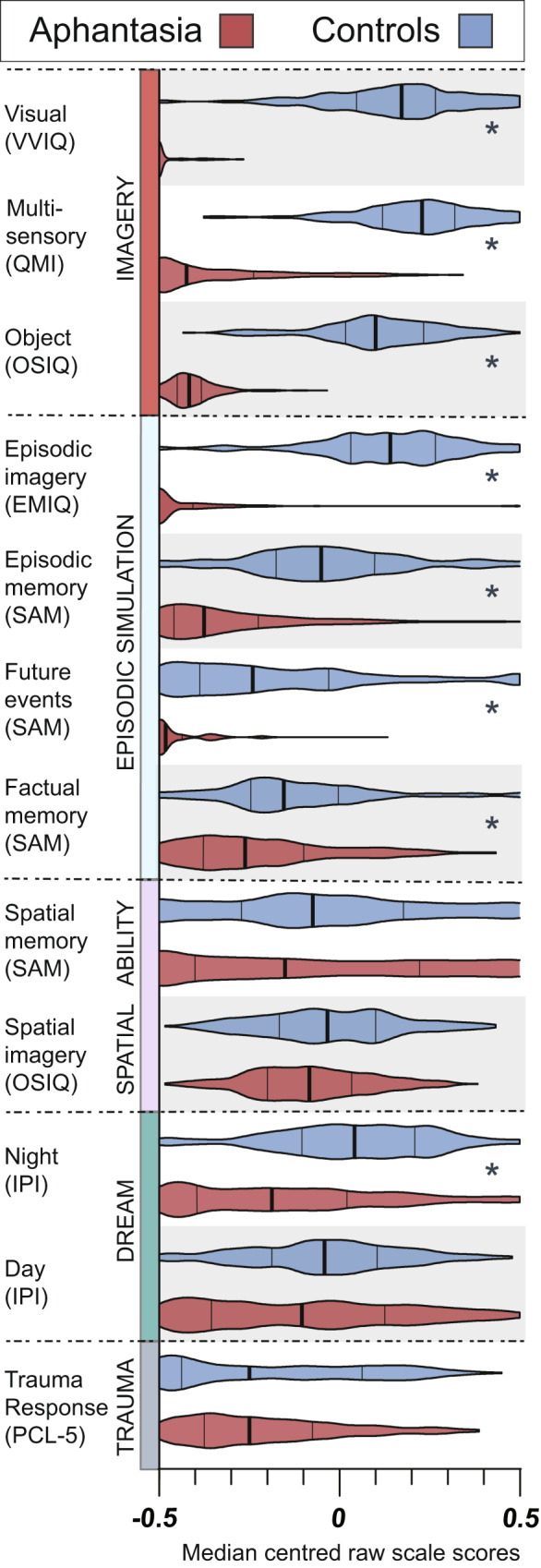
Notice how the study and Zeman’s examples can both be true. Some people who cannot visualize voluntarily while awake report visual dreams. At the same time, a group of people with aphantasia can, on average, report fewer night dreams or less sensory dream content than a comparison group. A group average does not describe every member, and an individual example does not erase a group difference.
A dream report has a memory problem built into it
Consider the statement “I did not dream last night.” It might mean no dream experience occurred. It might also mean a dream was experienced but was never stored well enough to recall, could not be retrieved on waking, or could not be put into a report. Those possibilities are difficult to separate using a morning questionnaire alone.
A review called New strategies for the cognitive science of dreaming explains this limitation and describes an unusual way researchers try to reduce it.
New strategies for the cognitive science of dreaming
This review examines the gap between dreaming and later reports. Read it to understand why fewer reported dreams do not, by themselves, establish fewer dreams experienced.
In the opening discussion, before Box 1, read the report limitation, from the difficulty of observing dreams directly through the proposed alternatives. Then, in “Observing dreams with real-time reporting,” read the real-time approach. Follow how signaling during a lucid dream can reduce reliance on later recall, and note the review’s cautions about low success rates and selected participants.
The four-stage model below turns that distinction into a useful reading tool. It is a model of where information might be lost, not a test that identifies which stage explains any particular person’s report.

For the questionnaire study, the distinction matters in two ways. First, a lower night-dream score may reflect less dream experience, reduced recall, differences in reporting, or some combination. The study’s self-reports do not isolate those causes. Second, ratings such as “how much color was in your dreams” are evidence about remembered and reported dream qualities. They are valuable first-person data, but researchers did not watch each participant’s dream and independently score its color.
Real-time signaling during lucid dreams offers a partial way around the delay between experience and report. In the review, researchers use sleep measurements to check that signals occur during sleep. The review also describes accurate responses during sleep in cases without later recall—an especially vivid reason not to equate “no report afterward” automatically with “nothing happened.” It does not establish what every unremembered dream felt like. Moreover, lucid-dream studies often depend on people able to become lucid and signal successfully; they are not a direct measurement of dreaming across people with aphantasia.
Making claims at the strength of the evidence
The most defensible interpretation keeps person, measure, and inference together. Reports of visual dreams from people lacking voluntary waking imagery show that waking visualization and reported dream imagery can come apart. Questionnaire group comparisons show differences in reported night-dream frequency and sensory qualities in the studied groups. Neither result warrants an absolute claim about everyone’s sleeping experience.
| Claim | What the evidence permits |
|---|---|
| “Someone with aphantasia can report seeing a dream.” | Yes. Lacking voluntary waking imagery does not rule out reported visual dreams. |
| “People with aphantasia never have visual dreams.” | No. Reports of visual dreams provide counterexamples. |
| “A group reported fewer night dreams and less sensory dream content.” | Yes, for the group comparison in the study, with “reported” retained. |
| “They objectively dreamed less often.” | Not established by questionnaires alone; occurrence and recall were not separately measured. |
| “Everyone with aphantasia dreams just like everyone else.” | Not supported by the group differences or by individual variation. |
This way of stating the findings is not merely cautious wording. It preserves the central scientific question: whether a difference in a later account reflects a difference in the dream as experienced, the memory of it, or both.
What to carry forward
Aphantasia concerns difficulty or inability to form voluntary visual imagery while awake; it is not, by definition, the absence of dream images. Some people with aphantasia report visual dreams, while one questionnaire study found lower average reports of night-dream frequency and sensory qualities in its aphantasia group. Because dreams are usually assessed after waking, dream experience, dream recall, and dream reporting must remain separate.
The next module turns to creativity and broader claims about aphantasia. The same habit will help there: identify what was measured, then check whether a popular conclusion goes beyond it.