Welcome back. The previous lesson found that describing a personal event and recognizing previously seen material place different demands on memory. This lesson applies the same care to pictures of rooms. If someone draws fewer objects from a remembered scene but puts the objects they do draw in the right places, what does that tell us? We will separate object memory, spatial memory, and the conscious experience of picturing something—three things that need not rise or fall together.
A drawing can reveal more than one kind of memory
Imagine studying a photograph of a room for ten seconds and then drawing it after the photograph disappears. A researcher could count how many objects you include, examine their colors or features, and measure where you place them. Those are different scores, even though they come from one drawing. None directly records whether you saw a mental picture while drawing.
The diagram below shows the sequence used in a study by Wilma Bainbridge and colleagues. Participants studied three scenes, drew them from memory, took a recognition test, and later copied the same scenes while looking at them.
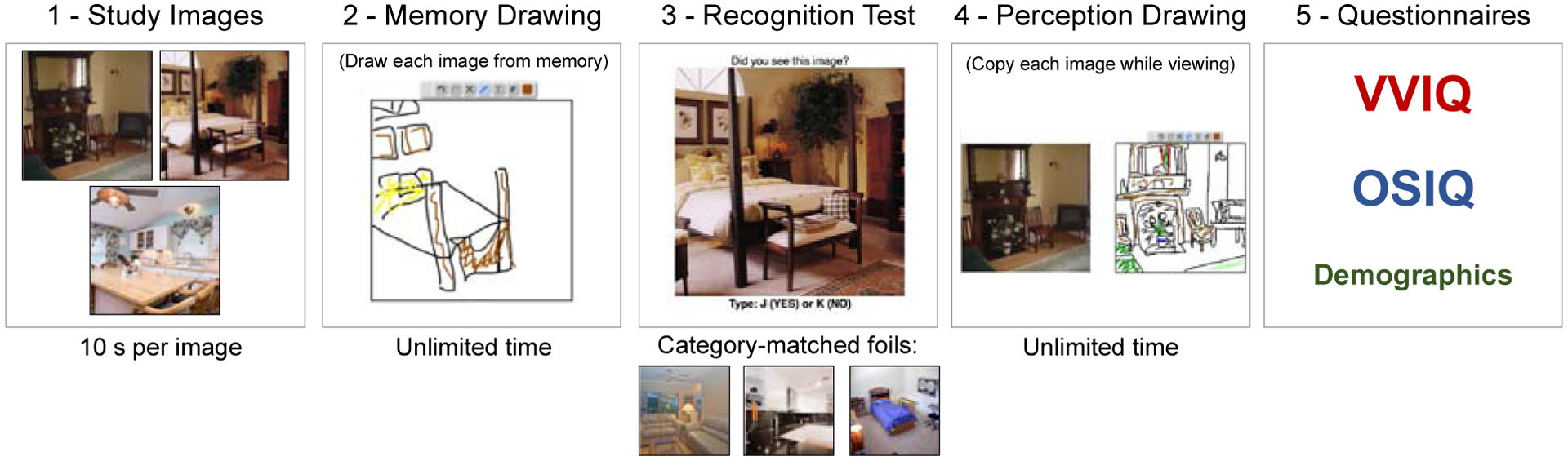
The copying condition matters. If one group draws fewer objects only when the photograph is absent, a simple explanation such as “they cannot use the drawing tool” becomes less convincing. Copying is not a perfect control for every difference in attention or strategy, but it makes the memory-specific pattern more informative.
Watch Bainbridge explain how the researchers arranged the comparison. Her account is useful for understanding what each phase can measure; the drawing itself should not be treated as a literal image of a participant’s inner experience.
Quantifying Aphantasia through Drawing With Wilma Bainbridge
In “Quantifying Aphantasia through Drawing,” researcher Wilma Bainbridge explains the scene-study, memory-drawing, recognition, and copying phases of the experiment.
Watch the study design. Focus on when the photographs were visible, when participants had to rely on memory, and why recognizing a photograph is not the same task as drawing it.
Fewer remembered objects, but accurate positions
In the study, participants reporting aphantasia drew fewer objects from memory on average than controls with typical imagery: about 5 versus 6.3 objects per scene. Their memory drawings also contained color less often. Yet when participants copied the visible photographs, the researchers did not find the same group difference in object count. This supports a difference in what participants produced during recall, rather than a general inability to perceive or draw the scenes.
There is an important qualification about “detail.” The researchers found less color and less time spent drawing each remembered object in the aphantasia group. But a separate rating of fine traits within the objects that were drawn did not detect a group difference. “Fewer objects and less color in memory drawings” is therefore more precise than “every remembered object was less detailed.”
Spatial placement showed another pattern. Independent scorers marked the locations and sizes of objects appearing in the drawings. For objects participants had included, the two groups placed them with comparably high accuracy relative to the source photographs. The image below displays average placements over the original scenes.
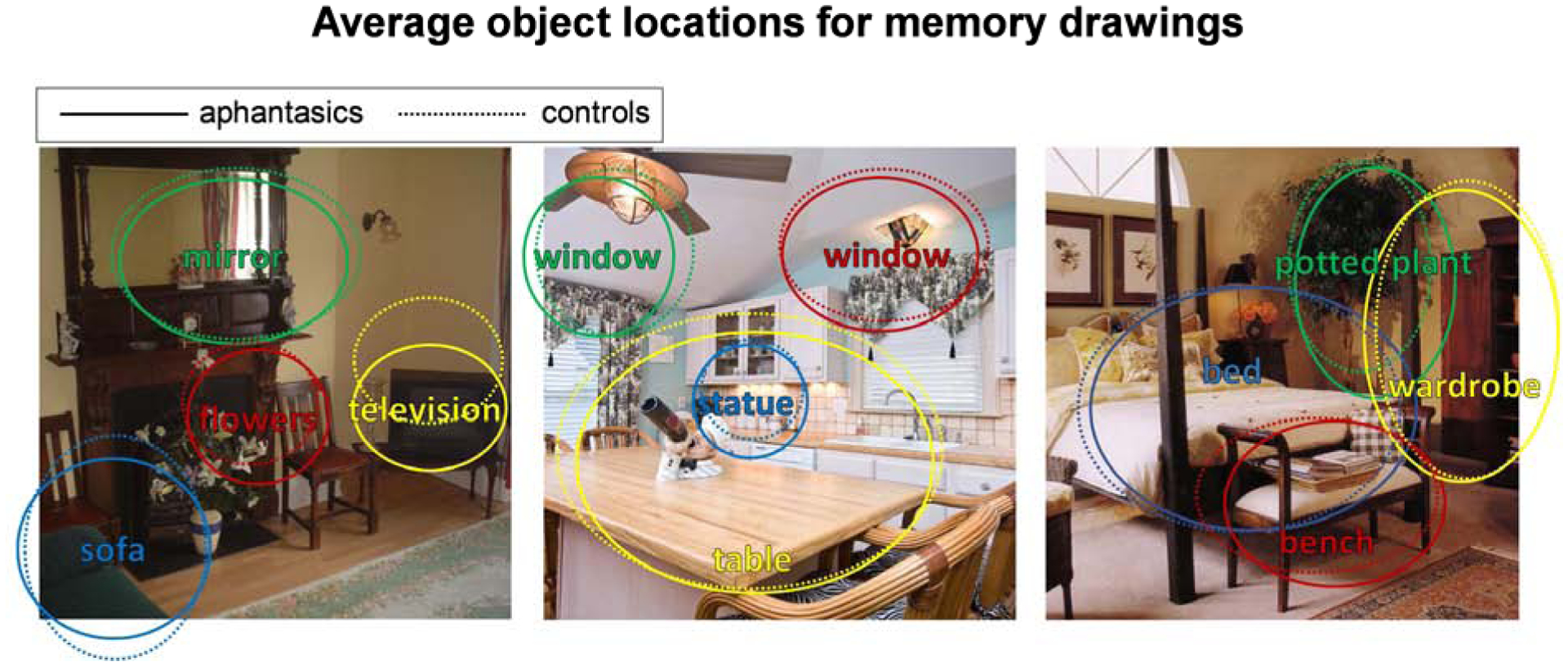
That last distinction is essential. Location accuracy was assessed for objects that made it into a drawing. It cannot show that a participant remembered the positions of objects they omitted. Equally, omitting an object from a drawing does not prove that no information about it was available to the participant.
The drawings offered clues about possible strategies. Written labels appeared more often in the aphantasia group’s memory drawings, and some participants described remembering lists or verbal descriptions of scene components. Such reports are consistent with combining knowledge of what was present with knowledge of where it belonged. They do not establish one universal strategy used by everyone with aphantasia.
Watch the results with these limits in mind. The presentation includes striking example drawings, but the group measurements—not a selected example—support the comparison.
Quantifying Aphantasia through Drawing With Wilma Bainbridge
Bainbridge now shows the memory and copying drawings and explains how the researchers scored objects, labels, positions, and errors.
Start with drawing examples to see why the copying condition matters. Then watch the measured results. Pay particular attention to the ellipses used for spatial scoring, and remember that they locate objects actually drawn.
Participants with aphantasia also drew fewer objects that had not appeared in the source scenes. That is a finding about false insertions in this task, not proof that they are generally less susceptible to false memories: drawing fewer objects overall could affect the opportunity to insert an incorrect one. On the recognition test, both groups scored near the top of the scale. This shows that both readily identified these particular photographs among the alternatives; a near-ceiling test may miss subtler differences.
Taken together, the results resist either sweeping conclusion. They do not show that object memory is absent in aphantasia—participants drew several correct objects per scene. Nor do they show that all visual memory is unaffected—the object counts differed during recall. They show a task-dependent contrast between recalled object content and placement of recalled objects.
Does success on another spatial task imply a mental picture?
A second paper tests that assumption from a different angle. In Pattern Recognition Memory, participants saw unfamiliar patterns and later selected the previously seen pattern from a pair. In Spatial Span, they watched squares change color in sequence and selected the squares in the same order. The first tests recognition of visual patterns; the second tests short-term memory for a sequence of locations. Neither asks participants to describe what, if anything, they consciously pictured.
Individuals with congenital aphantasia show no significant ...
Read these selected methods and results from the paper by Zoë Pounder and colleagues to compare pattern recognition with spatial-sequence memory. The point is to identify the task demand before interpreting a group score.
On pp. 6–7, in “2.2.1. Cambridge Neuropsychological Test Automated Battery (CANTAB),” read the “Pattern Recognition Memory” description, beginning where the patterns are introduced. Then read “Spatial Span,” from the square sequence through its scoring measures. Skip the other task descriptions. On p. 10, under “3.1.1. Pattern Recognition Memory,” read the recognition result and continue to the end of that short subsection, just before “3.1.2. Verbal Recognition Memory.” On pp. 10–11, under “3.2.1 Spatial Span,” read the spatial results. Notice which scores were compared, rather than treating both tasks as a single measure of “visual memory.”
The researchers did not detect a significant group difference on either of those tasks. That does not prove identical performance across all pattern or spatial-memory tasks. It does show why low voluntary visual imagery cannot, by itself, be taken to imply failure at recognizing an unfamiliar pattern or retaining a sequence of locations.
These findings also do not cancel the drawing study. Selecting a previously seen pattern from two visible options is unlike producing the contents of a room on a blank canvas. Spatial Span asks for an ordered sequence of positions, not a detailed reconstruction of objects in a scene. What a task requires determines what a good score can tell us.
Mental rotation provides an especially tempting shortcut: if someone judges that two differently oriented shapes match, it can feel as though they must have turned a visible picture in their mind. Watch a short explanation of why similar performance by people with and without reported visual imagery makes that inference unsafe.
Joel Pearson Extreme Imagery 2021 (Aphantasia and mental imagery)
In “Joel Pearson Extreme Imagery 2021,” researcher Joel Pearson discusses mental rotation as a task that may draw heavily on spatial transformation.
Watch mental rotation. Focus on the distinction between judging how a shape changes orientation and consciously seeing the shape rotate. Treat the proposed account of the underlying process as an interpretation, not something a correct answer reveals directly.
A person might solve such a task using spatial relations, learned rules, or another strategy; a person who can visualize might use a picture. Comparable accuracy does not prove that the groups used identical processes. Conversely, a report of no conscious picture does not mean that no spatial information was represented. Successful performance identifies an ability demonstrated on the task, not the private experience or exact mechanism that produced it.
What to carry forward
Object identity, visual features, spatial layout, recognition, and conscious imagery are related but separable. In scene drawings, the aphantasia group recalled fewer objects while placing the objects they drew comparably accurately. In other studies, participants with aphantasia performed comparably on particular pattern-recognition and spatial-sequence tasks. These results rule out the simple assumption that accurate visual or spatial performance always requires a conscious mental picture; they do not establish that imagery never helps, or that every person uses the same alternative strategy.
Next, we will apply the same separation of experience from performance to dreaming: reported dream images, remembering a dream, and voluntarily visualizing while awake are different claims requiring different evidence.