Welcome to our third lesson. In our previous discussion, we defined literary realism as a 19th-century movement that, in reaction to Romanticism, sought to portray life with truth and objectivity. We touched upon its historical and philosophical context, establishing that it was a product of its time.
Today, we will delve into the material conditions of that time. Our goal is to understand the specific social and economic forces—namely industrialization, urbanization, and the rise of the middle class—that created the world the realists were so determined to capture. Think of this as examining the initial conditions of a system; by understanding the environment, we can better understand why the literary output evolved as it did. This exploration will provide the crucial backdrop for the novels we are about to study, whose plots and characters are deeply enmeshed in the very struggles and opportunities these changes created.
A World in Flux: Industrialization and Urbanization
The 19th century was a period of unprecedented transformation. The Industrial Revolution, which began in Britain and spread across Europe, systematically dismantled the old agrarian, rural way of life. For the first time in history, masses of people left the countryside to seek work in factories, leading to the explosive growth of cities. This created a new human landscape—one that was crowded, dynamic, often brutal, and ripe for literary observation.
A short academic article on Honoré de Balzac provides an excellent summary of how these forces created a perfect environment for realism to flourish.
[PDF] Honoré de Balzac and the Rise of Realism in Literature
This text explicitly connects the major historical shifts of the 19th century to the emergence of realism as a literary form.
Please read the paragraph under the heading "Historical Context and Balzac’s Contribution to Realism" that begins here. Then continue to the next section, "The Social and Political Landscape of Balzac’s Time," and read the paragraph starting here. Focus on how the author describes these changes as having "created fertile ground for realist literature."
This phenomenon was not unique to France. Across the continent, writers found themselves compelled to grapple with these new realities. In an interview, scholar Vadim Shneyder discusses how Russian literature also responded directly to the onset of capitalism.
A Chat with Vadim Shneyder about Russia's Capitalist Realism
This interview highlights the universality of the economic and social changes that fueled realism across Europe.
Read the first response from Vadim Shneyder. Note the list of phenomena he mentions: "urban migration, industrialization, the growth of railroad and banking industries." These are the very engines of the new society that realist authors sought to document.
This new urban world was a chaotic mixture of classes, professions, and fortunes. The painting Work by Ford Madox Brown, completed in 1865, is a masterful visual representation of this new social reality.

The Rise of a New Power: The Bourgeoisie
The economic shifts of industrialization created not just new landscapes, but new people. The most significant of these was the bourgeoisie, or the middle class. Unlike the aristocracy, whose power was based on inherited titles and land, the bourgeoisie's power came from capital—wealth generated through manufacturing, commerce, finance, and the professions. This new class brought with it a new ideology that would come to dominate the 19th century.
A short documentary from the British Library provides a superb analysis of the English middle class, whose values and anxieties were mirrored across Europe.
This video explains the origins, values, and social impact of the Victorian middle class.
Please watch from the beginning to understand why class became an obsession in this period of rapid change. Then, continue watching the next segment from the explanation of middle-class values. Pay close attention to the core tenets of this new ideology: individualism, meritocracy, hard work, and free trade, as well as the crucial social distinction it created between the "deserving" and "undeserving" poor.
As the video explains, this new ideology was revolutionary. It suggested that a person's station in life was not fixed by birth but could be achieved through individual effort. This idea was particularly potent in post-revolutionary France, where the old aristocratic hierarchy had been formally dismantled. This created a society in constant motion, driven by ambition and the pursuit of wealth.
The following segment from a documentary on Balzac explains this dynamic perfectly.
How Balzac's Uncensored Novels Defined Post-Napoleonic Life | Literary Classics
This part of the documentary explores how Balzac's novels reflect the new social mobility and the central role of money in post-revolutionary France.
Watch the segment from this discussion on social mobility. The commentator notes Balzac's great achievement was depicting this "dynamism," this "constant motion of Capital," where people could rise and fall.
Money, Class, and Social Commentary
In this new bourgeois, capitalist world, money became the ultimate measure of all things. It dictated social status, romantic prospects, and moral choices. For realist authors, to describe society truthfully meant to describe how money functioned as its engine. Novels became laboratories for observing the effects of economic forces on human character.
The Balzac documentary makes this point explicitly.
How Balzac's Uncensored Novels Defined Post-Napoleonic Life | Literary Classics
This clip continues the analysis of Balzac's work, focusing on money as a primary theme.
Please watch from this point, where money is described as "one of the main characters" in Balzac's novels, with relationships being described in monetary terms and social climbing achieved through speculation and marriage.
This focus on class and economic exploitation was not merely descriptive; it was often deeply critical. By laying bare the mechanics of their society, realist authors exposed its inequalities and hypocrisies. This is starkly illustrated in a famous Russian political cartoon from 1900, which depicts the class structure of the Russian Empire as a pyramid.
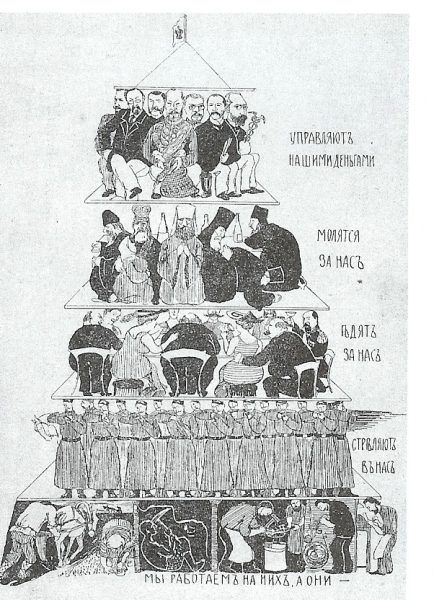
This critical impulse is a key dimension of realism. By documenting the "unvarnished truth," these authors were providing a powerful social commentary.
[PDF] Honoré de Balzac and the Rise of Realism in Literature
This final reading reinforces how realism functions as social critique.
Please read the section titled "Realism as a Social Commentary". It emphasizes that Balzac's work "expose[s] the contradictions and hypocrisies of French society, particularly the tensions between the ideals of equality and the realities of class disparity."
Conclusion
In this lesson, we have explored the material foundations of literary realism. We have seen how the profound social and economic upheavals of the 19th century provided both the setting and the subject matter for this new literary movement.
Here are the key takeaways:
- Industrialization and Urbanization: The shift to factory production and the mass migration to cities created a new, complex, and often harsh urban environment that became the principal stage for realist fiction.
- The Rise of the Bourgeoisie: A new and powerful middle class emerged, whose wealth was based on capital, not lineage. This class brought a new ideology centered on individualism, competition, and meritocracy.
- Money and Class as Central Themes: In this new society, money and social class became the primary drivers of conflict and motivation. Realist authors meticulously documented and often critiqued the ways these economic forces shaped individual lives and societal structures.
You now have a grasp of the "what" (the definition of realism from our last lesson) and the "why" (the socio-economic conditions that produced it). In our next lesson, we will complete our foundational module by taking a closer look at the philosophical "how"—the intellectual currents of positivism, empiricism, and materialism that provided realist authors with their method for interpreting this new world.