In our last lesson, we examined the powerful philosophical currents of empiricism, positivism, and materialism that shaped the 19th-century mind. We saw how these ideas gave writers a new lens for viewing reality and a new mandate for their art: to observe, document, and analyze the world with scientific rigor. Now, we will bring together everything we've discussed—the historical context, the social upheavals, and the philosophical foundations—to construct a clear and practical definition of literary realism.
This lesson directly addresses the learning outcome of listing the defining characteristics of realist fiction. We will crystallize the abstract principles into four core features that you will use as an analytical toolkit for the rest of this course:
- Verisimilitude: The appearance of being true or real.
- Ordinary Subjects: A focus on the everyday lives of the middle and lower classes.
- Detailed Social Observation: The novel as a document of social structures, norms, and problems.
- Psychological Depth: The faithful representation of complex inner lives.
By the end of our session, you will have a concrete framework for identifying and analyzing realist literature, preparing you to tackle your first novel, Balzac's Père Goriot.
The Core Characteristics of Realism
Let's begin by reading a concise overview of these principles. The following text will serve as our foundation for the rest of the lesson.
Characteristics of Realism | World Literature II Class... - Fiveable
This study guide from Fiveable provides a clear, structured summary of the key principles and techniques of realism. It neatly corresponds to the characteristics we are examining today.
Please read the sections titled Key principles of realism and Realist literary techniques. Pay close attention to the definitions of verisimilitude, the focus on everyday life, and psychological realism.
This reading gives us the essential vocabulary. Now, let's explore each of these characteristics in greater depth, connecting them to the ideas we've already covered.
1. Verisimilitude: The Ring of Truth
The primary aim of realism is to achieve verisimilitude—the quality of seeming true and plausible. A realist novel should make you feel that "this could happen." This doesn't mean the story is a factual report, but that its events, characters, and settings are governed by the same logic as the real world. Fantastical coincidences, divine interventions, and heroic feats are replaced by the probable and the mundane.
This commitment to plausibility is a direct literary application of the empiricist philosophy we discussed. If truth is discovered through the senses and observation, then literature must represent a world that is consistent with that sensory experience.
The following video provides an excellent explanation of verisimilitude, contrasting a realist scenario with a romantic one.
WHAT IS LITERARY REALISM? 7 ASPECTS OF REALIST NOVELS!
In this video, Tristan and the Classics breaks down the key features of the realist novel. We will watch several clips from it.
Watch the first aspect discussed, from the explanation of verisimilitude. Notice how he emphasizes that the story should feel like it could happen "anywhere to anyone" and avoids contrived plot devices. His contrast between The Count of Monte Cristo and a more mundane tenement story is particularly illustrative.
2. Ordinary Subjects and Detailed Social Observation
In a radical departure from the aristocratic and heroic focus of earlier literature, realism turns its attention to the lives of ordinary people. The shopkeeper, the factory worker, the provincial doctor, the ambitious student—these become the new protagonists. Their daily struggles, economic anxieties, and social aspirations are deemed worthy of serious literary treatment. This is the materialism we discussed in the previous lesson made manifest: an understanding that the material conditions of life—class, money, work—are the primary forces shaping human existence.
This focus on ordinary life is inseparable from detailed social observation. The realist novelist often acts as a sociologist, meticulously documenting the customs, institutions, and hierarchies of their society. The novel becomes a social chronicle, a "true history" of the present. This ambition is fueled by Comte's positivism, which proposed that society itself could be studied as a science.
The video below offers a quick summary of this aspect.
Realism in Literature : A Detailed Analysis #englishliterature
This concise video from Essay Academy highlights several key features of realism.
Watch the introduction from the beginning of the video for its emphasis on portraying "the lives of ordinary people." Then, watch the section on the focus on social problems, which connects this focus to social critique.
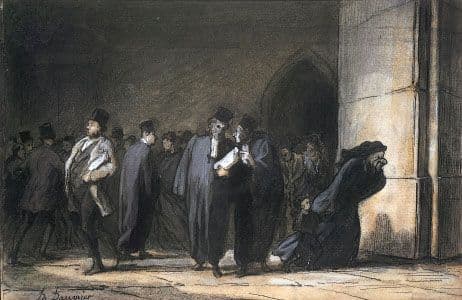
Visual artists of the period shared this documentary impulse. In the last lesson, we saw Millet's The Gleaners. Another key artist was Honoré Daumier, who chronicled the urban life of Paris with an unflinching eye.
3. Psychological Depth
Realism does not just observe the external world; it also charts the internal one. A defining feature of the movement is psychological depth: the complex, often contradictory, and minutely rendered inner lives of its characters. Realist authors sought to portray thought, emotion, and motivation with the same fidelity they applied to physical settings.
This introspection is not the emotional outpouring of Romanticism. Instead, it is an analytical exploration of consciousness. Characters are shown thinking, rationalizing, deceiving themselves, and reacting to stimuli. This reflects the 19th century's growing interest in psychology as an emerging science. The goal is to show how and why a character thinks, not just what they feel.
To achieve this, realist writers often employed a third-person omniscient narrator. This "all-knowing" perspective allows the author to move seamlessly from external description to the internal thoughts of multiple characters, providing a comprehensive and seemingly objective psychological portrait.
WHAT IS LITERARY REALISM? 7 ASPECTS OF REALIST NOVELS!
We return to the same video for two related points on character and psychology.
First, watch the sixth aspect, which discusses the respectful handling of moral judgments. This is key to psychological realism: the author presents a character's motivations and rationale, allowing the reader to understand them, even if they don't agree with their actions. The analysis of Balzac's Père Goriot here is a direct preview for our next module. Next, watch the seventh aspect on the omniscient narrator. Pay attention to how this narrative technique allows the author to access and convey the unfiltered thoughts and feelings of characters, making their inner world feel authentic. The example of Dostoyevsky's Crime and Punishment is crucial, as it is one of the supreme examples of psychological realism we will study.
4. The Realist Style: Detail and Objectivity
Finally, how are these effects achieved? The style of realism is itself a characteristic. It is built on two pillars: exhaustive detail and authorial objectivity.
- Detail: Realist prose is dense with specific, concrete, sensory details. Descriptions of rooms, clothing, faces, and city streets are often lengthy and meticulous. This is empiricism in practice—grounding the fictional world in a wealth of observable "data" to enhance its verisimilitude.
- Objectivity: Realist writers often adopt a detached, scientific tone. They strive to show, not tell. The ornate language and overt authorial moralizing of previous eras are replaced with plain, direct prose. The narrator's voice becomes impersonal, presenting events and characters without explicit judgment, letting the carefully chosen details speak for themselves.
Let's watch one last clip that powerfully illustrates this stylistic choice.
WHAT IS LITERARY REALISM? 7 ASPECTS OF REALIST NOVELS!
This final clip from Tristan and the Classics discusses the realist use of detail and detachment.
Watch the second aspect, which covers how realist literature is both detail-oriented and detached. The most important part of this segment is the explanation of why realists avoid metaphor and simile, and the comparison of two different ways to describe London. This demonstrates the pursuit of an objective, almost clinical, descriptive style.
Conclusion
Today we have built a practical framework for understanding realist fiction. These four characteristics are interconnected and mutually reinforcing, stemming from the historical and philosophical shifts of the 19th century.
Here are the key takeaways:
- Verisimilitude: Realism's primary goal is to create a plausible world that feels true to life, avoiding the contrived and fantastical.
- Ordinary Subjects: The focus shifts from the elite and heroic to the everyday lives of the middle and lower classes, treating their struggles as serious literary subjects.
- Detailed Social Observation: Novels serve as sociological documents, meticulously observing and critiquing the social structures, institutions, and problems of their time.
- Psychological Depth: Realism provides complex, analytical portraits of characters' inner lives, exploring their thoughts, motivations, and consciousness with precision.
- These aims are achieved through a style emphasizing exhaustive detail and authorial objectivity.
You now have a set of criteria—a kind of analytical checklist—to apply to the novels we will read.
In our next and final lesson of this introductory module, we will sharpen our understanding of realism by contrasting it directly with its predecessor, Romanticism. This comparison will highlight just how revolutionary the realist project truly was and solidify your grasp of its unique properties before we begin reading.