Welcome to our fourth lesson. In our last session, we explored how the brain organizes knowledge into interconnected mental models, or schemas. We established that the goal of teaching is not just to present facts, but to help students build these rich, durable cognitive structures. The question we ended with was: how do we ensure this learning lasts?
Today, we will answer that question by examining two of the most well-evidenced principles from cognitive science: the spacing effect and retrieval practice. This lesson will describe what these principles are and, more importantly, provide you with concrete strategies for integrating them into the structure of your computer courses. Mastering these techniques will allow you to intentionally design courses that build robust, long-lasting knowledge, moving your students from fragile understanding to genuine mastery.
The Spacing Effect: Why Cramming Fails
We've all seen students (and perhaps been guilty of it ourselves) "cramming" for an exam—concentrating all their study into one long session the night before. While this might lead to success on the test, the knowledge often vanishes just as quickly. This is known as massed practice. Cognitive science offers a much more effective alternative.
The spacing effect, also known as distributed practice, is the principle that learning is more effective when study sessions are spread out over time.

To formalize this, let's look at a clear definition from a practical guide on this topic.
Spacing and retrieval practice guide
This guide from the Australian Education Research Organisation provides concise, evidence-based definitions and practices.
First, read the introductory section for the definitions of Spacing and retrieval. Next, read the section under the heading "Key practices" that begins "Spacing learning allows students..." This part emphasizes the core principle: spread the learning of a concept across multiple lessons.
The reason spacing works seems counterintuitive: it leverages the power of forgetting. When you revisit a topic after a delay, your brain has to work harder to reconstruct the knowledge. This effortful process strengthens the neural pathways associated with that schema, making the information more durable and easier to access in the future. Massed practice, in contrast, creates an "illusion of memory" because the information is constantly held in the easily-accessible state of working memory, but it never undergoes the difficult work of being consolidated into long-term memory.
For your computer courses, this means resisting the urge to cover an entire topic, like "object-oriented programming principles," in a single, exhaustive lesson. Instead, you could:
- Day 1: Introduce the concept of a "class" and an "object."
- Day 3: Teach "inheritance."
- Day 5: Introduce "polymorphism," and include a brief review question about classes from Day 1.
Retrieval Practice: The Power of Active Recall
Spacing tells us when to study, but retrieval practice tells us how.
Retrieval practice is the act of actively trying to recall information from memory, rather than passively rereading or reviewing it. Every time a student pulls a piece of information from their long-term memory, they aren't just accessing it; they are fundamentally strengthening their ability to retrieve it again later.
The following video provides an excellent overview of why retrieval is so crucial for learning and offers a very simple way to start using it.
Understanding and Applying Retrieval Practice in Lesson Planning
This video by a university instructor clearly explains the "why" and "how" of retrieval practice in a classroom setting.
First, watch the section from the video that explains three key reasons for incorporating retrieval practice. Pay close attention to the third point, which links foundational knowledge to higher-order creative thinking—a vital connection for a field like computer science. Next, watch the segment describing the first practical exercise, the "pop quiz". Notice the emphasis on making it low-stakes (ungraded) and providing immediate feedback.
As the video explains, retrieval practice is not about high-pressure assessment. It's a learning tool. The key is that the act of recalling is what matters, even if the student initially gets the answer wrong. In fact, making a mistake and then receiving corrective feedback is an incredibly powerful learning event.
The Power Duo: Integrating Spaced Retrieval into Your Course
While spacing and retrieval are powerful on their own, their effects are multiplied when used together. This combination is often called spaced retrieval: asking students to retrieve information after a period of time has passed since they last saw it.
This is where you, as the teacher, can be most intentional in your course design. By building in regular, low-stakes opportunities for spaced retrieval, you create a powerful engine for long-term retention.
Here are some practical ways to structure this:
Spacing and retrieval practice guide
Returning to our guide, we'll now focus on the practical implementation of retrieval and how to plan for it.
First, read the section on effective retrieval practice. Note the advice to ask conceptual questions, not just factual ones, and to involve all students. Then, read the next section on being deliberate. This section introduces routines like "bell ringers" (Do Now activities) and "exit tickets," which are perfect vehicles for spaced retrieval.
A "bell ringer" or "Do Now" activity is a short task that students begin as soon as the lesson starts. An "exit ticket" is a brief question students answer before they leave. Both are ideal for implementing spaced retrieval.
Imagine you're teaching a unit on Python data structures. Your weekly plan could look like this:
- Monday: Teach lists.
- Tuesday: Teach dictionaries. Do Now: "Without looking at your notes, write one line of code to add an element to the end of a Python list." (Retrieves Monday's content).
- Wednesday: Teach sets. Do Now: "What is the key difference between a Python list and a dictionary?" (Retrieves Mon/Tues content).
- Friday: Project day. Exit Ticket: "Name the three main data structures we've studied this week and one characteristic of each."
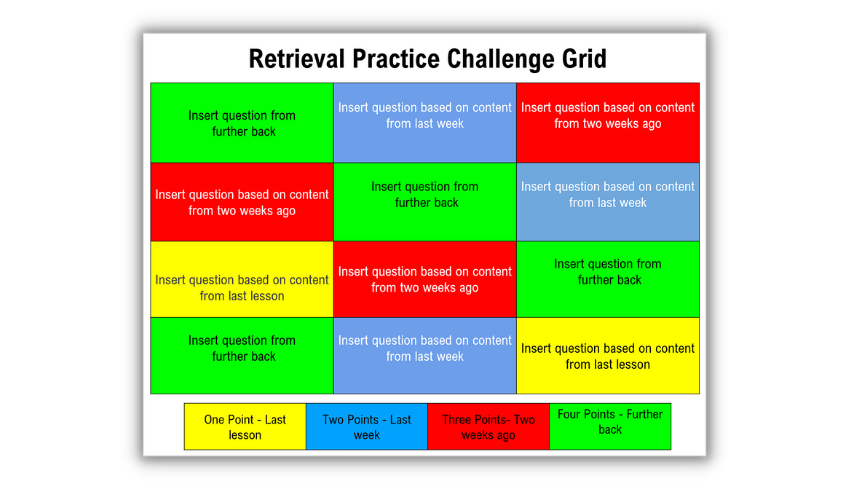
To systematize this, you can use a simple tool like a challenge grid.
A Menu of Retrieval Techniques and a Nod to AI
There are many ways to prompt retrieval beyond simple questions. The key is that the student must be producing the information, not just recognizing it.
Retrieval practice learning strategies
This short animated video provides a quick tour of several retrieval techniques.
Watch the segment from the video which outlines five techniques. Pay special attention to the Leitner System, as it is a perfect, self-contained example of a system that combines flashcards (retrieval) with a built-in spacing schedule.
Given your interest in technology and AI, you'll be pleased to know that these tools can be powerful allies in implementing spaced retrieval. You can design prompts to have an AI generate questions for you, tailored to your specific curriculum schedule.
Using AI to Support Interleaving & Spaced Practice and ...
This blog post by an educator provides a fantastic, modern application of these principles, demonstrating how to use AI as a planning assistant.
Read the section titled "For Creating a Weekly Spaced Retrieval Plan." The example prompt shows exactly how you could instruct an AI like ChatGPT or Claude to generate a week's worth of "Do Now" activities that intelligently mix old and new concepts for an Algebra class. You can easily adapt this prompt for any computer science topic.
This AI-assisted approach can save you significant time while helping you be more systematic in your application of these cognitive principles, ensuring your daily practice activities are both targeted and effective.
Conclusion
In this lesson, we have moved from the "what" of learning (schemas) to the "how" of making learning last. By understanding and applying the spacing effect and retrieval practice, you can architect a learning experience that builds durable, flexible knowledge.
Here are the key takeaways:
- The Spacing Effect: Spreading learning out over time is far more effective for long-term retention than massing it into a single session.
- Retrieval Practice: Actively recalling information from memory strengthens that memory far more than passively reviewing it. This is a learning strategy, not just an assessment tool.
- Spaced Retrieval: The most powerful approach combines these two principles—periodically asking students to recall information they learned in the past.
- Practical Implementation: You can integrate spaced retrieval into your daily routine using simple, low-stakes activities like "Do Nows," "exit tickets," and short quizzes, and even use AI to help generate the materials.
The knowledge your students build through these methods will not only be more durable, but it will also be more flexible. In our next lesson, we will explore this idea of flexibility directly by examining the concept of transfer of learning—the ultimate goal of education, where students can take what they've learned in your classroom and apply it to solve new and unfamiliar problems.