Welcome to the fifth and final lesson in our module on the cognitive foundations of learning. In our previous lesson, we explored the powerful principles of the spacing effect and retrieval practice, which are essential for building durable knowledge. But what is the ultimate purpose of that knowledge? It's not just to be remembered, but to be used.
Today, we delve into the concept of transfer of learning. This is the crucial process of taking what is learned in one context and applying it to new situations, tasks, and problems. For you as an educator, fostering transfer is the primary goal; it's the bridge between what your students learn in your computer course and how they use those skills in their future projects, jobs, and creative endeavors.
This lesson will explain what transfer is, why it is surprisingly difficult to achieve, and most importantly, identify the evidence-based strategies you can use to design lessons that explicitly promote it.
What is Transfer of Learning?
At its core, transfer is about applying knowledge beyond the specific context in which it was learned. It's the difference between a student who can only solve a programming problem exactly as it was demonstrated, and a student who can adapt their understanding to solve a completely new problem.
The following guide provides a clear and concise introduction to this idea.
RETRIEVAL PRACTICE AND TRANSFER OF LEARNING:
This guide from RetrievalPractice.org provides a fantastic introduction to transfer, written specifically for educators.
Please read the first two pages. Start with the introduction on page 2, which defines the concept. Then, continue on page 3, reading the section "Transfer is more than ordinary learning", which provides several concrete examples of what successful transfer looks like in practice.
As the reading suggests, transfer isn't a single phenomenon. Psychologists and educators often classify it into different types. Understanding these types will help you be more intentional about the kind of learning you are aiming for.
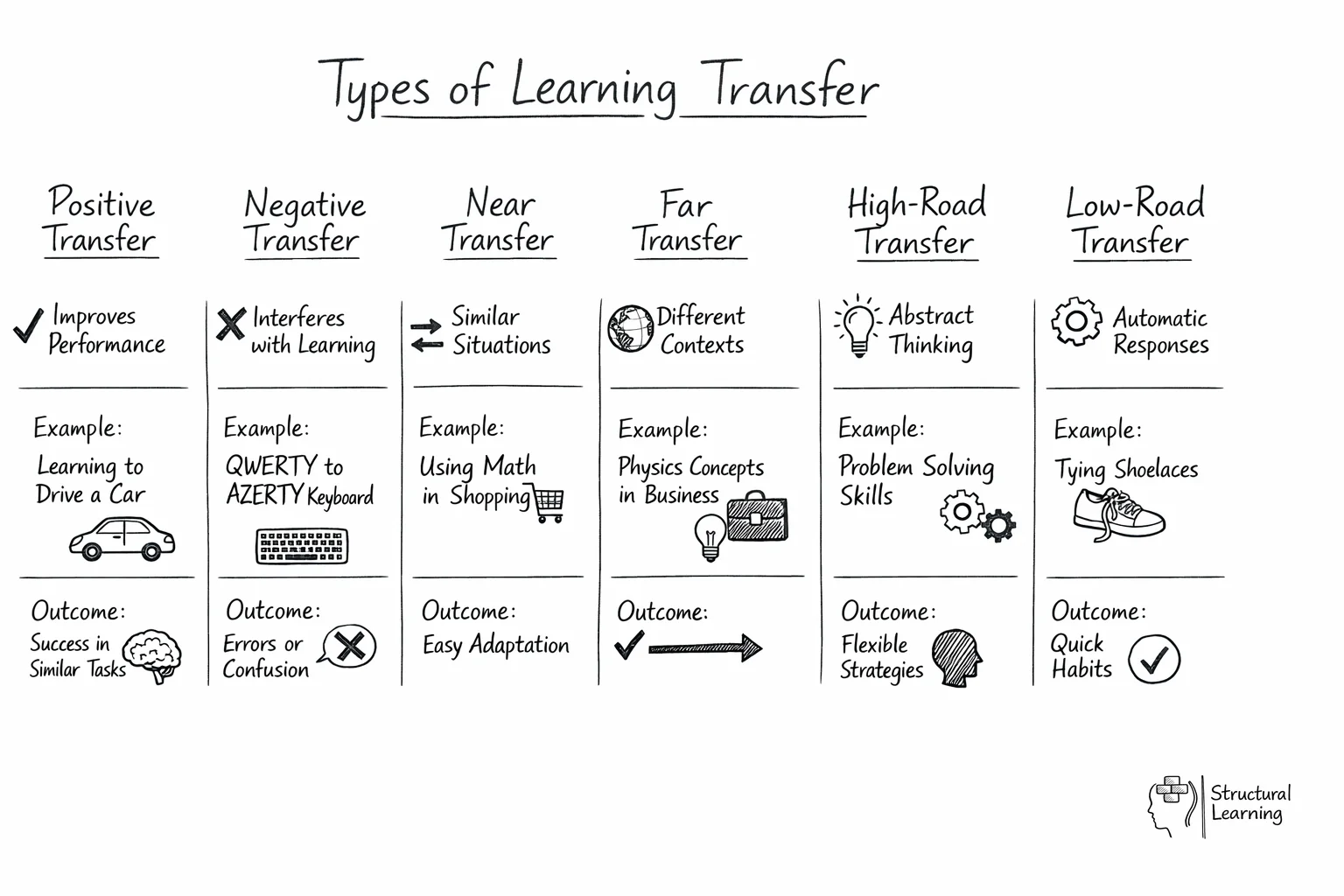
Let's break down the most important pairs from this illustration:
- Positive vs. Negative Transfer: Positive transfer is when prior learning helps with a new task (e.g., knowing Java helps you learn C#). Negative transfer is when prior learning interferes (e.g., learning to drive an automatic car can make it harder to learn a manual transmission initially, as you might forget to use the clutch).
- Near vs. Far Transfer: This is a crucial distinction for teaching.
- Near Transfer is applying a skill to a very similar situation. For example, a student who learns to use a
forloop to print numbers from 1 to 10 then uses it to print numbers from 1 to 100. The context is nearly identical. - Far Transfer is applying a skill to a very different context. For instance, a student who learns about recursion through a factorial function (a math concept) and then applies that understanding to write a program that crawls a website by recursively following links. This requires a deeper, more abstract understanding.
- Near Transfer is applying a skill to a very similar situation. For example, a student who learns to use a
This short video provides a clear explanation of near and far transfer.
What Is ‘Transfer of Learning’ and How Does It Help Students?
This video from Education Week gives a concise summary of the core concepts.
Watch the first minute of the video from the beginning, which defines transfer and clearly distinguishes between near and far transfer with examples.
Finally, there's the distinction between Low-Road and High-Road Transfer.
- Low-Road Transfer happens almost automatically, when a new situation is so similar to a well-practiced one that the learned response is triggered with little conscious thought. Think of tying your shoelaces or a seasoned programmer instinctively using common keyboard shortcuts in a new code editor.
- High-Road Transfer, in contrast, is effortful and conscious. It involves deliberately abstracting a principle from one situation and looking for ways to apply it in a new one. This is the kind of deep, analytical thinking that allows a software architect to apply principles of system design learned from building a banking application to designing a new e-commerce platform.
As an educator, while near and low-road transfer are important for building fluency, the ultimate goal is to cultivate far, high-road transfer—the ability to solve novel problems.
The Challenge of Transfer: Why is it So Hard?
Teachers often assume that if students learn a concept, they will naturally be able to apply it. Cognitive science research shows this is far from true. Transfer is difficult because our minds tend to get stuck on the surface features of a problem, rather than understanding its deep structure.
Dr. Geoff Norman, a leading researcher in medical education, explains this phenomenon using a classic psychology experiment.
A Cognitive Perspective on How People Learn: Implications for Teaching
In this segment of his talk, Dr. Norman uses a powerful analogy to show why transfer often fails.
Watch the section from the video where he discusses the "Fortress Problem" and the analogous "Radiation Problem." Pay close attention to his distinction between the memorable "surface context" (armies, tumors) and the abstract "deep structure" (multiple simultaneous pathways).
The Fortress and Radiation problems are perfect illustrations of why far transfer is so challenging. The students in the experiment learned the solution to the Fortress problem, but their knowledge was "stuck" to its surface context (an army attacking a fortress). When faced with the Radiation problem, which had a different surface context (x-rays and a tumor), most failed to see that the underlying principle—the deep structure—was identical.
For your students, this might look like:
- Learning about binary search with an array of sorted numbers.
- Failing to apply binary search to find a specific word in a digital dictionary or a specific version in a list of software commits.
They understand the procedure, but their knowledge is tied to the concrete example of "a sorted array of integers" and doesn't transfer to the abstract concept of "a search algorithm for any sorted collection."
Strategies to Promote Transfer
The good news is that we can design instruction to overcome this challenge. The key is to help students move past surface features and grasp the deep structure of the concepts you teach. Here are four evidence-based strategies.
1. Use Multiple, Varied Examples
The single most effective way to help students see the deep structure is to show them the same concept cloaked in different surface features. If you only teach a concept with one example, students will inevitably fuse the concept with the example's surface features.
Dr. Norman's talk again provides compelling evidence for this.
A Cognitive Perspective on How People Learn: Implications for Teaching
This part of the talk demonstrates the dramatic effect of using multiple examples.
Watch the segment from this part. The study with MBA students is remarkable. Notice how the group that was asked to actively compare and contrast two examples side-by-side achieved a transfer rate three times higher than the group that just saw a principle and one example.
The takeaway is clear: don't just provide multiple examples; prompt your students to actively find the common thread.
- Teaching
if/elsestatements: Show an example checking a password, another checking a user's age for an age-restricted site, and a third deciding whether to display a file's icon based on its extension. Then ask, "In all three cases, what is the fundamental job theif/elsestatement is doing?"
2. Mix Up Your Practice (Interleaving)
Conventional teaching often presents topics in "blocks." You teach Topic A and practice Topic A. Then you teach Topic B and practice Topic B. This is called blocked practice. While it feels efficient, it's poor at promoting transfer. Students learn the procedure, but they don't learn when to use it.
A more powerful method is mixed practice (or interleaving), where problems of different types are jumbled together. This forces students to diagnose the problem and select the correct strategy, rather than just mechanically applying the chapter's formula.
A Cognitive Perspective on How People Learn: Implications for Teaching
Here, Dr. Norman explains the flaw in how most textbooks structure practice and shows the power of mixing it up.
Watch the section from the video on "mixed versus blocked practice." His critique of statistics textbooks is a perfect analogy for how many programming books are structured. The study on ECG diagnosis shows a 50% improvement just by mixing the examples.
- Teaching data structures: Instead of having a chapter on lists with only list problems, and a chapter on dictionaries with only dictionary problems, create a problem set where students must first decide whether a list, dictionary, or set is the right tool for the job. This teaches them to discriminate based on the problem's requirements (e.g., "Do I need to maintain order? Do I need fast lookups by a key? Do I need to prevent duplicates?").
3. Bridge Concepts and Make Connections Explicit
Because transfer is not automatic, you often need to explicitly build bridges for your students. This can be done through analogies, metaphors, or simply by prompting them to see connections.
The following guide has an excellent checklist that includes this idea.
RETRIEVAL PRACTICE AND TRANSFER OF LEARNING:
Let's return to the RetrievalPractice.org guide. It provides actionable advice for overcoming the difficulty of transfer.
Read the sections on pages 9 and 10, starting with the fortress problem. Notice the crucial finding: when students were given a simple hint that the prior story might be helpful, transfer rates skyrocketed. Then, review the "Implementation Checklist" on page 11. One of the key recommendations is to "Offer hints or prompts to ensure students recognize opportunities to transfer their learning."
You are the expert who can see the deep structure. Your job is to make that structure visible to your students.
- Teaching function parameters: You can use the analogy of a food recipe. A function is like a recipe (e.g., "make a cake"). The parameters are the ingredients you give it (flour, sugar, eggs). You can use the same recipe (function) with different ingredients (parameters) to get slightly different cakes (results).
4. Guide Students to Generalize
The final step is to help students move from concrete examples to abstract principles. This is the essence of high-road transfer. After they have worked through several varied, mixed examples, you can prompt them to state the general rule or principle themselves.
This four-step process is beautifully summarized in the following infographic.

Let's imagine you are teaching the concept of API (Application Programming Interface) calls. Using this model:
- Identify Targets: You want students to be able to use APIs in their own projects to fetch data (e.g., from a weather service, a social media platform, or a stock market tracker).
- Vary Situations: You show them how to fetch weather data, then how to get a user's timeline from Twitter, then how to look up a book by its ISBN. The surface details are different, but the deep structure is the same (HTTP GET request, headers, parsing a JSON response).
- Bridge Concepts: You explicitly say, "Notice how in the weather example and the Twitter example, we had to include an 'Authorization' key? That's a common pattern for APIs that aren't fully public."
- Generalize Learning: You ask students to formulate a general principle: "Based on these examples, what are the three essential steps you must always follow when you want to get data from a new API?"
Conclusion
In this lesson, we've defined transfer as the critical ability to apply learning in new contexts. We've seen that it's far more difficult than it appears because learners often get trapped by the surface features of problems. By being intentional in our teaching, we can help them see the underlying principles.
The key takeaways are:
- Transfer is the goal: The purpose of teaching is not for students to solve problems you've already shown them, but to equip them to solve problems they've never seen before.
- Transfer is hard: Don't assume it will happen automatically. Students need to be guided from concrete examples to abstract principles.
- Promote transfer with specific strategies:
- Use multiple, varied examples and have students actively compare them.
- Mix up practice problems (interleaving) to teach discrimination.
- Explicitly bridge concepts with analogies and hints.
- Guide students to generalize abstract principles from their work.
This lesson concludes our first module on the cognitive foundations of learning. We've journeyed from the basics of memory and cognitive load, to the formation of mental schemas, to the techniques for durable retention, and finally, to the ultimate goal of transfer.
In our next module, "Designing Effective Lessons," we will begin putting this theory into practice. Our very first step will be to learn how to define clear and precise goals for what our students should know and be able to do. We will use a powerful framework called Bloom's Taxonomy to classify our learning objectives and ensure our teaching is aimed at the right level of understanding.