Hello!
In our last lesson, you mastered calculating the total flow rate (Q_zone) for a sprinkler zone. This number tells us how much water the zone needs from the source. Now, we'll answer the next crucial question: How fast does the zone apply that water to the landscape?
This is the Precipitation Rate (PR), measured in millimeters per hour (mm/hr). Understanding this concept is what bridges the gap between your physical sprinkler layout and a functional watering schedule. By calculating the PR, you can determine exactly how long to run your system to deliver the precise amount of water your plants need, preventing waste and ensuring a healthy landscape.
By the end of this 60-minute lesson, you will be able to calculate the precipitation rate for any sprinkler zone you design and use it to determine the required irrigation runtime.
1. What is Precipitation Rate?
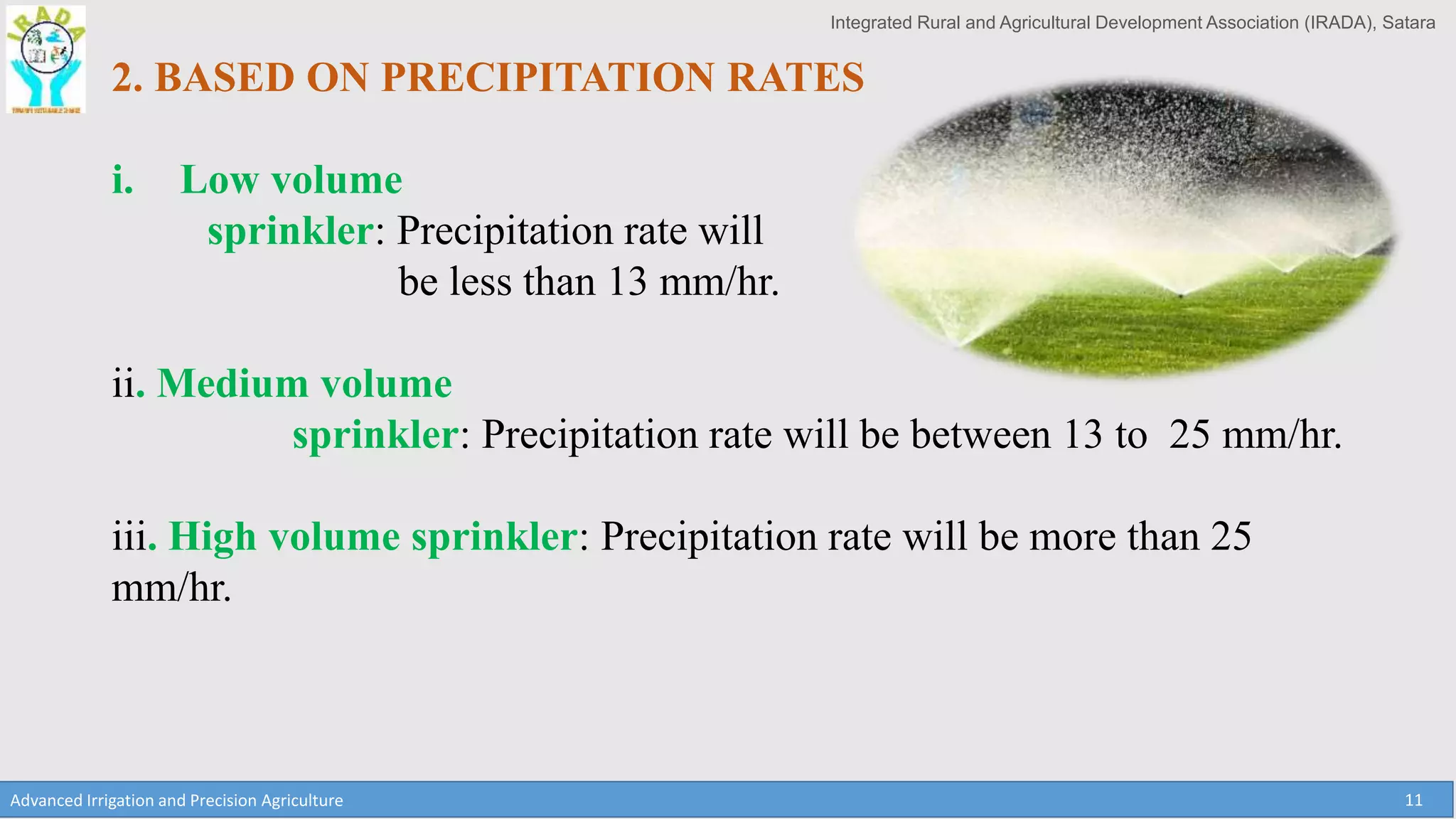
Think of precipitation rate in the same way you think about rainfall. A light drizzle might have a rate of 2 mm/hr, while a heavy downpour could be 25 mm/hr or more. The precipitation rate of a sprinkler zone is the average depth of water it applies over the entire area in one hour.
The key relationship to remember, which makes the calculations very straightforward, is:
1 millimeter of water depth over 1 square meter of area equals exactly 1 Liter of water volume.
Therefore, applying water at a rate of 1 Liter per hour over an area of 1 square meter results in a precipitation rate of 1 mm/hr. This direct conversion is the foundation of our main calculation method.
2. The "Total Area" Method for Calculating Precipitation Rate
The most reliable and universally applicable way to calculate the average precipitation rate for a zone is the Total Area Method. This method works for any zone, regardless of its shape or whether the sprinklers are in a perfect grid.
The formula is beautifully simple:
You already know how to calculate both of these values!
- Total Zone Flow: You learned this in the last lesson by summing the flow rates of all individual sprinklers.
- Total Zone Area: As a landscape architect, calculating the area of a defined space is a core skill.
Let's work through an example using the zone from our previous lesson.
- Zone Area: A rectangular lawn measuring 10m x 8m = 80 m².
- Total Zone Flow: We calculated this to be 3150 L/h.
Now, apply the formula:
The precipitation rate for this zone is approximately 39.4 mm/hr. This is a high rate, which is typical for spray-type sprinklers.
3. Using Precipitation Rate to Calculate Irrigation Runtime
Now we get to the "why." The primary reason we calculate PR is to create an accurate watering schedule. The formula to determine how long to run a zone is:
The "Required Water Depth" is the ETc (Crop Evapotranspiration) that you would calculate for that specific hydrozone, as we discussed in Module 2.
Let's continue our example. Assume that after analyzing the local climate and plant type, you determined that the lawn needs 5 mm of water on a given day.
- Required Water Depth: 5 mm
- Precipitation Rate: 39.4 mm/hr
Calculate the runtime:
Irrigation controllers are set in minutes, so we convert the result:
You would set the controller to run this zone for approximately 8 minutes to deliver the 5 mm of water required by the lawn.
To deepen your understanding of this connection between precipitation rate and scheduling, please review the following resource.
PreciPitation rates and sPrinkler irrigation
This guide from Hunter Industries, 'Precipitation rates and sprinkler irrigation', explains the core concepts. We will focus on the 'Total Area Method' and its importance for scheduling.
Please read two sections from this document: The Total Area Method (Page 11): Start at the heading 'The Total Area Method'. Read this page to see the same formula we just used, presented with US units. The principle is identical: total flow divided by total area. Scheduling Sprinkler Run Time (Page 5): Start at the heading 'Scheduling Sprinkler Run Time'. This short section is crucial as it directly explains why we calculate PR and how it prevents over- or under-watering.
Test your understanding!
You have designed a sprinkler zone for an irregularly shaped lawn with a total area of 120 m². The zone uses the sprinklers from the previous lesson's exercise:
- 4 Three-Quarter circle heads (15TT)
- 2 Half-circle heads (15H)
- Operating Pressure: 3.0 bar
The daily water requirement (ETc) for this lawn is 4.5 mm.
Calculate the following:
- The total zone flow rate in L/h. (You calculated this in the last lesson's exercise).
- The precipitation rate (PR) for the zone in mm/hr.
- The required daily runtime for this zone in minutes.
Show answer
1. Total Zone Flow Rate:
From the previous lesson's exercise, we found the total flow rate was 3680 L/h.
- 15TT @ 3.0 bar = 0.69 m³/h = 690 L/h
- 15H @ 3.0 bar = 0.46 m³/h = 460 L/h
- Total Flow = (4 x 690) + (2 x 460) = 2760 + 920 = 3680 L/h.
2. Precipitation Rate (PR):
3. Daily Runtime:
You would set the controller to run for approximately 9 minutes.
4. An Alternative: The "Sprinkler Spacing" Method
For zones where sprinklers are arranged in a regular rectangular or square grid, there is a shortcut method to estimate the precipitation rate. This method is based on the area covered by a single full-circle sprinkler.
Calculating sprinkler precipitation rates - Wetec
The article 'Calculating sprinkler precipitation rates' from Wetec provides a clear, metric-based formula for this shortcut method.
Please read from the beginning down to the first formula and its example. Focus on the formula itself, which is presented in an image. The formula for a square grid is: PR = Flow Rate (L/hr) / (Spacing (m) x Spacing (m)) This is essentially the same as our 'Total Area' method, but applied to the repeating unit of a single sprinkler in a grid.
This method is useful for quick checks on standard layouts but remember that the Total Area Method is the most accurate and versatile tool, especially for the complex, irregular lawn shapes you'll be designing for.
Conclusion
You have now connected the physical design of a sprinkler zone to its operational schedule. This is a major step in creating a truly efficient and effective irrigation system.
Key Takeaways:
- Precipitation Rate (PR) measures how fast water is applied to a landscape, in mm/hr.
- The most robust calculation is the Total Area Method:
PR (mm/hr) = Total Zone Flow (L/hr) / Total Zone Area (m²). - PR is the essential link for calculating irrigation runtime:
Runtime = Required Water (mm) / PR (mm/hr). - This process allows you to translate the plant's theoretical water needs (ETc) into a practical, programmable watering schedule for a controller.
In our next lessons, we will shift gears from watering large turf areas with sprinklers to irrigating shrubs, trees, and planters. We will explore the principles and components of Drip Irrigation, a highly efficient method for delivering water directly to the plant's root zone.