Hello!
In our last lesson, we finalized our understanding of sprinkler systems by learning how to calculate their precipitation rate and use it to determine irrigation runtimes. This is the key to creating an efficient watering schedule for large areas like lawns.
Now, we shift our focus from the broad coverage of sprinklers to the precision of Drip Irrigation. This method is ideal for watering individual plants, dense garden beds, shrubs, and trees, which are common features in the villa landscapes you'll be designing. The first crucial step in drip design is choosing the right tool for the job.
This lesson addresses exactly that. You will learn to differentiate between the two primary types of drip emission devices: inline dripline and individual point-source drippers. By the end of this 60-minute lesson, you will be able to analyze different planting scenarios and confidently select the most appropriate drip irrigation method for each.
1. The Core Principle: Dense vs. Sparse Plantings
The most fundamental concept that guides the choice between drip irrigation methods is the density of the plants you need to water. As a landscape architect, you are already accustomed to thinking in terms of planting schemes. We can simplify the decision by categorizing them into two groups.
To understand this foundational concept, let's turn to a professional design manual.
Low-Volume Landscape Irrigation Design Manual
The 'Low-Volume Landscape Irrigation Design Manual' from Rain Bird provides the perfect framework for our discussion. It introduces the critical distinction between sparse and dense planting schemes, which directly determines the type of drip product to use.
Please read the section titled 'Individual Plants Versus Dense Plantings' (it spans from page 7 to 8). Pay close attention to the definitions and the accompanying figures. The key takeaway is how the manual links planting schemes to specific irrigation approaches: individual emitters for individual plants, and inline tubing for covering an entire area.
As the manual explains:
- Sparse Plantings: These are individual plants with significant space between them, such as specimen trees, scattered shrubs in a mulched bed, or container plants. The goal is to deliver water to a specific point—the root zone of each plant.
- Dense Plantings: This includes groundcover, flowerbeds, or hedges where plants are closely spaced. The goal is to water the entire area or line where the plants are growing.
This single distinction—watering a point versus watering an area—is the key to choosing your emitter type.
2. An Introduction to the Two Main Emitter Types
Now that we have our design principle, let's meet the hardware. There are two main categories of drip emitters that correspond to our two planting schemes: Point-Source Emitters and Inline Dripline.
Let's get a quick visual overview of these components.
4 Main Drip Irrigation Emitters and When to Use Them
This video from Drip Depot, '4 Main Drip Irrigation Emitters and When to Use Them', provides a great introduction to the different types. We will focus on the first two it covers.
Please watch the following two segments: Point-Source Drippers (1:16 - 2:50): This section discusses 'button drippers' and 'flag drippers'. Notice how they are described as 'point source' or 'spot' emitters used to target a specific plant. Dripline (4:55 - 6:00): This section introduces 'drip line' or 'emitter line'. Observe how it's described as tubing with pre-installed emitters, ideal for watering rows of plants.
Let's break down these two types further.
Point-Source Emitters (for Sparse Plantings)
Also known as individual drippers or "button" drippers, these are small, separate devices that you manually insert into a solid pipe, often called "blank" tubing.
- How they work: You run the blank tubing near the plants you want to water. At each plant, you punch a hole in the tubing and insert an emitter. You can either place the emitter right at the plant's base or use a short length of smaller 1/4" (6mm) tubing to run from the emitter to the precise watering location.
- When to use them:
- Irregularly spaced plants: Perfect for landscape beds where shrubs are placed for aesthetic effect rather than in a grid.
- Container pots and hanging baskets: You can run tubing to each pot and install one or more emitters.
- Mixed plantings with varied needs: If you have a large shrub next to a small one in the same zone, you can give the large one a high-flow emitter (e.g., 8 L/h) and the small one a low-flow emitter (e.g., 2 L/h). This offers great flexibility.
Inline Dripline (for Dense Plantings)
This is polyethylene tubing with the emitters already manufactured inside the pipe at fixed intervals (e.g., every 30, 40, or 50 cm).
- How it works: You lay the tubing in a grid or serpentine pattern throughout the area you want to irrigate. When the water is turned on, every emitter weeps water, effectively wetting the entire bed.
- When to use them:
- Dense groundcover and flowerbeds: Laying dripline in parallel rows ensures the entire soil area receives water.
- Hedges and row crops: A single run of dripline along the base of the hedge is highly effective.
- Watering large trees: While a single point-source emitter is poor for a large tree (it encourages one-sided root growth), creating concentric circles of inline dripline around the tree ensures the entire root zone is watered evenly.
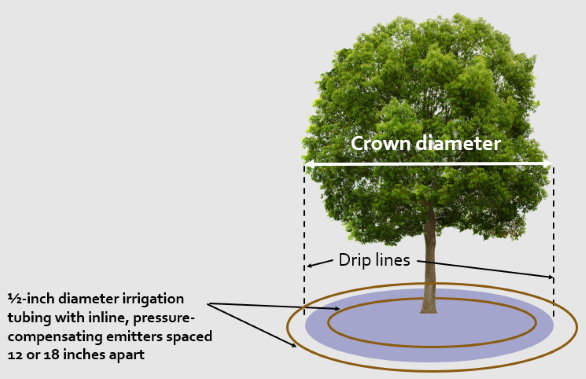
To see how these layouts are applied in practice, the following short video is very helpful.
Common Dripline Design Layouts
The video 'Common Dripline Design Layouts' from Ewing Outdoor Supply illustrates several standard applications for inline dripline.
Watch from 01:14 to the end (03:19). The video demonstrates layouts for flower beds (end-fed), larger zones (center-fed), trees (concentric circles), and narrow hedgerows (single run). This will help you visualize the scenarios we've been discussing.
3. A Decision Framework for Your Designs
Let's synthesize this into a practical framework. When faced with a new planting area, ask yourself these questions:
| Planting Scenario | Primary Choice | Why? |
|---|---|---|
| Dense Groundcover / Flowerbeds | Inline Dripline | Provides even area coverage. More efficient to install than hundreds of individual drippers. |
| Rows of Hedges or Shrubs | Inline Dripline | A single run along the row is simple and effective. |
| Scattered, Irregularly Spaced Shrubs | Point-Source Emitters | Delivers water precisely to each plant's location without watering the empty space in between. |
| Potted Plants / Planter Boxes | Point-Source Emitters | Allows you to run a supply line and tap off to each individual pot. |
| Single Large Tree | Inline Dripline (in rings) | Distributes water over the entire root zone for healthy, balanced growth. |
| Mixed Bed: Dense groundcover with a few larger shrubs | Combination | Use inline dripline for the groundcover and add supplemental point-source emitters for the shrubs. |
This "combination" approach is powerful and directly applies to the complex villa landscapes you will design. You can satisfy the basic needs of the dense planting while giving a targeted boost of water to the larger specimen plants that need it most.

Test your understanding!
For each of the following scenarios in a villa garden, which drip method would you choose and why?
- A 10-meter long hedgerow of Thuja plants.
- A large mulched area featuring three olive trees and five lavender bushes, all spaced far apart.
- A dense, 20 m² bed of flowering perennials.
- The same 20 m² perennial bed, but it also contains two large, mature rose bushes that require more water than the perennials.
Show answer
- Hedgerow: Inline dripline. A single run along the base of the hedge is the most efficient and effective method for a linear, dense planting.
- Scattered Trees/Bushes: Point-source emitters. This is a classic "sparse planting." You would run blank tubing and place individual emitters at the base of each tree and bush to water them precisely without watering the mulch in between. You might even use higher flow emitters for the olive trees than for the lavender.
- Perennial Bed: Inline dripline. This is a "dense planting." A grid or serpentine layout of dripline will provide the even area coverage needed.
- Mixed Perennial Bed: Combination approach. You would use inline dripline for the base coverage of the perennials. Then, you would add one or two supplemental point-source emitters with a higher flow rate at the base of each of the two rose bushes to give them the extra water they need.
Conclusion
You now have the fundamental knowledge to select the correct type of drip irrigation for virtually any landscape scenario. By analyzing whether a planting is dense or sparse, you can make an informed choice that maximizes water efficiency and promotes plant health.
Key Takeaways:
- Point-Source Emitters are for sparse plantings—individual, scattered plants where you want to water a specific point.
- Inline Dripline is for dense plantings—groundcover, hedges, and rows where you want to water a continuous area or line.
- The two methods can be combined in a single zone to handle complex layouts with mixed plant types and water needs.
In our next lesson, we will build directly on this foundation. Now that you can choose the type of emitter, we will learn how to select the appropriate emitter flow rates and spacing based on specific plant water requirements and soil conditions.