Hello!
In our last lesson, we established the crucial "golden rule" of zoning: one zone, one precipitation rate. You learned how to group sprinklers into logical zones based on their type and matched precipitation rates, ensuring that some parts of your landscape aren't overwatered while others stay dry.
This lesson takes the next logical step. Now that we have our sprinklers grouped into a zone, we need to answer a fundamental question: How much water does this zone demand? This is the total flow rate, and it is arguably the single most important number you will calculate for any given zone. It dictates pipe sizes, influences pressure loss, and ultimately determines whether your water source can handle the load.
By the end of this lesson, you will be able to confidently calculate the total flow rate for any sprinkler zone in Liters per Hour (L/h), a skill that forms the foundation for all hydraulic design.
1. Finding the Flow Rate of a Single Sprinkler
Before we can find the total flow for a zone, we must first find the flow rate for each individual sprinkler within it. This information isn't arbitrary; it comes directly from the manufacturer's technical specifications.
As a landscape architect, you're used to consulting technical data for materials and plants. Sprinklers are no different. Their performance—specifically their flow rate and throw radius—is directly tied to the operating pressure.
Let's look at a typical manufacturer's performance chart.
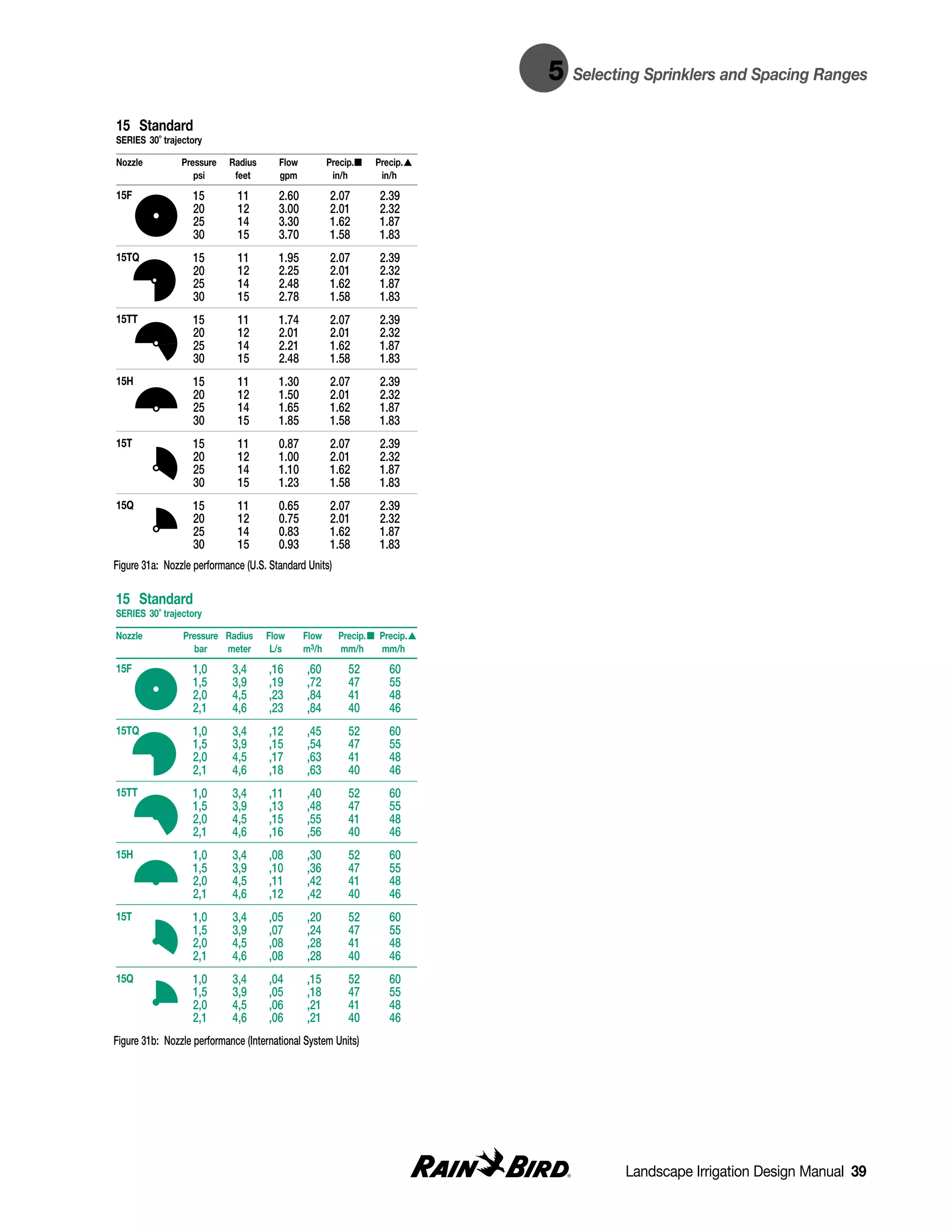
Take a moment to study the metric table (Figure 31b). Notice a few key things:
- Pressure (bar): As pressure increases, both the radius and flow rate generally increase.
- Nozzle Type: Different nozzles (e.g., 15F for full-circle, 15H for half-circle, 15Q for quarter-circle) have different flow rates.
- Flow (m³/h): This is the volume of water the nozzle emits per hour.
Let's find the flow rate for a 15H (half-circle) nozzle operating at a typical design pressure of 2.1 bar.
- Find the row for the "15H" nozzle.
- Look across to the column under "2.1" bar.
- You will see two numbers: the radius (4.6 m) and the flow rate (0.40 m³/h).
It's that simple. You have now found the flow rate for one sprinkler.
2. Calculating the Total Zone Flow Rate
The total flow rate for a zone is simply the sum of the flow rates of all the sprinklers operating in that zone.
Where is the flow rate.
Let's apply this to a practical example. Imagine you have designed a small lawn zone with the following sprinklers, all from the Rain Bird 15 Series and designed to operate at 2.5 bar:
- 2 full-circle heads (15F)
- 3 half-circle heads (15H)
- 1 quarter-circle head (15Q)
Step 1: Find the individual flow rates from the chart.
Using the metric table in the image above, find the flow rate (m³/h) for each nozzle type at 2.5 bar:
- Flow of one 15F head = 0.84 m³/h
- Flow of one 15H head = 0.42 m³/h
- Flow of one 15Q head = 0.21 m³/h
Notice how the flow rates are proportional to the arc, ensuring matched precipitation, just as we discussed in the last lesson. The half-circle flow is exactly half the full-circle flow.
Step 2: Sum the flow rates for all heads in the zone.
- Total flow from the full-circle heads:
- Total flow from the half-circle heads:
- Total flow from the quarter-circle head:
Now, add them all together:
Step 3: Convert to Liters per Hour (L/h).
Your syllabus and many professional contexts use L/h. The conversion is straightforward: 1 m³ = 1000 Liters.
This is your final answer. This zone requires a flow of 3150 Liters per Hour to operate correctly. This is the value we will use for sizing the pipes and checking against our water source's capacity.
To see this same process described in another format, you can review this section from a Hunter Industries design guide. It uses US units (GPM), but the principle of adding up the individual head requirements is identical.
Residential Sprinkler System Design Handbook
This section from the 'Residential Sprinkler System Design Handbook' by Hunter provides a step-by-step guide to dividing sprinklers into zones and calculating the total flow for each.
Please read the section 'Divide Sprinklers Into Zones' on page 4. Focus on steps 2 and 3, where it instructs you to write down the individual sprinkler's GPM and then add them up. Note the 'AREA CAPACITY EXAMPLE' table, which shows this process in action.
Test your understanding!
You are designing a zone for an irregularly shaped lawn area. Your layout requires the following nozzles from the Rain Bird 15 Series chart, and you are designing for an operating pressure of 3.0 bar.
- 4 Three-Quarter circle heads (15TT)
- 2 Half-circle heads (15H)
Using the Rain Bird Nozzle Performance Chart above, calculate the total zone flow rate in both m³/h and L/h.
Show answer
Step 1: Find individual flow rates at 3.0 bar.
- Flow of one 15TT head = 0.69 m³/h
- Flow of one 15H head = 0.46 m³/h
Step 2: Sum the flow rates.
- Total flow from 15TT heads:
- Total flow from 15H heads:
Step 3: Convert to L/h.
The total required flow rate for this zone is 3680 L/h.
Conclusion
You have now mastered a simple but non-negotiable step in irrigation design. Calculating the total zone flow rate provides the foundational data point for all the hydraulic analysis that follows.
Key Takeaways:
- The total flow rate for a sprinkler zone is the sum of the individual flow rates of every sprinkler in that zone.
- Individual sprinkler flow rates are found in manufacturer performance charts and are dependent on the operating pressure.
- Always ensure you are using a consistent design pressure when looking up flow rates for a single zone.
- The final zone flow rate is a critical value, often denoted as 'Q', that you will carry forward into pipe sizing and pressure loss calculations.
In our next lesson, we will use this flow rate to answer a different but related question: "How fast does the zone apply water to the ground?" We will calculate the precipitation rate (mm/hr) for the zone, which is the key to determining how long the system needs to run to satisfy the plants' water requirements.