Hello! In our last lesson, we introduced the three main types of sprinklers for turf irrigation—spray heads, rotors, and MP rotators—and compared their core characteristics like radius and precipitation rate.
Today, we will build directly on that knowledge. The goal of this lesson is to learn how to select the appropriate sprinkler type for various lawn area shapes and sizes. As a landscape architect, you are accustomed to analyzing a site's form and function. We will apply that same thinking to choose the right irrigation hardware for each distinct area of your design, a critical step before we start placing individual heads on a plan.
1. The Primary Deciding Factor: Area Size
The most straightforward way to begin selecting sprinklers is by looking at the dimensions of the lawn area you need to water. Different sprinkler types are engineered for different throw distances, or radii.
Let's start with a resource that establishes a clear rule of thumb based on size.
How Far Apart Should Sprinkler Heads Be?
This article from Sprinkler Warehouse provides a clear, practical starting point for deciding between the two most common sprinkler categories: rotors and spray heads.
Read the section titled 'Should I Use Rotors or Sprays for My Sprinkler System?'. Focus on the typical throw distances provided for rotors (minimum ~15-20 ft) and spray heads (maximum ~15 ft). We will be using metric, so you can think of this threshold as being around 5 to 7 meters.
From this reading, we can establish our first and most important decision-making guideline:
- For large, open areas where the shorter dimension is greater than 7-8 meters, rotors are the default choice. Their long-range throw allows you to cover the area with fewer heads, reducing material and installation costs.
- For smaller areas with dimensions less than 5 meters, traditional spray heads are suitable.
- This leaves a middle ground, roughly between 5 and 10 meters, where either can be used, but this is also the ideal range for MP Rotators.
Let's refine this middle-ground choice.
The Great Debate: MP Rotator vs. Rotor
What if your area is in that 5-8 meter range? Or what if you want a more water-efficient option than a traditional spray head? This is where MP Rotators fit in. This short clip clarifies when to use an MP Rotator versus a traditional rotor based on distance.
Watch the segment from 05:27 to 06:42. The key takeaway is the simple rule of thumb provided for choosing between MP Rotators (for shorter range) and traditional rotors (for longer range).
This leads us to a simple decision framework:
- Large Areas (>8m): Use Rotors.
- Small to Medium Areas (<8m): Your choice is between spray heads and MP Rotators.
- Choose MP Rotators for better water efficiency, on slopes, in windy areas, or when you want the highest quality coverage.
- Choose Spray Heads for very small, intricate areas or when minimizing initial cost is the absolute top priority.
2. Matching Sprinklers to Specific Shapes
Your villa projects will feature "complex plantation placements." This means you'll rarely be dealing with perfect squares. Your selection must also account for shape.
The following reading provides excellent, practical guidance for the common shapes you will encounter. It also gives a preview of sprinkler placement, which we will cover in detail in the next lesson.
How Far Apart Should Sprinkler Heads Be?
Now that we have a general rule based on size, let's see how the specific shape of a lawn influences our choice. This article is highly practical for landscape design.
Please review the following sections: 'Sprinkler Head Spacing for Rectangular Spaces', 'Sprinkler Head Spacing for Narrow Spaces', 'Sprinkler Head Spacing for Irregular Spaces', and 'Use Triangular Shaped Spacing for Trees, Plants, and Other Obstacles'. For now, focus on which sprinkler types and patterns are recommended for each scenario, not the specific spacing rules.
Let's summarize these strategies for different shapes:
Rectangular and Square Areas
- Large Rectangles: This is the classic application for rotors. You'll typically use 90° (quarter-circle) rotors in the corners, 180° (half-circle) rotors along the sides, and 360° (full-circle) rotors in the center if the area is wide enough.
- Small Rectangles: Use spray heads or MP Rotators with the same logic: quarter patterns in corners and half patterns on the sides.
Narrow Strip Areas
These are common along driveways or between a house and a path. Standard circular patterns would cause excessive overspray.
- The solution is to use special strip-pattern nozzles. These come in rectangular patterns like "side-strip," "center-strip," and "end-strip."
- Both traditional spray heads and MP Rotators offer strip nozzle options, giving you a choice between standard and high-efficiency application.
Irregular and Curved Shapes
This is where your design skills as a landscape architect are key. To avoid watering paths and walls, you need precise control.
- The solution is to use adjustable arc nozzles. These allow you to set the spray pattern to any angle, perfectly matching the curve of a lawn edge.
- Most modern spray heads and MP Rotators offer adjustable arc models (e.g., 0-360° or 90-210°). These are invaluable for custom shapes.
Areas with Obstacles (e.g., Trees in a Lawn)
Your goal is to water the lawn and the tree's root zone without constantly soaking the tree trunk, which can promote disease.
- As the reading suggests, you can place sprinklers around the tree's drip line.
- Use sprinklers with adjustable arcs or smaller radii to control the spray and avoid the trunk. Often, you will use smaller radius sprinklers (sprays or MP Rotators) around obstacles even if the rest of the lawn uses large rotors. These would need to be on a separate zone due to the difference in precipitation rates.
To see the variety of nozzles available to solve these problems, let's look at one product family as an example.
MP Rotator® Nozzle Product Guide: Models and Distances, 2024
To give you a sense of the specific models available, let's look at the MP Rotator product line. Even within one 'type' of sprinkler, there is a family of nozzles designed for different radii and shapes.
Watch from 05:25 to 08:30. Note the different model series (MP1000, 2000, etc.) and their radius ranges, as well as the dedicated strip nozzles. This shows how manufacturers provide a complete toolkit for the varied situations you'll face in a villa design.
3. Worked Example
Let's apply this logic to a hypothetical villa garden plan.
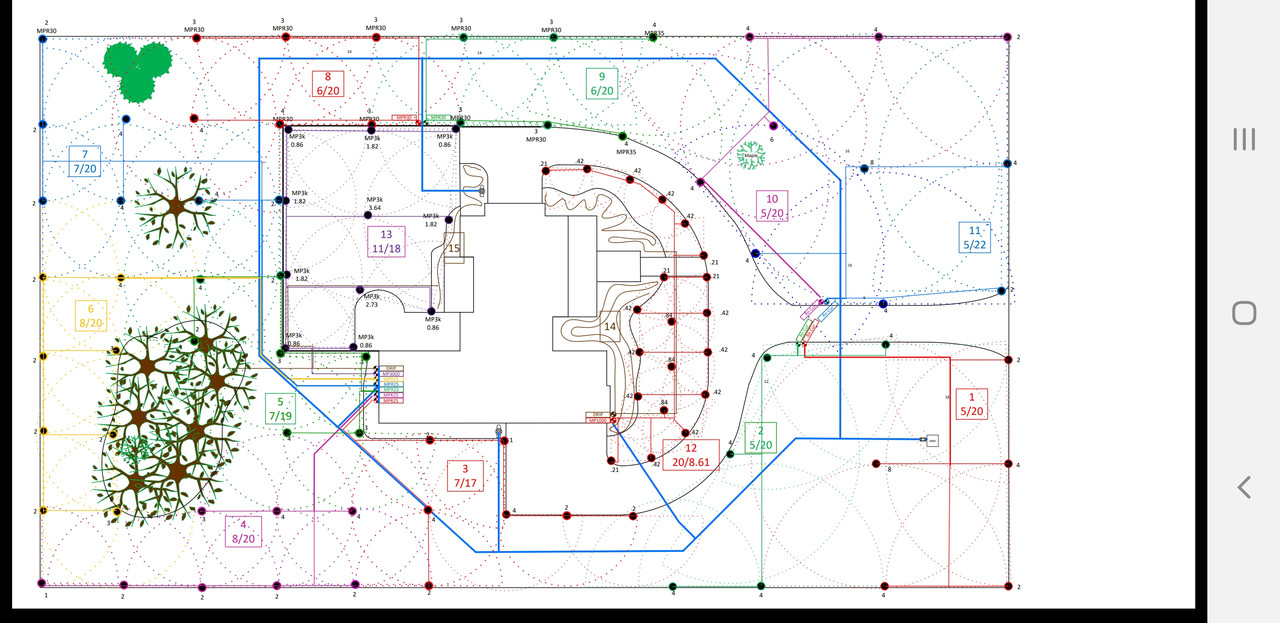
Here is a step-by-step selection process for a similar site:
| Area | Description | Dimensions | Analysis | Selected Sprinkler Type |
|---|---|---|---|---|
| A | Large, open back lawn | 20m x 12m | The shorter dimension (12m) is well over our 8m threshold. It's a simple rectangular shape. | Rotors (e.g., Hunter PGP, Rain Bird 5000) |
| B | Narrow side yard | 15m x 3m | The width (3m) is too narrow for a standard rotor or spray. This will cause massive overspray. | Strip-Pattern Nozzles (either on Spray or MP Rotator bodies) |
| C | Small, curved front lawn | ~ 6m x 5m | The dimensions are small, and the shape is irregular. Precise control is needed to avoid watering the driveway. | MP Rotators with Adjustable Arcs (e.g., MP1000 90-210°) |
Test your understanding!
You are given a new site plan with two lawn areas to irrigate:
- Area 1: A rectangular lawn measuring 10m x 15m. The soil is heavy clay and it's on a slight slope.
- Area 2: A perfectly flat, L-shaped lawn. The two rectangular parts of the 'L' are 4m x 8m and 4m x 6m.
For each area, state which sprinkler type you would choose and briefly explain why, considering size, shape, and any other relevant factors.
Show answer
- Area 1 (10m x 15m, sloped clay): The best choice would be Rotors or MP Rotators (MP3000/3500 series).
- Reasoning: The size (10m width) is suitable for long-throw sprinklers. However, given the clay soil and slope, runoff is a major concern. MP Rotators, with their very low precipitation rate, would be the superior choice for water efficiency and preventing erosion. If cost is the primary driver and runtimes must be shorter, a low-precipitation nozzle on a traditional rotor could also work, but MP Rotators are designed specifically for this scenario.
- Area 2 (L-shaped, 4m wide): The best choice would be Spray Heads or MP Rotators (MP1000/2000 series).
- Reasoning: The width of the area is only 4 meters, which is too small for standard rotors. The L-shape will require careful use of 90° (quarter-circle) and 270° (three-quarter-circle) patterns to cover correctly. Both standard sprays and MP Rotators offer the necessary patterns and radius for this shape and size. The choice between them would come down to water efficiency needs versus initial cost.
Conclusion
You can now systematically select the correct sprinkler category for any given lawn area. This decision-making process is a cornerstone of efficient and effective irrigation design.
Key Takeaways:
- Size is the first filter: Use the ~8-meter rule to quickly decide between rotors and smaller-radius options.
- Shape dictates the pattern: Use standard arc nozzles for simple shapes, adjustable arcs for curves, and strip nozzles for narrow rectangles.
- Site conditions are the tie-breaker: For areas with slopes, compacted soil, or high wind, lean towards high-efficiency options like MP Rotators to minimize water waste.
In our next lesson, we will tackle the next logical step: applying the 'head-to-head' coverage principle to create a sprinkler layout plan. We'll move from choosing the right type of sprinkler to deciding exactly where to place each one for perfect, uniform coverage.