Hello! Welcome to the first lesson in our module on sprinkler system design.
In our previous lessons, we completed the foundational work of site analysis. We defined hydrozones, calculated their specific water needs (ETc), and converted that need into a concrete daily water volume (Liters/day). We concluded by introducing the concept of flow rate (Q)—the amount of water the system must deliver per hour to meet the zone's daily needs within a set watering time.
Now, we shift from planning how much water to designing how to apply it. Today's learning outcome is to compare spray heads, rotors, and MP rotators based on radius, precipitation rate, and application. Understanding these three core sprinkler types is the first step in selecting the right tool for the job.
1. The Three Main Sprinkler Categories
For residential and small commercial landscapes like the villa projects you'll be designing, irrigation is dominated by three main types of sprinklers. Let's start with a quick visual introduction to each.
This video from Sprinkler Warehouse provides a clear overview of the three most common sprinkler types: spray heads, rotors, and rotary nozzles (which we'll often call MP Rotators, a leading brand name).
Watch the segment from 00:16 to 03:21. Focus on the visual difference in how each sprinkler distributes water and the general applications mentioned for each type (e.g., rotors for lawns, sprays for flower beds).
As you saw, the fundamental differences are:
- Spray Heads: Emit a static, fan-shaped spray of water.
- Rotors (or Gear-Drive Rotors): Shoot a single stream of water while rotating.
- MP Rotators (a type of Rotary or MSMT Nozzle): Distribute water through multiple, distinct rotating streams.
2. A Deeper Comparison: Key Characteristics
To make informed design decisions, we need to move beyond general descriptions and compare these sprinklers on their technical specifications. Your background in landscape architecture gives you a strong appreciation for how form follows function, and the same is true for sprinklers.
The Hunter Irrigation System Design Guide provides a professional-level breakdown of these types and the criteria for selecting them.
This guide from Hunter Industries is a professional standard. We'll look at the section that formally introduces sprinkler types and their characteristics.
Please read the first part of the 'Selecting the Proper Sprinkler' chapter. Start at 'Types of Landscape Sprinklers' and read through the descriptions of Spray Heads and Gear Driven Rotors, including the summary tables. This should take about 10 minutes. Pay close attention to the typical uses, radius ranges, and the advantages/disadvantages listed for each.
From this reading, we can distill the primary applications:
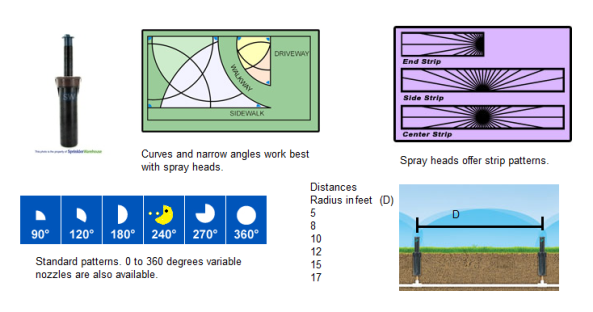
- Spray Heads: Ideal for smaller, more intricate areas (less than ~5 meters in radius). Their fixed patterns and availability in various arcs (90°, 180°, etc.) and special strip patterns make them perfect for the irregular lawn shapes and narrow planting beds common in villa gardens.
- Rotors: The workhorses for medium to large, open turf areas (typically >5-7 meters). Because they cover a larger area per head, they often result in a more cost-effective system with fewer sprinklers, valves, and pipes compared to using sprays for the same large area.
3. The Critical Difference: Precipitation Rate
Perhaps the most important metric for comparing sprinklers is the Precipitation Rate (PR), measured in millimeters per hour (mm/hr). It tells you how quickly water is applied to a given area. This is crucial for two reasons:
- Runoff: If the PR is higher than the soil's infiltration rate, you get pooling and runoff, which wastes water and can damage hardscapes.
- Runtime: A lower PR means the system must run longer to apply the same total volume of water.
Let's look at some hard data. The following document provides an excellent, direct comparison.
This report on rotating nozzles includes a table that perfectly illustrates the dramatic differences in flow and precipitation rates between sprinkler types.
Focus on 'Table 1. Example of sprinkler flow and precipitation rates variation by equipment type.' It compares a rotating nozzle, a conventional spray, and a conventional rotor, all set to cover a similar area. This should take about 5 minutes.
Here is a summary of that table's data, converted to the metric units we are using in this course (approximated for a 4.5m radius):
| Sprinkler Type | Flow Rate (L/h) | Precipitation Rate (mm/hr) |
|---|---|---|
| Conventional Spray Head | ~840 | ~40 |
| MP Rotator (MSMT Nozzle) | ~180 - 340 | ~10 - 15 |
| Conventional Rotor | ~140 | ~15 |
The takeaway is clear: Spray heads apply water about three times faster than rotors and MP Rotators. This high precipitation rate makes them less suitable for slopes or compacted soils where runoff is a concern.
4. The High-Efficiency Choice: MP Rotators
MP Rotators combine the body of a spray head with the water-efficient characteristics of a rotor. They are designed to be a direct, high-efficiency replacement for traditional spray nozzles.

The key advantages of MP Rotators are:
- Low Precipitation Rate: Significantly reduces runoff and improves water absorption.
- High Uniformity: The multiple streams provide very even water coverage, eliminating the "dry spots" common with poorly adjusted sprays.
- Wind Resistance: The streams are heavier and less susceptible to being blown off course.
This next video offers practical advice on the MP Rotator product line.
How Do I Know If Hunters MP Rotators are an Option? | SprinklerSupplyStore.com
This video from Sprinkler Nerd Andy, while product-specific to Hunter's MP Rotators, explains key concepts applicable to all multi-stream nozzles.
Watch from 02:17 to 05:01. Focus on two key points: 1) The different 'series' (1000, 2000, 3000) correspond to different radius capabilities. 2) The crucial explanation of matched precipitation and why you should never mix nozzles with different application rates (black vs. gray bodies) in the same zone.
The concept of matched precipitation is a "golden rule" in irrigation design. It means that a sprinkler watering a quarter circle applies 1/4 of the water of a full-circle sprinkler of the same series. This ensures all parts of your lawn receive the same amount of water, regardless of the arc. MP Rotators are designed to do this automatically within their series.
Test your understanding!
You are designing irrigation for a new villa. One area is a flat, rectangular lawn measuring 15 meters by 20 meters. An adjacent area is a narrow, sloping flower bed (2 meters by 10 meters) with clay soil that is prone to runoff.
Based on precipitation rates and typical applications, which sprinkler type would be your initial choice for the lawn, and which for the sloping flower bed? Why?
Show answer
- Lawn (15m x 20m): Rotors would be the best initial choice. The area is large and open, making it a perfect application for the long throw distance of rotors. Using rotors would be more cost-effective than using a large number of spray heads.
- Sloping Flower Bed (2m x 10m): MP Rotators would be ideal. The low precipitation rate (~10-15 mm/hr) is essential to prevent runoff on the slope and with the clay soil. Their radius range is also well-suited to the 2m width. While traditional sprays could cover the area, their high precipitation rate (~40 mm/hr) would likely cause significant water waste through runoff.
Conclusion
You now have a solid understanding of the three primary sprinkler types and their defining characteristics. This knowledge is the foundation for effective irrigation design.
Key Takeaways:
- Summary of Sprinkler Types:
| Characteristic | Spray Heads | Rotors | MP Rotators |
|---|---|---|---|
| Application | Small, intricate, irregular shapes | Medium-to-large open areas | Small to medium areas, slopes, windy sites |
| Radius | Short (2m - 5m) | Long (5m - 15m+) | Short-to-medium (2.5m - 10m) |
| Precipitation Rate | High (~40 mm/hr) | Low (~15 mm/hr) | Low (~10-15 mm/hr) |
| Key Advantage | Pattern flexibility for complex shapes | Cost-effective for large areas | High water efficiency and uniformity |
| Key Disadvantage | High precipitation can cause runoff | Not suitable for small or narrow areas | Longer run times required |
In our next lesson, we will put this knowledge into practice. We will focus on how to select appropriate sprinkler types for various lawn area shapes and sizes, moving us one step closer to laying out a complete system on a plan.