Hello! Welcome to your fifth lesson in the "Distributed Systems Concepts" module.
In our last lesson, we explored how message queues enable asynchronous processing, allowing services to be decoupled and more resilient. This naturally leads to a critical question: when a single business process (like booking a trip) involves multiple, decoupled services, how do you ensure the overall operation either succeeds or fails as a single unit?
Today's lesson addresses this head-on. Your learning outcome is to compare distributed transaction patterns (2PC, Saga) and articulate their trade-offs. This is a classic topic in senior-level system design interviews, and mastering it demonstrates a deep understanding of the trade-offs between consistency and availability.
1. The Problem: Atomicity Across Services
In a monolithic application, you can rely on the database's ACID properties to ensure a multi-step operation is atomic—it either completes entirely or not at all. You'd simply wrap the steps in a single database transaction.
However, in a microservices architecture where each service has its own database, a single database transaction cannot span multiple services. This creates the atomic commitment problem: how do we get a group of independent services to agree on the outcome (commit or abort) of a transaction that spans all of them?
Let's use a common example: placing an order in an e-commerce system involves the Order, Payment, and Inventory services. All three steps must succeed for the order to be valid.
To understand the formal definition of this challenge, the following short video provides an excellent introduction.
Distributed Systems 7.1: Two-phase commit
Watch this clip from Martin Kleppmann's renowned 'Distributed Systems' series. It precisely defines the atomic commitment problem and differentiates it from consensus.
Watch from 02:28 to 06:20. Focus on why atomicity is crucial and how the requirements for atomic commitment differ from a general consensus problem.
Two primary patterns have emerged to solve this: Two-Phase Commit (2PC) and the Saga pattern. They represent two fundamentally different philosophies.
2. Pattern 1: Two-Phase Commit (2PC) — The Strong Consistency Approach
The philosophy of 2PC is "lock and agree." It prioritizes strong consistency above all else, ensuring that a transaction is truly atomic across all participating services. It introduces a central coordinator to manage the transaction with multiple participants.
The process works in two phases:
- Prepare Phase (Voting): The coordinator sends a
preparemessage to all participants. Each participant then gets everything ready to commit (e.g., writing to a transaction log, acquiring database locks) and replies with a "yes" vote. A "yes" vote is a binding promise: the participant guarantees it can commit if asked. If a participant cannot commit, it votes "no." - Commit Phase (Decision):
- If the coordinator receives "yes" from all participants, it makes the final decision to
commitand sends this command to all of them. - If any participant votes "no" or times out, the coordinator decides to
abortand instructs all participants to roll back.
- If the coordinator receives "yes" from all participants, it makes the final decision to
The following video segments walk through these mechanics and, crucially, highlight the significant drawbacks.
Distributed Systems 7.1: Two-phase commit
Let's return to Martin Kleppmann's video for a detailed walkthrough of the 2PC protocol and its failure modes.
First, watch the explanation of the mechanics from 06:20 to 09:54. Then, watch the critical analysis of what happens when the coordinator fails from 09:54 to 12:39. This second part explains the core weakness of 2PC.
Trade-offs of 2PC
While 2PC provides the strong atomicity guarantees of a single database, it comes at a high price, which makes it unpopular in many modern microservice architectures.
- Blocking & Low Availability: This is the most significant issue. Once a participant votes "yes," it must lock the resources involved and wait for the coordinator's final decision. If the coordinator crashes, the participants are stuck—they cannot release locks or move forward, effectively halting that part of the system. This makes the coordinator a single point of failure for availability.
- Poor Performance: The protocol is synchronous and "chatty," requiring at least two round trips between the coordinator and all participants. This adds significant latency.
- Limited Scalability: The extended locking of resources reduces concurrency, limiting system throughput.
- Homogeneity Requirement: It generally assumes all participants are using compatible technologies that support a specific transaction protocol (e.g., XA transactions). This is often not the case in a diverse microservices ecosystem.
3. Pattern 2: Saga — The High Availability Approach
The Saga pattern takes the opposite approach. Its philosophy is "move and compensate," prioritizing availability and resilience. It accepts that temporary inconsistencies are okay as long as the system eventually becomes consistent.
A Saga is a sequence of local transactions. Each service executes its own transaction and immediately commits it. If a step in the sequence fails, the Saga executes compensating transactions to reverse the preceding completed steps.

Saga Implementation Styles: Orchestration vs. Choreography
There are two main ways to coordinate a Saga, and being able to compare them is key for an interview.
- Orchestration: A central service (the Saga Orchestrator) manages the entire workflow. It sends commands to services to execute local transactions and, if a step fails, sends commands to execute the necessary compensating transactions.
- Choreography: There is no central coordinator. Services communicate through an event bus. Each service performs its transaction and then publishes an event. Other services subscribe to these events and trigger their own local transactions in response. Compensating actions are also triggered by events.
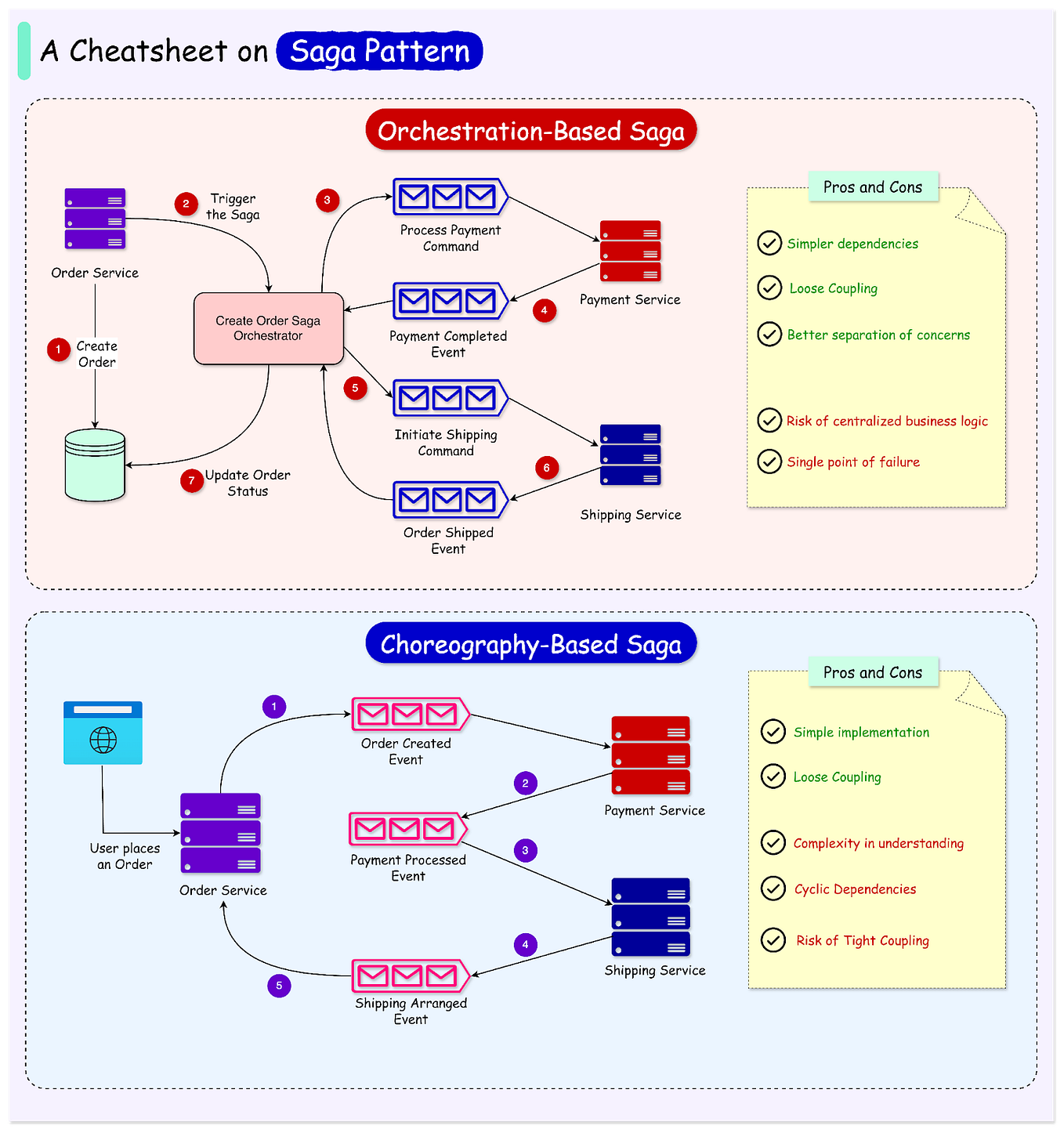
To get a full picture of the Saga pattern, including its implementation styles and a direct comparison with 2PC, the following video is an excellent resource.
Saga Pattern | Distributed Transactions | Microservices
This video by ByteMonk provides a comprehensive overview of the Saga pattern, its implementation styles, and how it stacks up against 2PC.
First, watch from 04:58 to 07:19 to understand the core concept of Sagas with local and compensating transactions. Then, watch from 07:19 to 12:59 to see the detailed comparison of Orchestration vs. Choreography.
Trade-offs of Sagas
- Eventual Consistency: The biggest trade-off. Sagas are not fully ACID. During a Saga's execution (and before compensation completes), the system is in a temporarily inconsistent state.
- Compensation Complexity: Designing compensating transactions can be difficult. Some actions are irreversible (e.g., sending an email). In these cases, you might need to implement a "forward fix" (e.g., sending a follow-up "cancellation" email).
- Increased Debugging Complexity: Tracing a business process across multiple services and events (especially in choreography) is harder than looking at a single transaction log. This requires robust observability with tools like distributed tracing and correlation IDs.
4. Choosing the Right Pattern: The Interview Clincher
In a system design interview, the crucial skill is not just knowing these patterns but articulating why you'd choose one over the other based on the problem's requirements.
For an extremely practical guide on this, the following article is an invaluable resource.
Saga vs Two‑Phase Commit (2PC): Which for distributed transactions?
The article 'Saga vs Two‑Phase Commit (2PC)' from DesignGurus.io is tailored for system design interviews. It provides a concise summary, a real-world example, and excellent advice on making the right choice.
First, study the 'Table of Comparison' to get a side-by-side view of the two patterns across key dimensions. Then, carefully read the section 'Choosing quickly in interviews'. This provides a heuristic that is perfect for structuring your answer under pressure.
Here is a summary of the decision framework:
| Dimension | Two-Phase Commit (2PC) | Saga |
|---|---|---|
| Consistency | Strong (Atomic) | Eventual |
| Availability | Lower (blocks on coordinator failure) | Higher (services are independent) |
| Data Isolation | High (resources are locked) | Low (intermediate states are visible) |
| Latency | Higher (synchronous, chatty) | Lower (asynchronous, local commits) |
| Complexity | Coordinator logic, recovery | Compensation logic, observability |
| Best For | Short-lived, internal, homogeneous systems where atomicity is a must (e.g., core banking ledger). | Long-running, distributed, heterogeneous systems where availability is critical (e.g., e-commerce, booking). |
A senior-level response also considers a third option: avoiding distributed transactions altogether.
Distributed Transactions: 2PC, Saga Pattern, and Coordination
The article 'Distributed Transactions' from System Design School offers another great perspective, especially its advice on reframing the problem.
Read the section 'Avoiding Distributed Transactions' to understand how redesigning service boundaries can eliminate the problem. Then, review the 'Interview Application' section for concrete phrasing on how to present these trade-offs.
Can you redraw service boundaries so that the atomic operation happens within a single service? For our e-commerce example, perhaps a CheckoutService could own the logic for orders, payments, and inventory updates, handling them in one local transaction. This is often the simplest and most robust solution.
Conclusion
You now have a solid framework for analyzing and discussing distributed transaction patterns. This is a topic that clearly separates junior from senior engineers in an interview setting.
Key Takeaways:
- 2PC provides strong consistency (atomicity) but at the cost of availability and performance. It's a blocking, synchronous protocol best suited for a narrow set of critical, internal use cases.
- Saga provides high availability and resilience but only guarantees eventual consistency. It requires careful design of compensating transactions and robust observability.
- The choice between Orchestration (central control) and Choreography (event-driven) for Sagas involves a trade-off between simplicity/monitoring and loose coupling.
- The most senior-level insight is often to question the premise: can the system be redesigned to avoid the need for a distributed transaction in the first place?
Next Lesson Preview:
A key requirement for implementing reliable Sagas, especially with message queues, is ensuring that retried operations don't cause duplicate effects (like charging a customer twice). Our next lesson, "Apply idempotency principles to ensure reliable distributed operations," will dive deep into the patterns that make this possible.