Hello! Welcome to your fourth lesson in the "Distributed Systems Concepts" module.
In our previous lesson, we explored eventual consistency and the strategies for resolving write conflicts in highly available systems. A key pattern we touched upon was offloading work to be done asynchronously to improve responsiveness and reliability. This is a perfect bridge to today's topic.
Your learning outcome is to apply message queues for asynchronous processing in system design contexts. As an experienced backend engineer, you've likely worked with technologies like Kafka, RabbitMQ, or SQS. This lesson will build on that practical knowledge, focusing on the architectural principles, core trade-offs, and communication frameworks you'll need to demonstrate senior-level expertise in a system design interview.
1. The Core Purpose: Decoupling with Asynchronous Communication
In a synchronous system, services are tightly coupled. When Service A calls Service B, it must wait for Service B to finish processing and return a response. If Service B is slow or unavailable, Service A is blocked, and the user is left waiting.
Message queues break this tight coupling by introducing an intermediary: the message broker.

This decoupling provides three critical benefits in system design:
- Enhanced Responsiveness: A user-facing service (the producer) can send a message and immediately respond to the user, while a background worker (the consumer) handles the time-consuming task.
- Increased Reliability: If a consumer service fails, messages remain safely in the queue. Once the service recovers, it can resume processing, preventing data loss. This is far more resilient than a synchronous call that would have simply failed.
- Load Leveling (Pace Matching): Queues act as a buffer during traffic spikes. Producers can handle bursty incoming requests by quickly enqueuing them, while consumers process them at a steady, sustainable rate, preventing the downstream system from being overwhelmed.
To see these benefits illustrated with practical examples like e-commerce notifications and high-throughput location tracking, watch the first part of this video.
16. System Design - Distributed Messaging Queue | Design Messaging Queue like Kafka, RabbitMQ
Let's watch the first section of 'System Design - Distributed Messaging Queue' by Concept && Coding. This part clearly explains the 'why' behind message queues with relatable use cases.
Watch the video from 01:28 to 07:48. Focus on how asynchronous processing, retry capabilities, and pace matching solve real-world system challenges.
2. The Two Fundamental Messaging Models
When you decide to use a message broker, the next critical choice is the messaging model. This determines how messages are distributed from producers to consumers.
A. Point-to-Point (Queue)
- What it is: A message is sent to a specific queue, and exactly one consumer from a group of consumers processes that message. This is a model for distributing units of work.
- Analogy: A task list for a team. Anyone on the team can grab the next task, but once a task is taken, it's off the list for everyone else.
- Use Case: An order processing system. Each order must be processed exactly once. Multiple worker services can consume from the order queue to scale out the processing. The article "Queues and pub-sub" provides a great example of a T-shirt ordering website that illustrates this.
B. Publish/Subscribe (Pub/Sub or Topic)
- What it is: A message is published to a "topic," and every subscriber to that topic receives a copy of the message. This is a model for broadcasting events or information.
- Analogy: A company-wide newsletter. The sender publishes it once, and everyone who has subscribed receives their own copy.
- Use Case: A social media platform where a user's post needs to be sent to multiple downstream systems simultaneously: a feed generation service, a notification service, and a search indexing service.
The following video segment clearly visualizes and explains this fundamental difference.
16. System Design - Distributed Messaging Queue | Design Messaging Queue like Kafka, RabbitMQ
Let's continue with the Concept && Coding video to see a clear distinction between the Point-to-Point and Pub/Sub models.
Watch from 07:48 to 10:36. Pay attention to how the message flow differs and how consumers interact with the message broker in each model.
In an interview, clearly stating whether your use case requires Point-to-Point (for tasks) or Pub/Sub (for events) is a key first step.
3. Key Design Considerations for Interview Discussions
Simply saying "I'll use a message queue" is not enough for a senior role. You need to discuss the trade-offs of how that queue will behave. Here are the most important points to cover.
Delivery Guarantees
This is about reliability. What happens if a broker or consumer fails?
- At-most-once: The fastest but least reliable. A message is sent once. If the consumer fails to acknowledge it, the message is lost. Good for non-critical data like metrics where some loss is acceptable.
- At-least-once: The most common choice. Guarantees the message will be delivered, but it might be delivered more than once if an acknowledgment is lost. This requires consumers to be idempotent (processing the same message multiple times has no additional effect).
- Exactly-once: The most reliable but also the most complex and slowest. Guarantees the message is delivered and processed exactly one time. This often involves complex coordination (like two-phase commits) between the broker and consumer.
The video "System Design Interview - Distributed Message Queue" explains these guarantees well.
System Design Interview - Distributed Message Queue
Let's watch a clip from the System Design Interview channel that focuses on replication and delivery guarantees.
Watch from 20:59 to 22:45. Focus on the definitions of the three delivery guarantees and the trade-offs between them.
Handling Consumer Failures: Retries and Dead-Letter Queues (DLQ)
What if a consumer can't process a message, not because of a transient network issue, but because the message is malformed or triggers a bug? Constant retries will create a loop and block the queue.
This is where a Dead-Letter Queue (DLQ) comes in. After a set number of failed retries, the broker moves the problematic message to a separate DLQ. This allows the main queue to continue processing other messages. Engineers can then inspect the DLQ to debug the issue without halting the entire system.
This concept is explained very clearly in the following video segment.
16. System Design - Distributed Messaging Queue | Design Messaging Queue like Kafka, RabbitMQ
The Concept && Coding video has an excellent section on handling message processing failures.
Watch from 34:10 to 37:25. Understand how the combination of a retry limit and a DLQ provides a robust mechanism for handling buggy messages.
4. Case Study: Kafka as a Streaming Platform
To go deeper, let's analyze the architecture of Apache Kafka, which is more than just a message queue—it's a distributed streaming platform. Understanding its design is crucial for many modern system design questions involving real-time data processing.
Kafka's power comes from its core abstraction: a partitioned, replicated commit log.
- Topic: A stream of records (e.g.,
user_clicks). - Partition: A topic is split into multiple partitions. Each partition is an ordered, immutable sequence of records (a log). Partitions allow for parallelism; different consumers can read from different partitions simultaneously.
- Offset: Each record within a partition has a unique, sequential ID called an offset.
- Consumer Group: A group of consumers that work together to consume a topic. Kafka ensures that each partition is consumed by only one consumer within the group at any given time, providing both scalability and load balancing.
The following resource provides a fantastic deep dive into Kafka's architecture. It's dense, but understanding these concepts will significantly elevate your interview performance.
16. System Design - Distributed Messaging Queue | Design Messaging Queue like Kafka, RabbitMQ
This is the most detailed part of our lesson. We will again use the Concept && Coding video to walk through Kafka's architecture piece by piece. This is what distinguishes a senior-level answer.
Watch from 10:36 to 32:51. This is a long segment, so focus on these key ideas: Components (10:36 - 18:59): Understand the roles of Broker, Topic, Partition, Offset, and Consumer Group. Message Routing (18:59 - 22:52): How does a message get to a specific partition? (Key hashing, round-robin). Consumption & Fault Tolerance (22:52 - 28:13): How do offsets and consumer groups enable reliable consumption, even when a consumer fails? Replication & High Availability (28:13 - 32:51): How do leader-follower replicas for partitions prevent data loss when a broker fails?
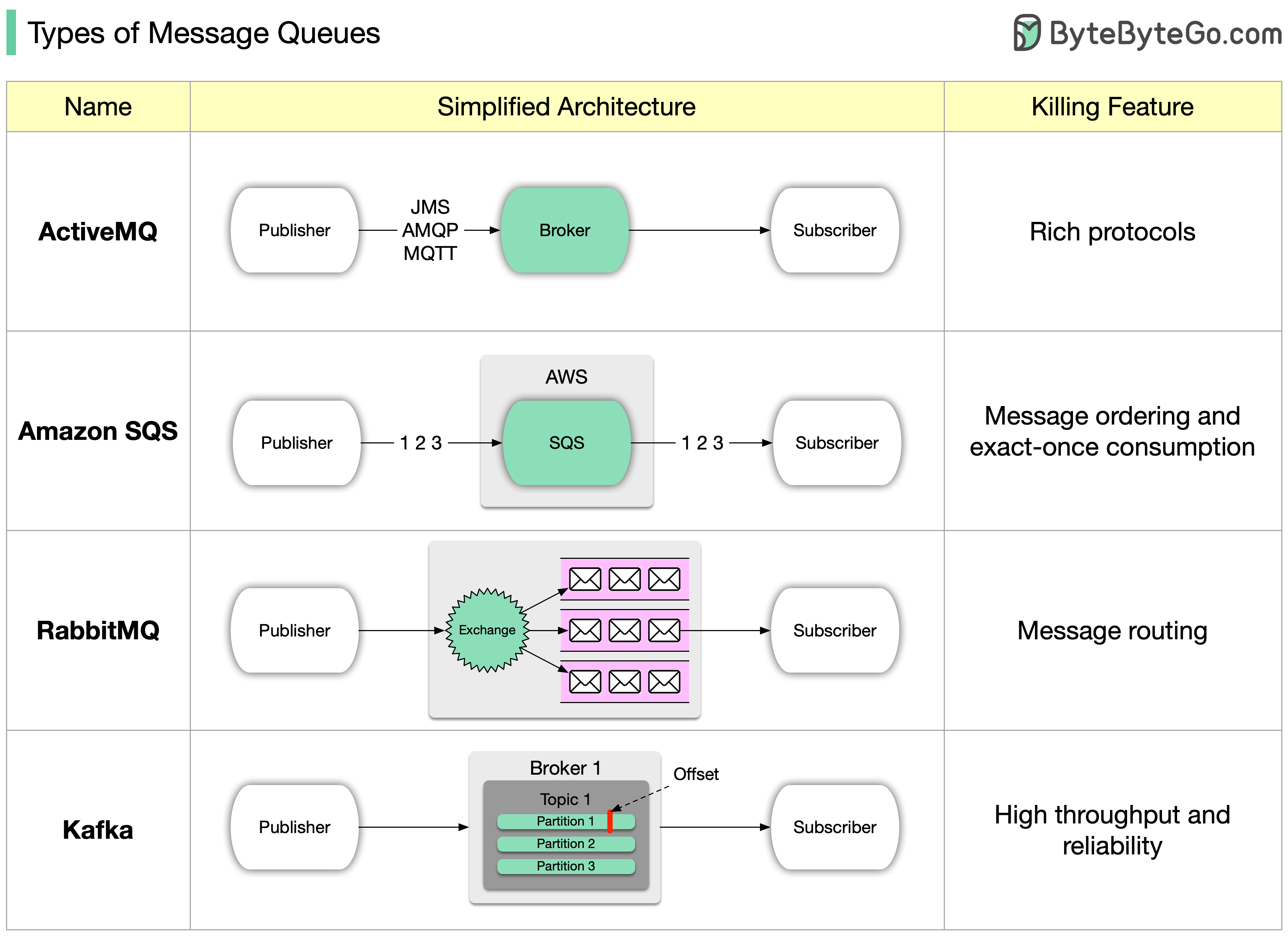
5. Architectural Comparison: Kafka vs. RabbitMQ
A common follow-up question is: "Why did you choose Kafka? What about RabbitMQ?" Knowing the difference shows you make deliberate architectural choices.
| Feature | Apache Kafka | RabbitMQ |
|---|---|---|
| Primary Model | Pub/Sub (replicated log) | Message Broker (smart broker/dumb consumer) |
| Architecture | Partitions and Offsets. Consumers pull data and manage their own offset (state). | Flexible routing with Exchanges (direct, topic, fanout, headers) and Queues. Broker pushes messages to consumers. |
| Message Retention | Messages are retained based on a policy (e.g., 7 days), even after being consumed. Supports replaying messages. | Messages are deleted from the queue after they are consumed and acknowledged. |
| Throughput | Extremely high. Designed for streaming large volumes of data. | Lower than Kafka, but excellent for complex routing and task queues. |
| Consumer Model | Pull-based: Consumers request messages from the broker. | Push-based: The broker actively pushes messages to consumers. |
| Best For... | Event streaming, log aggregation, real-time data pipelines, event sourcing. | Traditional task queues, complex message routing logic, decoupling microservices for RPC-style work. |
Conclusion
You now have a framework for discussing message queues in a system design interview, moving from the high-level "why" to the deep architectural "how."
Key Takeaways:
- Message queues are a fundamental tool for building responsive, reliable, and scalable distributed systems by enabling asynchronous communication.
- Clearly distinguish between Point-to-Point (Queue) for task distribution and Pub/Sub (Topic) for broadcasting events.
- Be ready to discuss critical trade-offs like delivery guarantees (at-least-once is a common, practical choice) and failure handling with Dead-Letter Queues.
- Understand the architectural differences between major platforms like Kafka (a pull-based, partitioned log system ideal for streaming) and RabbitMQ (a push-based, flexible broker ideal for complex task routing).
Next Lesson Preview:
Now that we've seen how to decouple services and process work asynchronously, a new challenge arises: how do you maintain data consistency across these separate services when a single business process involves multiple steps? Our next lesson, "Compare distributed transaction patterns (2PC, saga) and articulate their trade-offs," will tackle this very problem.