Hello! Welcome to the final lesson in our module on "Distributed Systems Concepts."
In our last lesson, we contrasted the 2PC and Saga patterns for managing distributed transactions. We established that Sagas, which are common in modern microservices, rely on asynchronous communication and retries to achieve eventual consistency. This raises a crucial question: if a payment service in a Saga receives the same charge-customer message twice due to a network retry, how do we prevent the customer from being charged twice?
Today, we'll answer that question directly. Your learning outcome is to apply idempotency principles to ensure reliable distributed operations. Mastering idempotency is a hallmark of a senior engineer, as it demonstrates a deep understanding of how to build robust systems that can gracefully handle the inevitable failures of a distributed environment.
1. What is Idempotency and Why is it Critical?
In simple terms, an idempotent operation is one that is "safe to retry." It can be performed multiple times, but the result and side effects will be the same as if it had been performed only once.
This is not just a theoretical concept; it's a fundamental requirement for reliability. Let's start with a video that defines idempotency and explains how it relates to standard HTTP methods.
Idempotency - What it is and How to Implement it
This video from Alex Hyett provides an excellent foundation, covering the problems caused by retries, the formal definition of idempotency, and which HTTP methods are idempotent by nature.
Watch the first 3 minutes and 39 seconds (from 00:00 to 03:39). Focus on: The types of problems that occur due to retries (e.g., double charges). The formal definition of idempotency. Why methods like GET, PUT, and DELETE are generally idempotent, but POST is not.
As the video highlights, operations like GET (read-only) or PUT (absolute update) are naturally idempotent. The challenge lies with operations like POST that create new resources or trigger actions with side effects.
To underscore why this is so critical in production, the following article details the common failure scenarios that idempotency protects against.
Idempotency in Real-World Systems: A Senior Engineer's Perspective
This article, written from a senior engineer's perspective, details the real-world failures that occur when idempotency is overlooked. It frames the problem from a practical, operational viewpoint.
Read the section titled 'Why Production Systems Break Without It'. It covers Network Failures, Retries from clients/load-balancers/queues, and even Human Behavior (like double-clicking a submit button).
2. The Core Pattern: The Idempotency Key
To make inherently non-idempotent operations safe to retry, the most common and effective pattern is the idempotency key.
The idea is simple:
- The client generates a unique identifier (like a UUID) for each distinct operation it wants to perform. This is the idempotency key.
- The client sends this key in a request header (e.g.,
Idempotency-KeyorX-Request-ID) along with the request payload. - The server uses this key to recognize and de-duplicate retries.
The following video explains the server-side mechanics of this pattern.
Idempotency - What it is and How to Implement it
Let's continue with the same video to see a clear explanation of how the idempotency key pattern is implemented.
Watch from 03:39 to 06:44. Pay close attention to: How an idempotency key makes a request unique. The server-side workflow: check key, process if new, store result, return response. The importance of using a persistent, shared store like Redis or DynamoDB. The concept of setting a Time-to-Live (TTL) for keys.
This flow is a standard pattern in many distributed systems. Payment gateways, in particular, rely heavily on it.

To see a real-world application, this next video explains how PayPal uses this exact pattern.
Idempotency and Intelligent Retry | PayPal
Payment gateways are a classic example where idempotency is non-negotiable. This video explains how PayPal uses this pattern to prevent duplicate charges.
Watch from 01:42 to 04:18. Notice how they use a specific header (PayPal-Request-ID) and how their SDKs help developers generate and include these keys.
3. The Distributed Race Condition: A Senior-Level Challenge
Given your backend experience, you know that a simple "check-if-key-exists, then-act" logic is a textbook race condition waiting to happen. What happens when you have multiple API server instances behind a load balancer and two identical requests arrive at different servers at almost the same time?
This is a classic interview question that separates senior candidates. The following article explains this problem and a robust, practical solution.
Idempotency in a Distributed System
Here's where we move from the basic concept to a critical implementation detail. This article brilliantly explains the race condition that occurs in a distributed setup and presents a simple, powerful solution.
Please read this article carefully: Start with 'Section 1: The Illusion of Safety' to understand the race condition timeline. Skip the section on Distributed Locks (it's a valid but complex pattern). Focus on 'Section 3: The Simpler, Better Way — Atomic Database Operations'. This 'act-first-then-check' pattern using a UNIQUE database constraint is a very interview-friendly solution.
The key takeaway is that you should offload the concurrency control to your database. Instead of checking first, you immediately attempt to INSERT the idempotency key into a table with a UNIQUE constraint.
- The "Winner": The first request to arrive will successfully insert the row. It has effectively acquired a "lock" and can proceed with the business logic.
- The "Loser": The second request's
INSERTwill fail with aUniqueViolationerror. This error is not a failure; it is your signal that this is a duplicate request. Your application code should catch this specific error and then fetch the original request's status or result.
4. Idempotency in Broader Contexts
The principles we've discussed are not limited to synchronous API calls. They are equally important in other parts of a modern backend system.
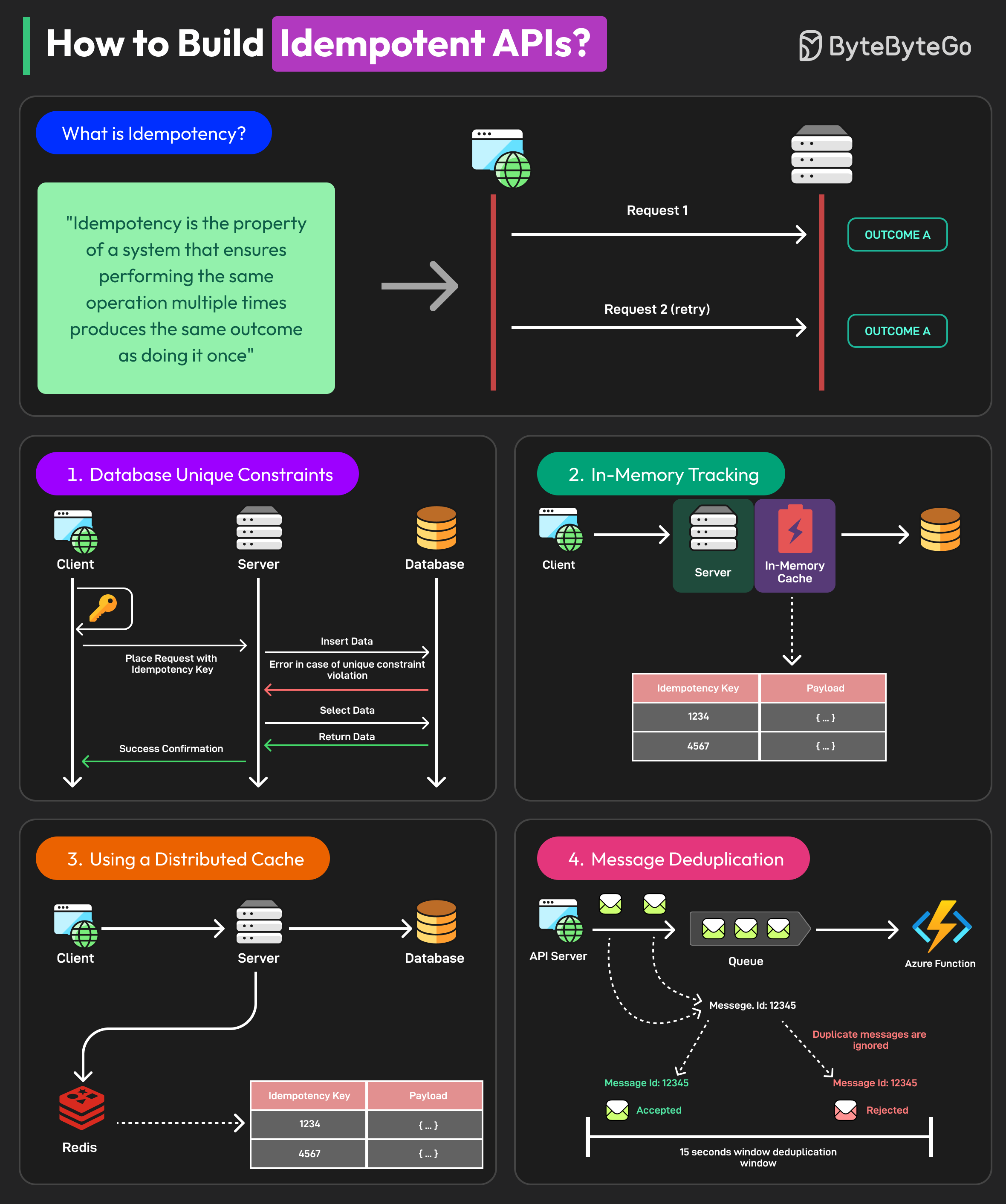
Let's quickly explore two other contexts where idempotency is crucial.
Idempotency in Real-World Systems: A Senior Engineer's Perspective
The principles we've discussed for APIs apply directly to other parts of a distributed system, especially asynchronous event consumers. Let's return to the 'Senior Engineer's Perspective' article to see how.
Read the sections 'Database and State Management' and 'Asynchronous and Event-Driven Systems'. Pay attention to: How database features like UNIQUE constraints and UPSERT operations can enforce idempotency at the data layer. The concept of an 'idempotent consumer' for handling duplicate messages from queues like Kafka or RabbitMQ.
As you can see, an idempotent consumer is a must-have when dealing with message brokers that offer "at-least-once" delivery guarantees. The implementation pattern is very similar: use a persistent store (like a database or Redis) to track the IDs of messages that have already been processed.
Conclusion
You've now covered a fundamental concept for building reliable distributed systems. Being able to discuss idempotency, its failure modes, and robust implementation patterns is a strong signal of seniority in any system design interview.
Key Takeaways:
- Idempotency means an operation is "safe to retry." It's essential for handling the inevitable failures and retries in distributed systems.
- The primary pattern for making non-idempotent operations safe is the idempotency key, a unique identifier generated by the client for each operation.
- A naive "check-then-act" logic for validating idempotency keys is flawed due to race conditions in a distributed environment.
- A robust and simpler solution is an "act-first-then-check" pattern, leveraging a
UNIQUEconstraint in a database to atomically handle concurrent requests. - Idempotency principles are not just for APIs; they are critical for asynchronous event consumers that process messages from queues.
Next Lesson Preview:
This lesson concludes our module on core distributed systems concepts. We've seen how components like API Gateways are natural places to implement cross-cutting concerns like idempotency checks. In our next module, "Core Infrastructure Components," we will start by taking a closer look at another foundational piece of infrastructure: the reverse proxy. We'll explore its role in scalability, security, and load balancing.