Hello! Welcome to our final lesson on advanced system design problems.
In our last session, we designed a time-series metrics collection system. A key challenge was handling immense write throughput while enabling fast queries, which we solved by using a message queue buffer and a specialized Time-Series Database (TSDB). We discussed how TSDBs are optimized for append-only writes and time-based queries.
Today, we're tackling another cornerstone of backend infrastructure: the distributed task scheduler. Your learning outcome is to design a distributed task scheduler focusing on job persistence, scheduling, and execution. This system is the engine behind everything from sending notifications and processing batch reports to running complex data pipelines like in Airflow or Celery. For a senior engineer, demonstrating a deep understanding of how to build such a system is critical.
This lesson will be our last deep dive into a specific design problem before we pivot to mastering the behavioral interview.
1. Framing the Problem: Requirements for a Distributed Scheduler
As always, we begin by establishing clear requirements. A "job scheduler" can mean many things, so defining the scope is the first step to a successful design.
Design a Distributed Job Scheduler - System Design Interview
Let's start by looking at a standard set of requirements for a distributed job scheduler. This will form the foundation of our design.
Read section '1. Requirements Gathering'. Pay close attention to both the functional and non-functional requirements. We will also adopt the 'Out of Scope' items to keep our initial design focused.
Based on that reading and typical interview expectations, here are our core requirements:
Functional Requirements:
- Job Submission: Users can submit jobs to be executed at a specific time (one-time) or on a recurring schedule (e.g., cron jobs).
- Job Management: Users can cancel or view the status of their jobs (e.g., pending, running, completed, failed).
- Execution: The system must trigger the job's execution at the scheduled time.
Non-Functional Requirements:
- Scalability: The system must scale to handle millions of job submissions and concurrent executions.
- High Availability: The system must be fault-tolerant. The failure of a single node should not halt the entire system or lose jobs.
- Durability & Reliability: Once a job is accepted, it must not be lost. We will aim for at-least-once execution semantics.
- Low Latency: The "scheduling drift" (the delay between the scheduled time and actual execution start time) should be minimal, on the order of seconds or less.
2. High-Level Architecture
With the requirements set, let's outline the main architectural components. We can logically separate the system into four main domains: Ingestion, Persistence, Scheduling, and Execution.

Let's briefly define the role of each component shown in the diagram:
- Job Submission Service: A stateless API layer that serves as the entry point for clients. It validates requests and passes them on for persistence.
- Job Store (Persistence): A durable database that acts as the system of record for all job definitions, schedules, and execution history.
- Scheduling Service: The core brain of the system. It identifies which jobs are due for execution.
- Distributed Job Queue: A message broker (like Kafka or RabbitMQ) that acts as a buffer between the scheduler and the executors. This decouples the components and absorbs load spikes.
- Execution Service (Workers): A fleet of worker nodes that pull jobs from the queue and execute the actual business logic. A coordinator manages these workers.
3. Deep Dive: Job Persistence
The persistence layer is the foundation of the scheduler's durability and reliability. The key decisions here revolve around the data model and the choice of database technology.
Data Modeling for Jobs
A common mistake is to lump all job-related information into a single, massive table. A more scalable approach, especially at the scale of millions of jobs, is to separate the static definitions from the dynamic scheduling information.
Distributed Job Scheduler Architecture at Meta Hyperscale
This article, which discusses design at Meta's scale, has an excellent section on separating job metadata from scheduling data. This is a key insight for a senior-level design.
Read the subsections '3.4 Jobs and JobSchedules table' and '3.5 Storage of One-Time vs. Recurring Jobs'. Understand the rationale for splitting data into a 'Job Definitions Table' and a 'JobSchedules Table'.
Our schema will include at least three key tables:
jobs: Stores the static definition of a job.job_id(Primary Key)job_nameowner_idpayload(e.g., a path to a binary, container image, or serialized task data)retry_policycron_expression(for recurring jobs)
job_schedules: A lean table tracking when a job should run next.job_id(Foreign Key)next_run_time(indexed)status(e.g.,WAITING,QUEUED)lock_token(for preventing race conditions)
job_runs: Stores the history of each execution attempt.run_id(Primary Key)job_id(Foreign Key)start_time,end_timestatus(RUNNING,COMPLETED,FAILED)worker_idoutput/error_message
Database and Sharding Strategy
The job_schedules table will be subject to intense read/write traffic from the scheduling service. A critical decision is how to partition (shard) this data to scale horizontally.
The "Distributed Job Scheduler Architecture at Meta Hyperscale" article gives a crucial piece of advice here: do not shard by time. Sharding by execution_time creates a massive hot spot, as all current activity focuses on a single shard.
Instead, a better approach is to shard by a hash of the job_id. This distributes the load evenly across all database shards, regardless of when the jobs are scheduled to run. We'd likely use a robust, sharded relational database like MySQL with Vitess or a distributed SQL database like CockroachDB to maintain transactional guarantees within a shard.
4. Deep Dive: The Scheduling Problem
This is the most interesting part of the design: How does the system efficiently find which of the billions of scheduled jobs are due to run right now?
The Naive Approach: Database Polling
The simplest method is to have a service periodically query the job_schedules table:SELECT job_id FROM job_schedules WHERE next_run_time <= NOW() AND status = 'WAITING';
While simple, this approach has major drawbacks at scale:
- High Database Load: Running this query every second against a massive table is extremely expensive.
- Latency & Jitter: The polling interval introduces inherent latency. If you poll every minute, a job scheduled for
12:00:01won't be picked up until12:01:00. - Race Conditions: Multiple scheduler instances could pick up the same job. This requires row-level locking (
SELECT ... FOR UPDATE), which further increases database contention.
An Improved Approach: The Watcher Service
A better design is to have a "Watcher" service that polls for jobs in a future time window (e.g., the next 5 minutes), loads them into a temporary buffer, and then dispatches them at the correct time.
✅ System Design 9: Design Distributed Job Scheduler like Airflow | Temporal | Celery | HLD | LLD
This video details a practical, refined architecture that uses a 'Watcher Service' to reduce database load. It's a solid intermediate step toward a truly hyperscale solution.
Watch from 31:40 to 36:50. Focus on the role of the 'Watcher Service'. Understand how it polls the database for a future window of jobs (e.g., next 5 minutes) and pushes them into a Kafka queue, effectively moving the scheduling pressure from the database to an in-memory component.
This "watcher" pattern is a good improvement, but for a top-tier company interview, you can showcase deeper knowledge by proposing an even more efficient, O(1) solution.
The Advanced Approach: Hierarchical Timing Wheels
The state-of-the-art solution for managing a vast number of timers is a data structure called a Hierarchical Timing Wheel. It allows for adding, removing, and advancing timers in amortized O(1) time, completely avoiding the need to scan a large list.
Distributed Job Scheduler Architecture at Meta Hyperscale
The 'Distributed Job Scheduler Architecture at Meta Hyperscale' article provides one of the best explanations of this advanced data structure. This is a key concept that distinguishes a senior-level answer.
Read section '4. The Scheduler: Hierarchical Timing Wheels'. Focus on understanding: Why min-heaps (priority queues) are not sufficient at this scale (O(log N) complexity). The concept of a timing wheel as a clock-like circular buffer. How the 'cascade' mechanism works across multiple wheels (seconds, minutes, hours) to manage long-term timers efficiently. How a Write-Ahead Log (WAL) provides durability for this in-memory structure.
In this model:
- Each scheduler node maintains its own set of in-memory timing wheels.
- A Shard Manager assigns ownership of
job_idshards to specific scheduler nodes. - Each scheduler node has a "loader" process that periodically queries the database for jobs in its assigned shards that are due in the near future (e.g., the next hour) and loads them into its timing wheel.
- The scheduler's main loop simply advances the lowest-level wheel one "tick" at a time (e.g., every second). Any jobs in the ticked slot are now due and are dispatched to the execution queue.
This design is incredibly efficient, as the scheduler is no longer bottlenecked by the database.
5. Deep Dive: Job Execution and Fault Tolerance
Once the scheduler determines a job is due, it must be reliably executed.
Decoupling and Backpressure
The scheduler's job is to identify when to run a task, not how to run it. We dispatch the job metadata to a distributed message queue (like Kafka). A separate fleet of worker nodes pulls jobs from this queue.
This pull model is critical because it provides natural backpressure. If the worker fleet is overloaded, it simply stops pulling jobs from the queue. The queue acts as a buffer, and the scheduler can continue its work without being blocked by slow execution.
Handling Failures
Failure is inevitable in a distributed system. We must design for it.
1. Job Failure (Application Logic Fails)
If a job fails, the worker node reports the failure. The system should then follow the job's retry_policy.
✅ System Design 9: Design Distributed Job Scheduler like Airflow | Temporal | Celery | HLD | LLD
Let's examine a concrete flow for handling job failures and retries using Kafka.
Watch from 42:57 to 46:40. Observe how a failed job is pushed to a 'retry' topic in Kafka. A consumer then picks it up, updates the retry count in the database, and re-schedules it. Note the use of a dead-letter queue (DLQ) for jobs that exhaust all retries.
2. Worker Node Failure
What if a worker node crashes mid-execution?
- Detection: A coordinator/master node can detect worker failures via heartbeats or by observing a lack of progress updates.
- Recovery: The job being executed by the failed worker must be re-queued for another worker to pick up. Since the worker might have partially completed its task, this is where idempotency becomes crucial. The job logic should be designed so that running it multiple times has the same effect as running it once.
- The "Zombie Worker" Problem: A worker might not crash but pause (e.g., due to a long garbage collection). It could lose its lease on a job, another worker starts it, and then the original worker "wakes up" and continues. This leads to concurrent execution. The "Meta Hyperscale" article introduces Fencing Tokens as a solution, where each lease is issued with a monotonically increasing token. The worker must present its token when committing results, and the system rejects writes from workers with stale tokens.
20: Distributed Job Scheduler | Systems Design Interview Questions With Ex-Google SWE
Let's explore the broader challenge of ensuring jobs run exactly once, which is theoretically impossible but can be approximated. This video provides an excellent discussion on the topic.
Watch from 22:42 to 27:51. Focus on the reasons for multiple executions, the use of distributed locks (like with Zookeeper) to prevent concurrent runs, and the ultimate conclusion: design for at-least-once execution and make your jobs idempotent.
6. Putting It All Together
Here is a diagram showing a more detailed, robust architecture incorporating the concepts we've discussed.
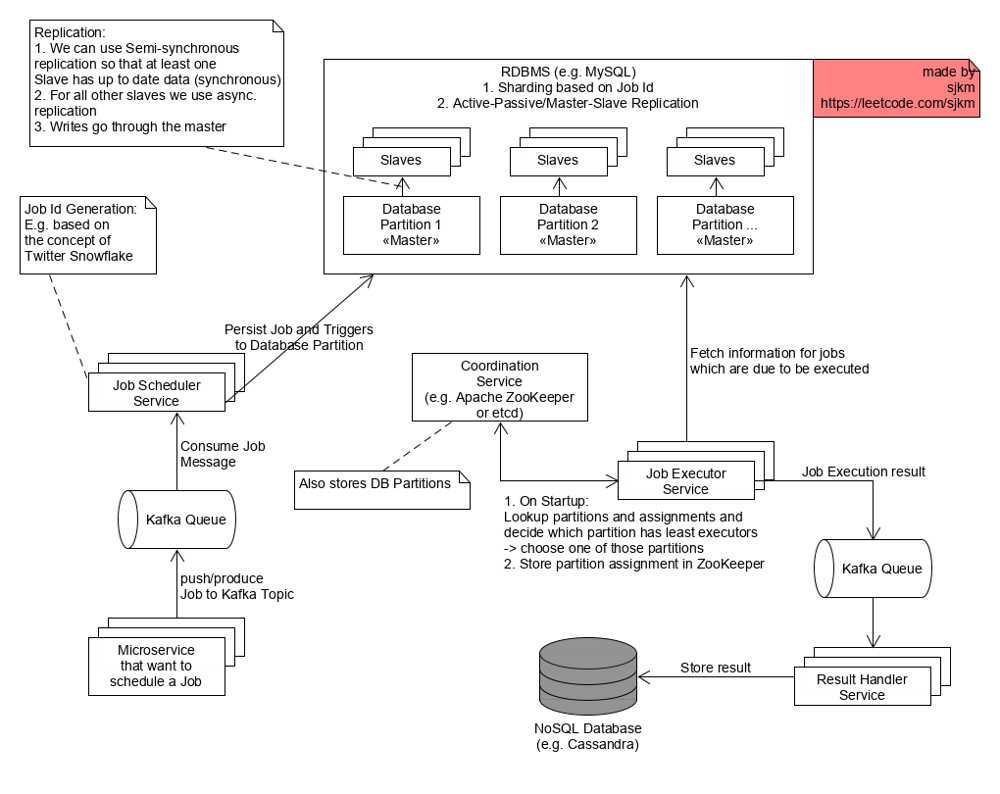
This design effectively separates concerns:
- Persistence is handled by a scalable, sharded database.
- Scheduling is made efficient with in-memory data structures (like timing wheels) and is made fault-tolerant by a Shard Manager and WAL.
- Execution is decoupled and resilient, using a pull-based queue model and designing for failure and idempotency.
Conclusion
In this lesson, we designed a distributed task scheduler capable of operating at a massive scale. We progressed from basic requirements to a sophisticated architecture that addresses the core challenges of persistence, scheduling, and execution in a distributed environment.
Key Takeaways:
- Separate Core Concerns: The architecture should clearly distinguish between job persistence, scheduling logic, and the execution environment.
- Solve the Scheduling Problem Efficiently: Naive database polling does not scale. Use advanced, in-memory data structures like Hierarchical Timing Wheels for O(1) timer management.
- Design for Distribution and Failure: Use patterns like the Shard Manager to assign responsibility in a stateful service. Handle node failures gracefully by designing for at-least-once semantics and ensuring jobs are idempotent.
- Decouple with Queues: Use message queues to buffer load and decouple the scheduler from the execution workers, providing natural backpressure.
Next Lesson Preview:
This concludes our module on advanced system design problems. You've now built a strong foundation in tackling complex, large-scale systems. The next critical step in your interview preparation is to effectively communicate your experience and leadership skills. In our next module, Behavioral Interview Fundamentals, we will begin by describing the purpose and evaluation criteria of behavioral interviews and mastering the STAR method to craft compelling stories.