Hello! Welcome to the fifth lesson in our module, "Measuring the Unconscious Consumer."
In our last lesson, we explored Electroencephalography (EEG) and saw how it can reveal a person's cognitive load and engagement by listening to the brain's electrical activity. We learned that EEG is fantastic for understanding states like focus, confusion, and interest.
But emotion has another critical dimension: its intensity. Think about the difference between gentle happiness and pure exhilaration, or mild concern versus sheer panic. This intensity is called arousal. Today, our goal is to explain how Galvanic Skin Response (GSR) is used to measure emotional arousal.
GSR gives us a direct, physiological measure of how strongly a person is feeling, moment by moment. For you, this is a powerful tool. It allows you to move beyond asking "Did you like it?" and instead answer "At which exact second did the advertisement create the biggest emotional spike?" This knowledge is invaluable for optimizing marketing content and a skill you can clearly communicate to any stakeholder.
1. What is Galvanic Skin Response (GSR)?
At its most basic, Galvanic Skin Response is a measure of the continuous changes in the electrical properties of the skin. It’s also known by other names, such as Electrodermal Activity (EDA) or Skin Conductance (SC).
Why is this important? Because these electrical changes are directly linked to our emotional state. When we feel emotionally aroused—whether by something exciting, funny, scary, or surprising—our body has an unconscious reaction that changes how well our skin conducts electricity.
To understand this core concept, let's turn to a guide that breaks it down.
Galvanic Skin Response (GSR): The Complete Pocket Guide
The article 'Galvanic Skin Response (GSR): The Complete Pocket Guide' from iMotions provides a clear definition of GSR and explains why it is such a valuable measure of unconscious emotional arousal.
Please read the first section, 'What is Galvanic Skin Response (GSR) and Why Does It Matter?'. Pay close attention to the idea that GSR captures behavior that is 'not under cognitive control,' which is what makes it so powerful.
The key takeaway is that GSR gives us a window into the body's automatic, unfiltered emotional responses—the kind people can't hide or might not even be aware of themselves.
2. The Science: From Emotion to Electrical Signal
So, how does a feeling turn into a measurable electrical signal? The process is a fascinating chain reaction managed by our autonomic nervous system. Given your goal to explain these concepts, understanding this chain is key.
-
An Emotional Trigger Occurs: You see, hear, or think of something emotionally relevant (e.g., a suspenseful scene in an ad, the satisfying click of a well-made product).
-
The 'Fight-or-Flight' System Activates: This trigger activates the sympathetic nervous system, the part of your body responsible for preparing for action. It's like the body's accelerator pedal. It increases heart rate, sharpens focus, and, crucially for us, activates sweat glands.
-
Emotional Sweating: The sweat glands on our palms and the soles of our feet are particularly sensitive to emotional stimulation. When the sympathetic nervous system fires up, these glands secrete a tiny amount of sweat. This sweating is often so subtle that it's not visible or felt.
-
Skin Conductance Increases: Sweat is composed of water and electrolytes (ions). This fluid fills the sweat ducts and increases the skin's ability to conduct electricity.
-
We Measure the Change: By passing a very small, imperceptible electrical current between two electrodes on the skin, we can measure how easily the current flows. When emotional arousal occurs, conductivity goes up.
The following resource provides an excellent and more detailed explanation of this physiological process.
Galvanic Skin Response (GSR): The Complete Pocket Guide
Let's return to the iMotions guide to explore the physiological mechanics behind GSR.
Read the section 'How Does Galvanic Skin Response (GSR) Work in Measuring Emotions?'. Focus on the roles of the skin, sweat glands, and especially the distinction between the sympathetic and parasympathetic nervous systems.
To make this practical, here is how the measurement is typically set up.
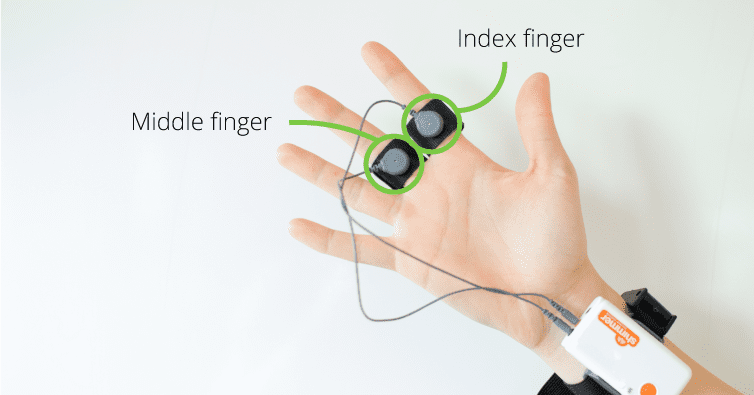
The data from these electrodes gives us a signal that fluctuates over time. Fast, sharp increases in the signal, often called "GSR peaks", correspond to moments of high emotional arousal. These peaks are derived from the phasic component of the signal, which reflects rapid changes in response to stimuli. This is distinct from the slower, baseline tonic component, which can vary between individuals.
3. Arousal vs. Valence: What GSR Can and Cannot Tell Us
This is perhaps the most important concept to master when using and explaining GSR.
- Arousal is the intensity of the emotion. It runs on a scale from calm to excited. GSR is an excellent measure of arousal.
- Valence is the direction of the emotion. It runs on a scale from negative (unpleasant) to positive (pleasant).
GSR cannot distinguish between positive and negative valence. A high GSR peak could be caused by the joy of seeing a puppy, the fear of watching a horror movie, or the excitement of a dramatic plot twist. All are high-arousal states.
Think of GSR as a car's speedometer. It tells you how fast you're going (arousal), but it doesn't tell you if you're driving toward a vacation destination or fleeing a hazard (valence).
What is the Galvanic Skin Response (GSR) and how to use it ...
The article from Dr. Marco Mancini clearly articulates this crucial distinction between arousal and valence.
Read the section 'What is the association between the galvanic skin response (GSR) and emotions?'. Focus specifically on the paragraphs under the subheading 'Can we discriminate emotions through the study of skin conductance?'.
Because of this, neuromarketing practitioners never rely on GSR alone. They combine it with other tools. For example, by syncing GSR data with Facial Coding (which we covered two lessons ago), you can get the full picture: the GSR peak tells you when a strong emotion occurred, and the facial expression (e.g., a smile or a frown) tells you what that emotion likely was.
Test your understanding!
You are testing a 30-second commercial for a new soft drink. The GSR data shows two large peaks:
- The first peak occurs as a group of friends are shown laughing and cheering at a concert.
- The second peak occurs during a fast-paced action sequence where a skateboarder almost falls but lands a difficult trick at the last second.
What can you confidently conclude from the GSR data alone? What can't you conclude, and what other data would you need to get the full story?
Show answer
What you can conclude: You can confidently say that both the concert scene and the skateboarding trick were moments of high emotional arousal for the viewer. They were the most emotionally intense parts of the ad.
What you can't conclude: You cannot know if the arousal from the skateboarding scene was due to positive excitement (thrill) or negative anxiety (fear of the fall). The arousal at the concert is likely positive, but the GSR data itself doesn't confirm it.
What you need next: To understand the valence, you would sync the GSR data with facial coding results. If viewers showed smiles (Zygomaticus Major activation) during both peaks, you could confirm both moments generated positive excitement. If they showed expressions of fear or stress (e.g., brow furrowing) during the skateboard scene, you'd know that moment created tension, not just exhilaration.
4. How to Explain GSR to a Business Colleague
Your ability to translate this science into simple, compelling language is crucial. Here’s a way you could frame it for someone in marketing or sales:
"We have a tool called GSR that acts like a real-time 'emotion meter.' When a person feels any strong emotion—like excitement, surprise, or even frustration—their body has a tiny, unconscious reaction where their skin briefly becomes a better conductor of electricity. We measure this with simple sensors on their fingers.
This tells us the exact moments in an ad or on a website that create the biggest emotional impact. It shows us what's grabbing their attention on a gut level.
The key is, it measures the intensity of the emotion, not whether it's good or bad. So, we pair it with other tools, like facial expression analysis, to see if that big emotional spike we found was caused by delight or by confusion. It helps us cut through the noise and pinpoint what truly resonates with customers."
Conclusion
Today we've added a vital tool to our neuromarketing measurement kit. We've seen how emotional reactions in the brain trigger an unconscious physiological cascade that we can measure on the surface of the skin.
Key Takeaways:
- GSR measures emotional arousal (intensity) by tracking changes in skin conductance caused by the sympathetic nervous system's activation of sweat glands.
- It is a powerful measure of unconscious, automatic responses, providing insights that self-report often misses.
- GSR's most critical limitation is that it cannot determine valence (whether an emotion is positive or negative).
- In practice, GSR is almost always combined with other measures like facial coding (FACS) or eye-tracking to provide a complete picture of the consumer experience.
Preview of Next Lesson:
We have now covered four major measurement techniques: eye-tracking (attention), FACS (emotional expression), EEG (cognitive states), and GSR (emotional arousal). But when should you use each one? In our final lesson of this module, we will learn how to critique the strengths and limitations of each tool for a specific marketing question, equipping you to select the right method for the right problem.