Hello! Welcome to the final lesson in our module, "Measuring the Unconscious Consumer."
Throughout this module, we've built an impressive toolkit. We started with eye-tracking to see where attention goes, moved to Facial Action Coding (FACS) to read emotional expressions, then used Electroencephalography (EEG) to measure cognitive engagement, and finally added Galvanic Skin Response (GSR) to gauge emotional arousal.
Today, we transition from understanding what these tools do to understanding when and why to use them. Our goal is to critique the strengths and limitations of a given neuromarketing measurement tool for a specific marketing question. This is the strategic capstone of our module. For you, this skill is paramount. It’s not just about knowing the science; it's about being the translator who can confidently advise a team, "For this specific problem, here is the right tool, and here is why."
Let's begin by setting the stage for why this critical evaluation is so necessary.
1. Why One Size Doesn't Fit All
As you've seen in your own career, asking the right question is half the battle. In marketing research, the same is true: the tool you use must match the question you're asking. Relying on self-report surveys alone can be misleading because, as we've learned, people often can't or won't articulate the subconscious drivers of their decisions. Biometric tools give us a way to peek under the hood.
However, it's a common mistake to think there's a single "best" tool. Each one is like a specialist instrument in a doctor's bag—a stethoscope is perfect for listening to a heart, but useless for looking at a bone. The video below gives a great overview of the different tools in the neuromarketing toolkit and cautions against oversimplification.
You make decisions freely? Neuromarketing says think again | Billy Sung | TEDxKingsParkSalon
Let's watch this TEDx talk by Dr. Billy Sung. He provides a compelling case for why we need these tools and gives a quick tour of what each one measures.
Watch from 01:56 to 07:11. Pay attention to: Why self-report is insufficient (01:56 - 03:39). The quick overview of different biometric measures (03:39 - 06:28). The crucial warning against oversimplification and the myth of a 'buy button' (06:28 - 07:11).
Dr. Sung's talk reinforces a key idea: these tools are powerful complements to traditional methods, but only when applied scientifically and for the right purpose. Your job is to be the person who ensures they are.
2. A Guide to the Neuromarketing Toolkit: Strengths and Weaknesses
Now, let's create a strategic guide. We will analyze the most common tools, focusing on what they are best for and what their blind spots are. The following article from INSEAD is written specifically for a business audience and is an excellent resource for this.
A Non-Scientist's Guide to the Neuromarketing Toolkit
This article, 'A Non-Scientist's Guide to the Neuromarketing Toolkit,' provides a clear, concise breakdown of the main tools.
Please read the sections describing the six main tools. For our purposes, focus on these five: fMRI: Start at 'Functional magnetic resonance imaging (fMRI)'. EEG: Continue at 'Electroencephalography (EEG)'. Eye-tracking: Continue at 'Eye-tracking'. SCR (GSR): Continue at 'Skin conductance response (SCR)'. FAR (Facial Coding): Continue at 'Facial affect recording (FAR)'. For each tool, identify its core strength and its main limitation.
To reinforce the points on EEG, which can be a bit more complex, here is a very short video that neatly summarizes its pros and cons.
2-Minute Neuroscience: Electroencephalography (EEG)
This '2-Minute Neuroscience' video on EEG will help solidify your understanding of its specific advantages and disadvantages.
Watch the final segment from 01:29 to 01:56, which directly addresses the strengths and limitations of EEG.
3. The Tool Selection Matrix
Based on what we've learned, we can organize this information into a decision-making framework. Think of this as your cheat sheet for selecting the right approach.
| Tool | What It Measures (Primary Use) | Strengths | Limitations | Ideal Marketing Question |
|---|---|---|---|---|
| Eye-Tracking | Visual Attention: Where people look, in what order, and for how long. | Direct, objective measure of what is seen (or ignored). Excellent for layout and design optimization. Relatively easy to implement. | Doesn't explain why someone is looking or what they think/feel. "Just because you look doesn't mean you like." | "Is our packaging visible on a crowded shelf? Are people seeing our call-to-action button on our website?" |
| Facial Coding (FACS/FAR) | Emotional Valence: The type of emotion being expressed (happy, sad, angry, surprised). | Provides valence (positive/negative direction) of emotion. Non-invasive and intuitive. | Less reliable for subtle or mixed emotions. Can be influenced by social norms (people might suppress expressions). | "Does our TV commercial elicit genuine joy or just polite smiles? Is our new user interface causing frustration?" |
| GSR (SCR) | Emotional Arousal: The intensity of an emotional response. | Excellent for pinpointing moments of high emotional impact (peaks). Very sensitive. | Cannot determine valence. Arousal could be from joy, fear, or confusion. Slower response time (~2-5 seconds). | "Which scenes in our movie trailer create the biggest spikes of excitement or tension? Does the unboxing experience have any 'wow' moments?" |
| EEG | Cognitive States: Engagement, cognitive load (confusion), attention, memory encoding. | Excellent temporal resolution (millisecond timing). Can track changes in real-time during an experience. Good for dynamic media like videos. | Poor spatial resolution (can't pinpoint deep brain locations). Signals from the cortex surface only. Data is complex to interpret. | "Is our ad engaging or is the viewer's mind wandering? Is this informational graphic too complex and causing cognitive overload?" |
| fMRI | Blood Flow (as a proxy for brain activity). | Excellent spatial resolution (can pinpoint activity in deep brain structures like the reward system or amygdala). | Very expensive, slow (measures blood flow, not neural firing), requires an artificial lab environment (lying in a scanner). Small sample sizes. | "Does our luxury brand logo activate the brain's reward centers more than a competitor's? Does this public health message activate fear or empathy regions?" |
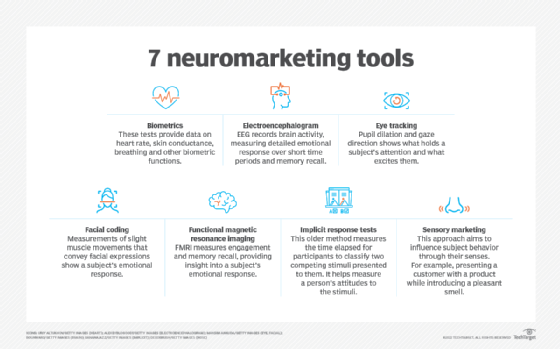
4. Broader Considerations: Cost, Ethics, and Accuracy
Beyond choosing a tool for a technical reason, a business leader must also weigh other factors.
Neuromarketing Advantages & Disadvantages
The article 'Neuromarketing Advantages & Disadvantages' from Neurons Inc. provides a great high-level overview of the strategic pros and cons of using these methods.
Please read the section 'What are the disadvantages of neuromarketing?' and then look at the summary table at the end. Focus on the four main limitations discussed: cost, ethics, real-world accuracy, and data complexity.
As the article highlights, you must always consider:
- Cost vs. Benefit: Is an fMRI study worth $50,000 to find the perfect color for a button? Likely not. Is it worth it to understand the core emotional drivers for a $100 million brand? Maybe.
- Ethics: Are you gathering data transparently and with consent? Are you using insights to help customers, or to exploit vulnerabilities?
- Real-World Validity: Results from a sterile lab may not perfectly predict behavior in a noisy, distracting supermarket. Always question how the study's environment matches the real world.
5. Application: You're the Consultant
Now, let's put your knowledge to the test. For each scenario, identify the primary marketing question and then choose the best combination of tools to answer it, explaining your reasoning.
Scenario 1: The Underperforming Website
A direct-to-consumer brand just launched a new homepage. Web traffic is high, but very few visitors are clicking the "Shop Now" button or scrolling down to see the product features. The marketing team is debating whether the hero image is unappealing or if the page layout is simply confusing.
What is the best tool or combination of tools to diagnose this problem, and why?
Show answer
Best Tool: Eye-Tracking.
Reasoning: The core problem is about visual behavior: "Where are people looking, and what are they missing?" Eye-tracking is the most direct and efficient tool to answer this. A heatmap would instantly reveal if users' gaze is drawn to the hero image while ignoring the "Shop Now" button. A gaze plot would show the path users' eyes take, revealing if they get "stuck" or fail to scroll down.
While you could add EEG to measure cognitive load (to see if the page is confusing), or GSR/FACS to measure emotion (to see if the image is unappealing), eye-tracking is the essential first step that directly addresses the primary business question.
Scenario 2: The Polarizing Super Bowl Ad
A company spent millions on a 60-second Super Bowl ad that tells an emotional story. In post-game surveys, half the audience says they "loved it" and the other half says they "didn't get it." The company needs to understand, moment-by-moment, what worked and what didn't. They want to create a 15-second cut-down for social media using only the most powerful scenes.
What is the best tool or combination of tools to help them, and why?
Show answer
Best Combination: GSR + Facial Coding + EEG.
Reasoning: This is a multi-faceted emotional and engagement question.
- GSR would identify the moments of highest arousal—the emotional peaks and valleys of the story. This is crucial for finding the most "powerful" moments.
- Facial Coding would provide the critical valence. When a GSR peak occurs, was it because of joy from a heartwarming scene or confusion from a complex plot point? This helps explain why half the audience was polarized.
- EEG would measure second-by-second engagement. It would show if viewers' minds were wandering during certain scenes ("didn't get it") or if they were deeply engrossed.
By synchronizing these three data streams, the company could find the scenes that produced the highest positive emotional arousal and engagement, and use those to create a highly effective 15-second ad.
Conclusion
You have now reached the end of this module and have a complete framework for evaluating consumer responses. You can not only describe what each major neuromarketing tool does but also critically evaluate its use for a specific business problem.
Key Takeaways:
- There is no single "best" neuromarketing tool; the choice is always driven by the marketing question you need to answer.
- Every tool has a unique set of strengths (what it's great at) and limitations (its blind spots). Critiquing them involves understanding this trade-off.
- The most powerful insights often come from combining tools—for example, using GSR to find when an emotion occurs and Facial Coding to find out what that emotion was.
- Strategic decisions must also account for practical constraints like cost, ethics, and real-world applicability.
Preview of Next Module:
In this lesson, you learned how to select the right tool for a given problem. In our next module, "Synthesizing and Applying Neuromarketing," we will take a step back. You will learn to start with a marketing challenge (e.g., low brand recall) and select the most relevant neurophysiological principle (e.g., the spacing effect, cognitive bias) to devise a solution. You are moving from a tool-centric view to a principle-centric, strategic one.