Hello! Welcome to the first lesson in our third module, "Memory and Building Brand Associations."
In our last module, we focused on perception and attention—how to capture a consumer's initial interest. We ended by discussing 'processing fluency,' the idea that making a message easy to understand makes it feel more pleasant and trustworthy in the moment. But how do we turn that pleasant moment into a lasting brand impression? That is the job of memory.
Today, we will begin our journey into this topic by addressing a fundamental question: how does the brain organize and store information? Our learning outcome is to differentiate between sensory, short-term (working), and long-term memory systems.
Think of the brain's memory not as a single filing cabinet, but as a multi-stage information processing system. Understanding these stages is the first step toward designing marketing that doesn't just get noticed, but gets remembered. For you, this is foundational knowledge for explaining why some campaigns have lasting impact while others vanish without a trace.
The Classic Model of Memory
To begin, let's look at a foundational framework in cognitive psychology called the Multi-Store Model of Memory, proposed by Richard Atkinson and Richard Shiffrin in the 1960s. It provides a simple, linear roadmap of how information journeys from a fleeting sensation to a potentially permanent memory.
To get a quick visual overview of this model, let's watch a short segment from the Sprouts channel.
The Multi-Store Model: How We Make Memories
This animated video provides a clear and simple introduction to the three main stages of memory according to the Multi-Store Model.
Please watch from 01:16 to 02:43. Focus on identifying the three 'processors' of memory and the key actions that move information between them.
As the video explained, memory isn't a single entity. It's a sequence of three distinct stores:
- Sensory Memory: The entry point for all raw information from our senses.
- Short-Term Memory (STM): A temporary workspace with limited capacity.
- Long-Term Memory (LTM): A vast, durable storage system.
Information flows through these stages, guided by processes like attention and rehearsal. The diagram below provides a great visual summary of this process flow.

This model gives us our structure for today's lesson. We will now explore each of these three stores in more detail, focusing on three key characteristics:
- Capacity: How much information can it hold?
- Duration: How long can it hold the information?
- Encoding: In what format is the information stored?
Stage 1: Sensory Memory – The Fleeting Impression
Every second, your brain is bombarded with an incredible amount of information from your eyes, ears, nose, skin, and tongue. Sensory memory acts as a very brief buffer for all this data. It holds an exact, raw copy of what you're sensing for just an instant.
Let's read a clear definition of this initial stage.
Multi-Store Memory Model: Atkinson and Shiffrin
The article 'Multi-Store Memory Model' from Simply Psychology offers excellent, easy-to-understand explanations of each memory store. We will use it as our guide for the next three sections.
Please read the section titled 'Sensory Memory.' Focus on the key features (duration, capacity, encoding) and the examples given, like the trail of a sparkler.
As you read, the key features of sensory memory are its huge capacity (it takes in everything) but extremely short duration (less than a second for vision, a few seconds for hearing). Unless you pay attention to a piece of sensory information, it decays and vanishes forever.
Marketing Application: This is the critical first hurdle for any ad. When a person scrolls past a social media ad or drives by a billboard, the image is briefly held in their sensory memory. If the ad doesn't use strong visual or auditory cues to capture attention within that fraction of a second, the information is lost.
Stage 2: Short-Term & Working Memory – The Mental Notepad
Once you pay attention to something, it moves from sensory memory into your short-term memory (STM). Think of this as your brain's conscious workspace or mental notepad. It's where you hold information you are actively thinking about right now.
Let's explore the characteristics of this temporary store.
Multi-Store Memory Model: Atkinson and Shiffrin
Now, let's continue with the Simply Psychology article to understand the function and, importantly, the limitations of short-term memory.
Please read the section 'Short Term Memory.' Pay close attention to its limited duration and capacity, and the role of 'maintenance rehearsal'.
As the article explains, STM is severely limited.
- Duration: Only about 15-30 seconds without active rehearsal (like repeating a phone number to yourself).
- Capacity: Famously, it can only hold about 7 +/- 2 "chunks" of information.
Psychologists now often prefer the term working memory, because it better captures the active nature of this stage. It's not just a passive holding bay; it's a dynamic workbench where you manipulate information, connect it to existing knowledge, and solve problems.
The following video provides a great explanation of this updated concept.
How We Make Memories: Crash Course Psychology #13
This Crash Course Psychology video, featuring the famous case of Clive Wearing, effectively illustrates the importance of memory and explains the evolution from the idea of short-term memory to the more comprehensive concept of working memory.
Please watch from 03:25 to 04:56. Notice how Hank Green describes short-term memory as a temporary holding place and then introduces 'working memory' as a more active processor that connects to long-term storage.
Marketing Application: STM's limitations are hugely important. When a customer is comparing prices, trying to remember a discount code, or reading product features, they are using their working memory. If you present too much information at once (e.g., a cluttered webpage or a fast-talking ad), you overload their working memory, causing confusion and frustration. This is why simple, clear calls-to-action ("Buy Now") and memorable slogans are so effective.
Test your understanding!
A radio ad for a plumber ends with "Our number is 212-555-3489-714." Based on the capacity of short-term memory, why is this a poorly designed ad, and what simple change could make it more effective?
Show answer
This is a poor design because a 10-digit phone number pushes the upper limit of STM capacity (7 +/- 2 items). The addition of the "714" at the end makes it 11 digits, which almost guarantees the listener will not be able to hold the entire number in their working memory to write it down or dial it.
A more effective strategy would be to use a "vanity number" that chunks the information into a meaningful word (e.g., "212-555-LEAK") or to simply repeat the business name and tell listeners to "search for 'Apex Plumbers' online." This reduces the cognitive load on working memory.
Stage 3: Long-Term Memory – The Brain's Library
The ultimate goal for any brand is to earn a permanent spot in the consumer's long-term memory (LTM). This is the vast, organized library of your knowledge, skills, experiences, and beliefs.
Let's look at the final stage in our model.
Multi-Store Memory Model: Atkinson and Shiffrin
Finally, let's read about the characteristics of long-term memory in the Simply Psychology article.
Please read the section 'Long Term Memory.' Focus on its duration and capacity, and note the crucial role of 'elaborative rehearsal' in transferring information here.
In stark contrast to STM, long-term memory has:
- Duration: Potentially a lifetime.
- Capacity: Virtually unlimited.
- Encoding: Primarily semantic, meaning it is organized by meaning and association, not just by sound or sight.
This is why, as the article notes, elaborative rehearsal (linking new information to what you already know) is far more effective for creating lasting memories than simple maintenance rehearsal (mindless repetition).
Marketing Application: This is where brand equity lives. The Nike "swoosh," the McDonald's golden arches, the feeling you get from a Coca-Cola ad—these are all stored in LTM. Getting here requires more than just repetition; it requires creating meaningful, emotional, and relevant associations that connect the brand to the consumer's existing knowledge and values.
Summary: The Three Systems at a Glance
Let's put it all together. The three memory systems work as a team, each with a distinct job.
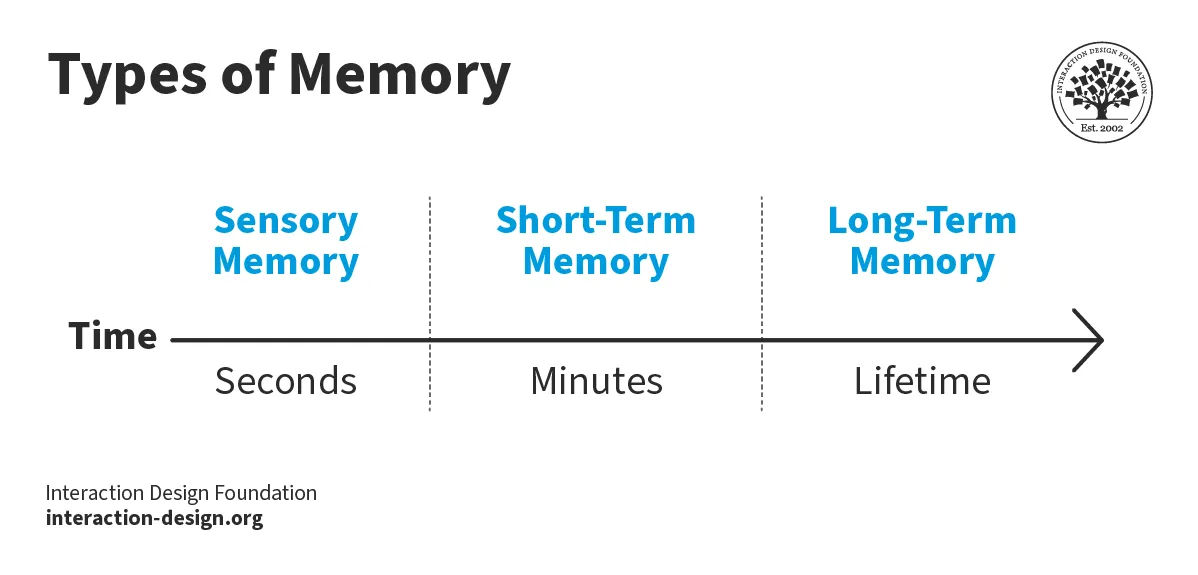
Here is a summary table to clearly differentiate the three systems:
| Feature | Sensory Memory | Short-Term (Working) Memory | Long-Term Memory |
|---|---|---|---|
| Role | "Holding bin" for raw sensory data | "Mental notepad" or "workbench" | "Permanent library" of knowledge & experience |
| Capacity | Very large | Very small (7 +/- 2 items) | Virtually unlimited |
| Duration | Very short (< 1 sec for vision) | Short (~15-30 seconds without rehearsal) | Potentially a lifetime |
| Encoding | Sense-specific (e.g., iconic, echoic) | Primarily acoustic (by sound) | Primarily semantic (by meaning) |
| Forgetting | Decay (fades away very quickly) | Displacement (pushed out by new info), decay | Retrieval failure (can't find the information) |
Conclusion
Today, we've dissected the brain's fundamental architecture for memory. We learned that information processing happens in stages, moving through three distinct systems: the fleeting Sensory Memory, the limited Short-Term/Working Memory, and the vast Long-Term Memory. Each has a different capacity, duration, and method of storing information.
Your key takeaways are:
- Memory is a process, not a place. Information must pass through filters to be retained.
- Sensory Memory is a brief, high-capacity buffer. If attention isn't captured here, the message is lost.
- Short-Term/Working Memory is a limited-capacity "notepad." Overloading it leads to confusion and forgetting.
- Long-Term Memory is the goal. It's a vast library where brand associations live, organized by meaning.
When explaining this to a colleague or client, you can use a simple analogy: "Our memory works in three stages. First, there's a 'sensory doorway' where everything enters for a split second. If we pay attention, it moves to a 'mental whiteboard' where we can work with a few ideas at once. To make something stick permanently, we have to file it away meaningfully in the 'long-term library.' Our job in marketing is to guide our message through that whole journey."
Now that we understand where memories are stored, our next lesson will focus on how they get there and how we pull them back out. We will explore the critical processes of encoding, storage, and retrieval in the context of brand messaging.