Hello! Welcome to the final lesson in our module on perception and attention.
In our last lesson, we explored sensory adaptation—the brain's tendency to tune out constant, unchanging stimuli. We learned that to keep a message from becoming invisible, marketers need to strategically introduce novelty and variation. But grabbing attention is only half the battle. What happens in the moment of perception that makes a person like what they see?
Today, we'll explore a powerful, counterintuitive principle. While surprise can capture attention, making things mentally effortless can capture preference. Our goal is to define 'processing fluency' and explain how making stimuli easy to process can increase preference.
Understanding this is like having a secret key to design. It explains why some logos, slogans, and websites just "feel right," while others feel off-putting for no obvious reason. For you, this is a fundamental concept for creating marketing materials that build instant, unconscious rapport with a customer's brain.
Part 1: The Brain's Love for the Easy Path
Imagine you have two instruction manuals for the same product. One is written in tiny, complicated font with dense paragraphs and confusing diagrams. The other uses a large, clear font, simple sentences, and clean illustrations. Which product would you feel more confident about using?
This immediate feeling of ease or difficulty is the essence of processing fluency. In cognitive psychology, it's defined as the subjective experience of ease with which our brains process information. Your brain, being highly efficient, prefers to take the easy path. It conserves energy whenever it can.
Let's get a more formal definition.
This Wikipedia entry on Processing Fluency provides a concise overview of the concept and its main types. It's a great starting point for a clear, academic definition.
Please read the introduction, which is the first few paragraphs before the 'Research' heading. Focus on the core definition and the difference between perceptual and retrieval fluency.
As you just read, there are several types of fluency, but two are most relevant for us:
- Perceptual Fluency: The ease of processing sensory information. A clean design, a high-contrast logo, or a clearly spoken message all have high perceptual fluency.
- Retrieval Fluency: The ease of pulling information from memory. A catchy jingle or a memorable brand name has high retrieval fluency.
The crucial insight is that the brain doesn't separate the feeling of ease from the thing it's processing. It uses a mental shortcut: "If this is easy to process, it must be good."
Now, let's connect this directly to the world of branding.
The Psychology Behind Brand Frameworks: Why Humans ...
This article from Young Marketing Consulting, 'The Psychology Behind Brand Frameworks', beautifully explains how processing fluency acts as a 'mental shortcut' that is central to building a strong brand.
Please read the first section, '1. Ease of Processing (Processing Fluency)'. Note how it links fluency to liking, trust, and the opposite concept of 'disfluency'.
The article makes a vital point: a consistent brand framework is essentially a "cognitive design system." By using the same colors, fonts, and tone of voice, you make your brand more fluent in the minds of your audience. In contrast, inconsistency creates disfluency—a moment of mental friction where the brain has to pause and work harder, leading to negative feelings.
Part 2: Why "Easy" Feels Good, True, and Familiar
So, why does this mental ease have such a profound effect? Because over millennia, our brains have learned to associate fluency with positive outcomes. Things that are easy to see and understand are often familiar, and what's familiar is usually safe. The brain misattributes this positive feeling of ease directly onto the stimulus itself.
This leads to several predictable effects:
- Familiarity & Liking: The more we're exposed to something (like a logo), the more fluently we process it. This fluency makes us feel like we know it, and we tend to like what we know. This is the famous mere-exposure effect.
- Truth: Statements that are easy to process are perceived as more truthful. This is called the illusion of truth effect.
- Confidence & Trust: When information is presented clearly, we feel more confident in our ability to understand it and, by extension, trust the source more.
Let's look at the research behind these claims.
The Wikipedia article provides excellent summaries of the research that underpins these effects. This section will give you the evidence for why fluency is so persuasive.
Please read the two main subsections under the 'Research' heading. The first (starting with 'Research in cognitive neuroscience...') covers the link between fluency, familiarity, and liking. The second (starting with 'Research relating to processing fluency and product design...') explains how fluency influences our judgment of truth and our preference for certain designs.
As the research shows, the effects are surprisingly powerful. Simply changing a font from hard-to-read to easy-to-read can make a statement seem more credible. Making a logo more symmetrical can make it more aesthetically pleasing. Even repeating an ad can increase liking, not just by reinforcing the message, but by making the ad itself more fluent and therefore more pleasant to see.
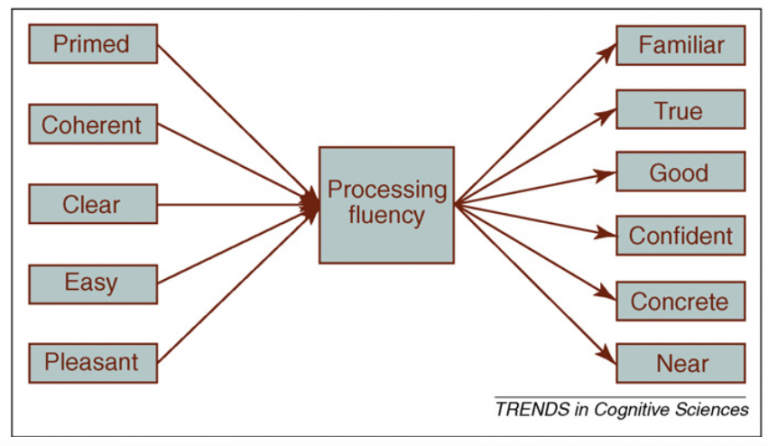
This diagram provides a great summary of the concept. Inputs that make processing easier lead to a range of positive outputs.
Test your understanding!
A company is launching a new "all-natural" snack bar. They are debating between two names: "Glycomar Nutrient Bar" and "The Good Bar". Using the principle of processing fluency, which name would you recommend and why?
Show answer
You should strongly recommend "The Good Bar." The name "Glycomar Nutrient Bar" has low processing fluency. "Glycomar" is a complex, unfamiliar word that is hard to pronounce. This creates cognitive friction, or disfluency. In contrast, "The Good Bar" has very high processing fluency. The words are simple, common, and easy to say. The brain processes it effortlessly, and this ease creates a subtle positive feeling that gets attached to the product itself, reinforcing the "good" in the name.
Part 3: Putting Fluency to Work in Marketing
Understanding processing fluency gives you a new lens through which to evaluate every piece of marketing material, from a business card to a multi-million dollar ad campaign. Let's look at a few key areas where you can apply this principle.
This visual breaks down the impact of fluency into four practical pillars for business.
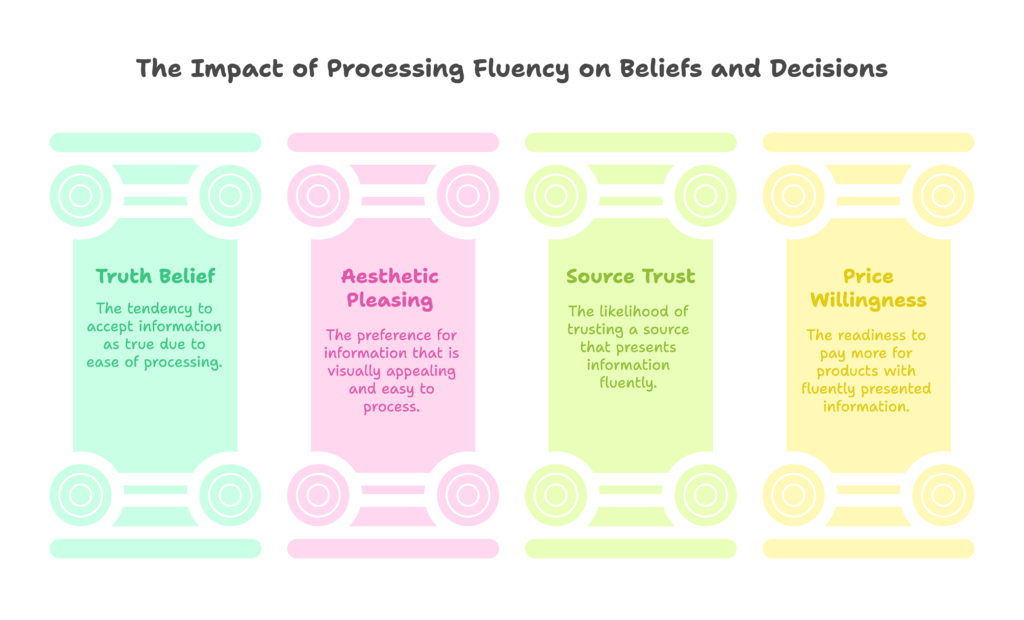
Let's walk through these four pillars with marketing examples:
- Truth Belief: You can make your claims more believable without changing the facts.
- How: Use simple language. Choose clean, high-contrast fonts. Use rhyming or alliterative slogans. The classic rhyming slogan "A Mars a day helps you work, rest and play" feels more true than a non-rhyming equivalent because of its phonetic fluency.
- Aesthetic Pleasing: Your brain finds simple, symmetrical, and coherent designs more beautiful because they are easier to process.
- How: Favor clean layouts, simple logos (think Nike, Apple, Target), and consistent color schemes. Google’s famously sparse homepage is a masterclass in using high fluency to create a positive user experience.
- Source Trust: A fluent experience feels safe and reliable.
- How: Ensure your branding is consistent across your website, social media, and packaging. An easy-to-navigate website or app builds trust because it functions predictably and without effort. A confusing site creates disfluency and distrust.
- Price Willingness: The feeling of quality that fluency imparts can even influence what customers are willing to pay.
- How: As we saw in the previous reading and your test question, products with fluent, easy-to-pronounce names are often perceived as being of higher quality and are more likely to be chosen.
Let's quickly review the "Applications" section of the Wikipedia article, which highlights a fascinating real-world financial example.
This brief section offers concrete examples of fluency's impact in business and finance, validating the principles we've discussed.
Please read the short 'Applications' section. Pay attention to the finding about stock ticker symbols.
The finding that stocks with easy-to-pronounce ticker symbols perform better is a striking demonstration of processing fluency at work in high-stakes environments. The feeling of ease translates into a feeling of confidence and safety for investors.
Conclusion
Today, we've added a crucial tool to your neuromarketing toolkit. While novelty and surprise are essential for breaking through the clutter (as we learned in the last lesson), processing fluency is what creates a feeling of comfort, trust, and preference once you have that attention.
Here are your key takeaways:
- Processing fluency is the subjective feeling of ease or difficulty when processing information. The brain prefers ease.
- The brain uses a mental shortcut: if a stimulus is easy to process, it must be good, true, and familiar. This is known as the fluency heuristic.
- This cognitive bias causes us to prefer things that are simple, clear, symmetrical, and consistent.
- In marketing, you can increase fluency through simple names, clean designs, clear fonts, rhyming slogans, and consistent branding to increase liking, trust, and perceived value.
When you're advising a team on a new ad or website design, you can now explain this complex idea simply. You might say: "Our customer's brain is wired to be lazy in a good way—it saves energy. If our design is clean and our message is simple, their brain doesn't have to work hard to understand it. That feeling of ease makes them feel good, and they transfer that good feeling directly onto our brand. Let's make this as effortless for them as possible to build that instant, unconscious trust."
This lesson concludes our module on Perception and Attention. We now understand the basics of how the brain filters the world and how to design messages that can pass through those filters. In our next module, we move to the next crucial step: Memory. How do we ensure that these positive perceptions are not just fleeting moments, but are encoded into long-term brand associations? We'll begin by exploring the different memory systems our brain uses to store information.