Hello! Welcome to your fourth lesson.
In our last session, we established the fundamental rule of learning in the brain: "neurons that fire together, wire together." We saw how this principle allows brands to physically build associations in the consumer's mind, connecting a logo like the Nike "swoosh" to a concept like "athletic excellence."
That raises a crucial question: If these connections can be built, can they also be changed? Are our brains "hard-wired" or are they adaptable?
Today, we will answer that question by exploring one of the most exciting concepts in neuroscience: neuroplasticity. Our goal is to explain the concept of neuroplasticity and its relevance to changing consumer habits and building brand memories. This idea is the biological basis for brand growth, customer loyalty, and behavioral change. Understanding it is key to your goal of mastering and communicating the science behind why marketing works.
What is Neuroplasticity? The Adaptable Brain
For a long time, scientists believed the adult brain was a fixed, unchanging organ. We now know this is not true. The brain is remarkably adaptable, constantly reorganizing itself in response to our experiences, thoughts, and actions. This ability to change is called neuroplasticity.
To get a clear picture of this concept, let's start with a short, animated video.
The video 'Neuroplasticity' by Sentis provides a superb and accessible introduction to this idea. It uses a simple analogy of roads and pathways that is perfect for explaining the concept to others.
Please watch the entire video (it's less than 2 minutes). Pay close attention to the analogy of creating a new path in a field. This is a powerful metaphor for how learning and habit change work.
As the video explains, every time you have a thought or perform an action, you are traveling down a neural pathway. The more you use a pathway, the more established and easy to travel it becomes. The old saying "practice makes perfect" is, at a neural level, a perfect description of neuroplasticity.
So, what does this "change" actually look like in the brain? It happens in several ways:
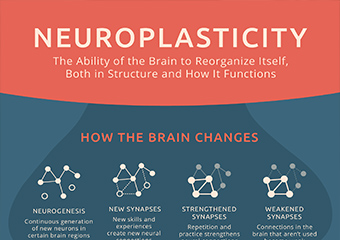
- Strengthened Synapses: This is what we covered in our last lesson (Long-Term Potentiation). When you repeat an action, the connection between the involved neurons becomes more efficient.
- Weakened Synapses: The opposite is also true. Pathways that are not used become weaker and less likely to fire. This is the "use it or lose it" principle. If you stop practicing a skill, the neural pathways for it degrade.
- New Synapses: Your brain can form entirely new connections between neurons as you learn new skills or have new experiences.
- Neurogenesis: In some parts of the brain, brand new neurons can even be generated throughout life.
This constant process of remodeling is what allows us to learn, form memories, and change our habits.
Building Brand Memories: Rewiring Consumer Perception
How does this relate to branding? A brand doesn't exist in the marketplace; it exists as a pattern of neural connections in the consumer's brain. Effective branding is the deliberate application of neuroplasticity.
Let's read an article that makes this connection explicit.
Brainding: neuroplasticity’s role in consumer perception
The article 'Brainding: neuroplasticity’s role in consumer perception' does an excellent job of connecting this brain science directly to marketing strategy.
Please read from the beginning of the article down to the end of the section 'Coca-Cola and the neuroplasticity effect'. Focus on how brand interactions are described as shaping neural pathways and take note of the classic fMRI study mentioned.
The Coca-Cola vs. Pepsi study mentioned in the article is a landmark finding in neuromarketing. Let's break it down, as it's a powerful story you can use to explain these concepts:
- The Test: Researchers had people drink Coke and Pepsi.
- The "Blind" Result: When people didn't know which brand they were drinking, their brains' reward centers (specifically the ventromedial prefrontal cortex) lit up about the same for both. Their preference was based purely on taste.
- The "Brand-Aware" Result: When they were told they were drinking "Coca-Cola," something fascinating happened. In addition to the reward center, other brain areas associated with memory and emotion (like the hippocampus and dorsolateral prefrontal cortex) also became highly active.
- The Insight: This shows that the Coca-Cola brand had, over years, built strong neural pathways connecting the product to a vast network of positive memories, cultural associations, and emotions. This network was so powerful it literally changed the subjective experience of drinking the soda. This is a visible demonstration of neuroplasticity shaped by decades of marketing.
Changing Consumer Habits: The Habit Loop
Neuroplasticity isn't just about building memories; it's also the key to changing behaviors. Many consumer choices are not conscious decisions but are, in fact, habits. Buying the same coffee every morning, scrolling a specific social media app when you're bored, or choosing a familiar brand at the supermarket are all automatic behaviors running on well-traveled neural pathways.
To change a habit, you can't just erase the old pathway. Instead, you must use neuroplasticity to build a new, stronger pathway. A very useful framework for this is the Habit Loop.
Let's watch a video that explains this loop and its connection to neuroplasticity.
The Science of How Your Brain Forms Habits (and How to Take Control)
In 'The Science of How Your Brain Forms Habits', Dr. Tracey Marks breaks down the habit loop and explains the role of the brain's reward system in reinforcing behaviors.
Please watch from 0:55 to 5:14. Focus on the three parts of the habit loop (cue, routine, reward) and the role of dopamine as a 'reinforcement chemical.'
As the video explains, the habit loop consists of:
- Cue: The trigger that tells your brain to go into automatic mode. (e.g., Feeling tired in the afternoon)
- Routine: The physical or mental action you take. (e.g., Going to Starbucks)
- Reward: The positive reinforcement that tells your brain this loop is worth remembering for the future. (e.g., The pleasant feeling from the sugar and caffeine)
The reward, driven by the neurotransmitter dopamine, is the engine of neuroplasticity here. It strengthens the connection between the cue and the routine, making you more likely to repeat the behavior next time.
A competitor brand can't just tell you to stop going to Starbucks. To change your habit, they must offer an alternative loop. For example, a new energy drink brand might:
- Target the Cue: Run ads showing people hitting that 3 PM slump.
- Insert a New Routine: Show them drinking the new energy drink instead.
- Promise a Better Reward: Emphasize a "cleaner" energy boost without the sugar crash, aiming to create a more powerful dopamine reinforcement.
By repeating this, they attempt to use neuroplasticity to carve a new, preferred neural pathway for that afternoon cue.
Test your understanding!
A consumer has a habit of using a specific software for managing their sales leads (e.g., Salesforce). A new, competing software company wants to get this consumer to switch. Using the Habit Loop and the principles of neuroplasticity, what could the new company do to encourage this change in habit?
Show answer
The new company needs to build a new habit loop that is more rewarding than the old one.
- Identify the Cue: The cue is likely "needing to update a sales lead" or "starting the workday."
- Interrupt the Old Routine & Insert a New One: The old routine is "log into Salesforce." The new company needs to make their software the new routine. They could do this with a free trial, a seamless data import tool (to lower the barrier to trying), and excellent onboarding to make the first few uses easy and successful.
- Provide a Stronger Reward: This is the key. The new software must provide a better dopamine-reinforcing reward. This could be:
- Efficiency: The software is faster, saving the user time and effort.
- Success: It provides better insights, helping the user close more deals (a powerful reward).
- Ease of Use: A cleaner, more intuitive interface reduces cognitive strain.
- Gamification: Features like progress bars or "deal won!" animations can provide small, rewarding dopamine hits.
By making the new routine more rewarding, the new company encourages the user's brain to strengthen the new pathway, eventually making their software the new automatic choice.
Conclusion
Today, we've elevated our understanding from how brain connections are formed to how the brain's entire network is constantly evolving. This is the essence of neuroplasticity.
Here are the key takeaways from this lesson:
- Neuroplasticity is the brain's lifelong ability to change its structure and function based on experience by creating, strengthening, and weakening neural connections.
- Brand memories are the physical result of neuroplasticity. Consistent and emotionally resonant marketing literally rewires consumer perception, as shown by the Coke vs. Pepsi study.
- Consumer habits are automatic behaviors driven by a Cue-Routine-Reward loop.
- Changing habits is not about willpower alone; it's about replacing an old routine with a new one that provides a stronger reward, thereby carving a new, preferred neural pathway.
You've now completed the foundational module of the course! You have a solid grasp of the brain's two systems, how neurons connect, and how those connections can change over time.
In our next lesson, we will begin a new module: "Perception and Attention in a Distracted World." We'll take a step back and explore the very first part of the process: how sensory information from the world around us—the sights and sounds of an advertisement—even gets into the brain to begin with.